

Prof at Korea Univ / Co-founder & CEO of MxT Biotech
Seoul, Republic of Korea
Joined October 2010
- Tweets600
- Following218
- Followers248
- Likes1.6K





Aram Chung retweeted

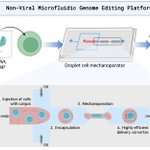
Excited to share our new publication on physical regulation of genome! Millisecond compression of cells may induce changes in chromatin accessibility, which can be targeted by guide RNA for more efficient CRISPR activation of genes in heterochromatin. Thanks to all team members!

This microfluidic device squeezes cells as they pass through, loosening their tightly packed DNA so CRISPR tools can reach and switch on genes to make cell reprogramming more efficient. 🧫🧬
🔗 ow.ly/WKyt5100kpB
#ResearchPowersProgresss #CellReprogramming #CRISPR

ALT a transparent microfluidic device lays on top of a cell slide

ALT Two fluorescence microscopy panels of cells with blue nuclei and green neuron-like cells. The left panel shows only a few sparse neurons with long, thin projections, while the right panel shows many more neurons with dense, branching networks.
Aram Chung retweeted

In vivo engineering of CAR natural killer cells for immunotherapy using ligand-directed lipid nanoparticles nature.com/articles/s41587-0…

Aram Chung retweeted

Jang et al., Microfluidic Mechanical Reactivation of Senescent Stem Cells, Small (Wiley, 9 September 2026), Konkuk University and Korea University, Seoul; figures cited from the bioRxiv preprint version.
onlinelibrary.wiley.com/doi/…

Aram Chung retweeted

A study from @GDE_UTSW developed a polymer-lipid hybrid nanoparticle platform enabling programmable encapsulation and controlled organ-specific delivery of diverse RNA payloads. Learn more: go.nature.com/4zPsMbD.

Aram Chung retweeted

Microfluidics-mediated spatial control of mRNA lipid nanoparticles primes translation and enhances vaccine potency go.nature.com/4rpmX0I
Our recent work on microfluidic mechanical reactivation/rejuvenation of aged stem cells has been published in Small

Microfluidic Mechanical Reactivation of Senescent Stem Cells
onlinelibrary.wiley.com/doi/…
Aram Chung retweeted
Lipid nanoparticles chart path beyond the liver nature.com/articles/s41587-0…
[🔓read free with login]

Aram Chung retweeted

For readers interested in the potential of in vivo CAR-T cell therapies for cancer and autoimmune diseases, here's a comprehensive review by pioneers in the field
rdcu.be/koc33UDidsza
nature.com/articles/s41573-0…

Aram Chung retweeted

Excited to share that Spatial Hi-C-RNA is now out in @CellCellPress! It brings the 3D genome into spatial multi-omics by co-mapping chromatin architecture and gene expression in the same tissue section. Congrats to the whole team! cell.com/cell/fulltext/S0092…

Aram Chung retweeted

”Genome-wide CRISPR screening identifies cellular factors controlling nonviral genome editing efficiency”
Shivani Saxena, Meha Kabra [..] Krishanu Saha
Nat Commun. 2026-08-13.
doi.org/10.1038/s41467-026-7…
#CRISPR #DDS

Aram Chung retweeted
mRNA technology is one of the platforms being used for n-of-1 therapies. Read about its application in this and a range of other areas such as in vivo CAR-T cell therapies and cancer immunotherapies in this Review nature.com/articles/s41573-0…
rdcu.be/fteeb

Aram Chung retweeted

Multifunctional-engineered NK cells overcome tumor immunosuppression by combining PD-L1 and HLA-E targeting and endogenous IL15 production 🇮🇹
nature.com/articles/s41392-0…

Aram Chung retweeted
Single-cell spatial pharmacobiology identifies conserved stromal barriers to therapeutic antibody delivery in human solid tumors go.nature.com/4atBJML

Aram Chung retweeted

In cancer, activated T cells release abundant extracellular vesicles that transfer DNA to the nucleus of tumor and immune (dendritic) cells, turning tumors from cold to hot. An immunotherapy in the works. @Cancer_Cell
sciencedirect.com/science/ar…
sciencedirect.com/science/ar…


Aram Chung retweeted
A multiobjective AI model for LNP engineering enhances tissue-selective mRNA delivery go.nature.com/4ugPm9D

Aram Chung retweeted

Macrophage senescence is a central driver of chronic inflammation in aging and metabolic liver disease, and a tractable therapeutic target.

Aram Chung retweeted

In the latest issue! Hallmarks of cancer—Then and now, and beyond dlvr.it/TS4Plc

Aram Chung retweeted
A lysosomal barcoding strategy to quantify endosomal escape of nucleic acids in vivo assesses the performance of branched ionizable lipids for potent liver delivery #NBTNV go.nature.com/4s4X7P7
rdcu.be/fdfzQ

Aram Chung retweeted
Steady progress towards engineering immune cells in the body now for refractory myeloma , with major implications for many autoimmune diseases and cancers
nature.com/articles/s41591-0…
nature.com/articles/s41591-0…
