

The automated lab for agentic biology
Joined July 2021
- Tweets258
- Following1
- Followers6K
- Likes257







Pinned Tweet
How good is Claude at protein design?
Anthropic benchmarked their newest Claude models on protein engineering tasks, and we ran the wet lab work behind it.

Adaptyv Bio retweeted

We're entering the final stretch of the Anthropic x Adaptyv protein design competition
Two challenges are still open:
• Challenge 4: Blood-brain barrier
Design a binder targeting TfR1.
Deadline: November 1, 23:59 AoE
• Challenge 5: Immunotherapy
Design a binder targeting KRAS G12D pMHC.
Deadline: November 8, 23:59 AoE
▶️ Make a submission: proteinbase.com/competitions…
Our last challenge in the Anthropic x Adaptyv Protein Design Competition is about immunotherapy, one of the most important ways of treating cancer.
Immunotherapy helps the immune system attack cancer cells, but distinguishing them from healthy cells isn't always easy. In some cancers, the difference can be as subtle as a single amino acid in a small protein fragment.
That's the case with KRAS, a protein that works like a growth switch in our cells. In many cancers, a mutation leaves the switch stuck on, and the cell keeps multiplying itself and grows into a tumor.
In Challenge 5, you need to design a binder that sticks to the mutated piece of KRAS, but not to the healthy version, so that the immune system can find and attack the cancer cells.
The deadline to submit protein designs for this challenge is November 8. Then, we'll pick the best designs and test them in our lab.
Submit now on @proteinbase
proteinbase.com/competitions…

Adaptyv Bio retweeted

We built a website to make it super easy to get started with protein design and participate in the Anthropic x Adaptyv protein design competition
▶️ design-a-protein.com
This week, we're challenging people to design an Ozempic-like drug. You can get started in just a few clicks, using the newly released RFD4 model to design proteins targeting the GLP-1 receptor.
We'll synthesize and test 1000+ of these designs in our automated biology lab, including whether they actually activate the cell receptor, and make all the results publicly available
We're excited to share results from our latest wet lab campaign with @AnthropicAI and @citrini.
Claude designed novel proteins to neutralize scorpion toxins and we tested 211 of these protein designs in our automated wet lab. 17 of them showed binding to the toxins in our experiments, with all data now available on @proteinbase.
This is a great example of what we're building towards: A world where anyone can run drug discovery campaigns on our automated wet lab.


Challenge 4 of the Anthropic × Adaptyv Protein Design Competition on @proteinbase is open: design a pH-sensitive protein to help shuttle drugs into the brain.
TfR1 is a receptor protein that brings iron-loaded transferrin into cells. It is highly expressed in the blood-brain barrier and drug developers can use this receptor to get drugs to pass the blood-brain barrier. The drug is fused to a binder to TfR1, which makes cells absorb the protein complex. If the binder is pH-sensitive it will release from the receptor inside the endosome and then exit the cells on the brain-facing side to deliver the therapeutic into the brain.
In this challenge, the goal is to make a pH-sensitive binder to TfR1 that targets precisely the right region on the receptor in order to allow absorption into the cell.

We’re also releasing the Claude prompt which we’ll use to select Track 2 and Track 3 designs for testing: proteinbase.com/competitions…
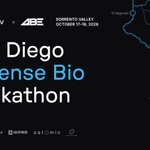
We’re sponsoring wet-lab validation for the Defense Bio Hackathon, hosted by American Bioenhancement today in San Diego
180+ designers, 300 designs wet-lab tested in 5 tracks:
- Frontier bio
- Biological data
- Human performance
- Biomanufacturing
- Biosecurity
See you there! luma.com/kfgh2fvu

Challenge 3 of the Anthropic × Adaptyv Protein Design Competition is open. You have to design a protein that switches on GLP1R, the receptor that semaglutide (Ozempic, Wegovy) and tirzepatide act on in type 2 diabetes and obesity.
Entry is free and open to everyone. Designs must be de novo and 10–250 amino acids. We select with a Claude-based workflow, then make and test in our automated lab, and every measurement is published on Proteinbase.
Open until Sunday 25 October, 23:59 AoE. After feedback from the community we decided to make each Challenge 2 weeks instead of 1 week. So that means Challenge 2 (TNF-α) is still open until Sunday 18 October.
Submit your designs on Proteinbase: proteinbase.com/competitions…
All experimental results from @GoogleDeepMind's SynthID Bio model are now available on Proteinbase, check them out!

Google DeepMind just released SynthID Bio, a watermark written into the amino acid sequence of an AI-designed protein. We validated the proteins in our lab at @adaptyvbio and you can now find all the experimental results on Proteinbase.
In rheumatoid arthritis and Crohn's disease, immune cells in the joint or gut wall produce TNF-α continuously. TNF-α is active as a homotrimer, with three identical chains forming one complex.
Each of its three receptor-binding sites sits in the groove between two neighbouring chains. The site only exists in the assembled trimer, not on a single chain. One trimer then pulls three receptors together on the cell surface, and that clustering switches on inflammatory genes inside the cell.
They produce cytokines and draw immune cells drawn into the tissue which erodes the tissue. Adalimumab and infliximab block the receptor sites to stop it.
The second constraint: the binder also has to recognise mouse TNF-α, so the same design can be tested in mouse models.
Human and mouse TNF are about 79% identical, and adalimumab doesn't bind the mouse version at all. The epitope has to land on surface that's shared between the two species, at the receptor interface, with the pH-sensitive residues built into it - all on the same small patch.
Challenge 1 (EGFR) was about the inverse setup, meaning binding in acidic conditions, no detectable binding at 7.4.
Anyone can participate in this challenge on @proteinbase. Designs must be de novo, 10–250 amino acids. Up to 40 for Track 1, up to 20 for Tracks 2 and 3.
We select with a Claude-based workflow, then produce and test in our automated lab. Every measurement is published on Proteinbase.
Open until Sunday 11 October, 23:59 AoE: proteinbase.com/competitions…
