

Venture Partner | ex-Google | Decoding AI • Motivational stories on innovation & resilience • Tesla/SpaceX insights 🚀
Joined February 2007
- Tweets136K
- Following12.2K
- Followers167K
- Likes6.1K





Pinned Tweet
Huawei Built a European Palace for 35,000 Researchers, Then Spent $28 Billion on R&D in a Single Year
I walked into what looked like a European palace.
Marble floors. Crystal chandeliers. Gilded railings. Classical statues. Vaulted ceilings that belong in a ministry building in Vienna or Paris.
Then the giant screen lit up with the Huawei logo.
This is not a government building.
This is Huawei’s Shanghai research campus.
A self-contained research city with lakes, landscaped grounds, modern laboratory blocks, elevated walkways, and its own internal light-rail system. Designed for 35,000 researchers. Current density is already extreme: roughly 80% hold a master’s degree or higher. About 10% are PhDs. Throw a stone and you hit advanced technical talent.
In 2025, Huawei generated CNY 880.9 billion in revenue.
It spent CNY 192.3 billion on R&D, 21.8% of total revenue, roughly US$27.9 billion.
That single-year R&D outlay exceeds the entire GDP of multiple countries with larger populations.
Total employees: ~213,000.
R&D headcount: 114,000 (53.7% of the workforce).
Most companies and most nations still treat research as a residual. Huawei treats it as the core operating expense.
The result is not just beautiful architecture. It is sustained technological capacity under pressure.
This is the case study that matters.
Resource allocation at this intensity, sustained for more than a decade, produces outcomes that incremental budgets and short-term political cycles cannot match.
Have you visited a corporate campus that genuinely changed how you think about what’s possible?
Video produced and edited by Arianne, my beloved daughter 😍
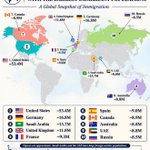
Immigration is no longer just a demographic story, it’s an economic strategy.
Look at the numbers. The US leads with approximately 53 million immigrants, followed by Germany, Saudi Arabia and the UK.
Countries aren’t just competing for capital, technology and investment, they’re also competing for people.
Talent, labour, entrepreneurship and skills are becoming increasingly important economic assets.
As populations age and labour shortages intensify, countries that can attract, integrate and retain global talent will have a significant competitive advantage.
The real question isn’t whether countries should embrace immigration, it’s whether they have the policies, infrastructure and economic opportunities to turn migration into a long-term growth engine.
In the economy of the future, talent has no borders and countries that understand this will have an advantage.

"Please, don't worry so much. Because in the end, none of us have very long on this Earth. Life is fleeting. And if you're ever distressed, cast your eyes to the summer sky when the stars are strung across the velvety night. And when a shooting star streaks through the blackness, turning night into day... make a wish and think of me. Make your life spectacular.”
- Robin Williams (as Jack in the movie 'Jack')

Alvin Foo retweeted

The Chinese renminbi (RMB) now accounts for approximately 8.5% of global foreign exchange trading, with average daily turnover exceeding US$800 billion.
What’s remarkable is that the RMB has achieved this position despite remaining the only major currency that is not fully convertible on the capital account.
China has deliberately maintained restrictions on cross-border capital flows while simultaneously expanding the RMB’s international use.
This is an indication of how far RMB internationalization has already progressed—and how much further it could potentially go.
From a long-term strategic perspective, I would argue that RMB internationalization is more consequential to U.S. interests than the bilateral trade imbalance that receives so much attention in Washington.
The dollar’s dominant position in international finance provides the United States with enormous economic and geopolitical advantages. Any sustained shift toward alternative currencies in global trade, financing, and reserves erodes those advantages.
There are implications for U.S. Treasury markets as well. If international diversification reduces structural demand for dollar-denominated assets, it increases U.S. borrowing costs. We’re seeing that play out now.
For now, the dollar remains overwhelmingly dominant. But the gradual diversification of the international monetary system is diminishing one of America’s most important structural advantages.
🦉

BREAKING 🇺🇸🇨🇳🇪🇺: China's yuan now accounts for 9% of global foreign exchange turnover, reaching $817 billion per day. It is now the world's fifth most-traded currency.
- The UK, France, and Germany use the Chinese RMB as a secondary currency option, accounting for approximately $205 billion to $210 billion USD per day.


Alvin Foo retweeted

Jim Rohn: "We get paid for bringing value to the marketplace — not for the time."
Two people, same hours, vastly different income. The difference is always value.
Your ceiling isn't set by your employer. It's set by what you bring.
Alvin Foo retweeted

China has officially declared today that two Chinese astronauts will land on the Moon before 2030.
Alvin Foo retweeted

Possibly the best Bitcoin explainer video for kids and adults 🧡
by @tether
Alvin Foo retweeted

🚨✈️ Dünyanın en zorlu havalimanlarından birine iniş yapmak, her pilotun harcı değil! 🇧🇹✈️
Butan'daki Paro Uluslararası Havalimanı'nda pilotları dar bir vadi, 5 bin 500 metreye ulaşan dağ zirveleri ve yalnızca son anda görüş alanına giren kısa bir pist karşılıyor.
Keskin dönüşlerle gerçekleştirilen bu zorlu yaklaşma, olağanüstü pilotaj ve özel eğitim gerektiriyor.
Buraya iniş yapabilmek için yalnızca deneyimli olmak yetmiyor; özel uçuş yetkisine sahip olmak gerekiyor.
Paro'ya her pilot inemiyor!
Alvin Foo retweeted

Yoshua Bengio on helping create AI, then realising his children might not have a life 20 years from now.
@Yoshua_Bengio
One of the simplest lessons in life, yet one of the most powerful.
We spend so much time chasing success, recognition and influence that we sometimes forget the impact we can have on someone simply by being kind.
Walk beside someone who is struggling.
Include someone who feels left out.
Recognise someone who feels invisible.
You don’t always need to do something extraordinary to change someone’s life. Sometimes, a little kindness at the right moment is enough.
Success is what you achieve. Character is how you make others feel along the way.
Never underestimate the power of making someone feel seen, valued and included.

Alvin Foo retweeted

Chinese ice-cream chain Mixue has become the world's largest food-and-beverage chain by selling ultra-cheap soft serve and drinks. Read more: on.wsj.com/4zl3EZW
Learn how to speak to Gen Alpha 😁
Initially it sounds Greek to me but thankfully my daughter who is a Gen Z gave me a quick run down:
1. SIGMA: The most common word you will hear is sigma. Unlike the Greek alphabet, Sigma here means dominant, leader cool and popular.
Example: Jane is so sigma... she gets invited to all the best parties.
2. ATE: Used to describe something impressive or outstanding.
Example: That presentation you just gave on financial projections totally ate!
3. FANUM TAX: Refers to the act of taking a bite of someone else’s food, popularized by streamer Fanum during streams on Twitch.
Example: My friend took a big Fanum Tax out of my pizza!
4. BUSSIN: Used to describe food that is exceptionally delicious.
Example: The cookies grandma made are bussin'.
5. DELULU: Someone who is delusional or has unrealistic expectations.
Example: He thinks he’s going to win this year, but he’s totally delulu.
6. IT'S GIVING: Exuding a certain energy.
Example: Everyone’s dressed so nicely tonight. It’s giving Met Gala.
7. RIZZ: Charisma, charm or magnetism that captivates others
Example: He has so much rizz, no wonder everyone wants to hang out with him.
8. SKIBIDI TOILET: Originating from a Bulgarian song called "Dom Dom Yes Yes," it was popularized by the YouTube series "Skibidi toilet" that involves a war between human-head toilets and humans with devices for faces. It can mean bad or good depending on the context.
Example: She's got that skibidi toilet rizz.
9. AURA: Aura is about how cool you are. These points can be gained or lost through simple tasks, like tripping or falling.
Example: He's gonna lose aura points with me if he doesn't reply soon.
10. OHIO: Ohio typically means weird or cringe.
Example: Did you see how she was dressed today? She's so Ohio.
Machines create efficiency, extraordinary people create impact.
This quote by Elbert Hubbard feels particularly relevant today, especially in the age of AI.
One machine can replace the work of 50 people. Today, AI can potentially multiply that number.
But here’s the real distinction: technology can automate tasks, accelerate execution and improve productivity. What it cannot easily replicate is extraordinary human judgement, vision, creativity, courage and the ability to inspire others.
The future won’t belong to those who compete with machines.
It will belong to those who know how to make machines work for them while bringing something uniquely human to the table.
AI amplifies capability, extraordinary people create the difference.
That’s the real competitive advantage.


The problem with measuring an economy by what people spend.
There’s a funny truth behind this image, but also a serious economic lesson.
A cyclist doesn’t buy petrol, car insurance, pay for parking or take out a car loan. Someone who walks doesn’t even buy a bicycle!
But here’s what the joke misses: GDP measures economic activity, not the quality of life.
A country shouldn’t need people to be sick, unhealthy, in debt or stuck in traffic just to keep its economy growing.
Perhaps we should rethink what progress really means.
Less consumption isn’t necessarily bad. Prevention is better than cure. Time saved is productivity. Good health is wealth.
The ultimate measure of a successful economy shouldn’t be how much money people spend, but how well people live.
Maybe the cyclist is actually winning. 🚴

Alvin Foo retweeted

Putin: only three countries have full digital sovereignty. Russia, the United States and China.
Speaking after the Russia-Africa summit in Moscow, he said Russia, "alongside the United States and the People's Republic of China", is one of the few countries achieving full sovereignty in digital technologies, with platforms competing in foreign markets.
Now look at who's missing.
Europe. 450 million people. No global search engine, no global social network, no hyperscale cloud, no AI champion at US or Chinese scale. Its data runs on American platforms, under American law.
China built WeChat, Alipay, Baidu, Huawei, DeepSeek. That's exactly why Washington spends so much energy trying to kill Chinese tech.
Sovereignty today is not just borders and armies. It's who owns your data.
Europe outsourced that too.

Alvin Foo retweeted

दुनिया में सिर्फ 50 से भी कम पायलट हैं जिन्हें यहाँ प्लेन उतारने की इजाज़त है और वजह देखकर रोंगटे खड़े हो जाएंगे!
ये है भूटान का पारो एयरपोर्ट न कोई ऑटोपायलट न राडार गाइडेंस रनवे तब तक नहीं दिखता जब तक विमान 18,000 फीट ऊंचे पहाड़ों के बिल्कुल करीब न आ जाए। एक सेकंड की चूक और खेल खत्म!
बताइए क्या आप कभी इस एयरपोर्ट पर फ्लाइट से उतरना चाहेंगे?
Alvin Foo retweeted

🚨🇺🇸 THE AI SELLOFF COULD BE THE BEGINNING OF A MUCH BIGGER FINANCIAL CRISIS
I spoke with financial analyst David Lin as some of the biggest names in technology were getting absolutely hammered.
Alphabet lost roughly $500 billion in market value in a single session. Intel plunged nearly 30%. Amazon is spending tens of billions on AI infrastructure while burning through cash.
But David thinks the real danger is hiding in the debt market.
He walked me through CoreWeave, an AI cloud company carrying an estimated $50 billion in debt, with some borrowing costs reaching 15–16%.
Its projected capital spending this year is roughly THREE TIMES its expected revenue.
And now, according to the Financial Times, Anthropic could receive a junk credit rating after its IPO despite planning more than $800 billion in computing investments through 2045.
David explained how this could unravel: financing dries up, data center construction slows, chip orders fall, and suddenly the companies supplying the AI boom get dragged down with their customers.
We also discussed China's tech collapse, Bitcoin and gold falling alongside stocks, and the Federal Reserve's increasingly uncomfortable position.
Oil prices are keeping inflation elevated. A weakening technology sector could mean layoffs and slower growth. The Fed may soon have to choose which problem to confront.
David isn't predicting that every AI company will fail. He thinks the technology will survive, just as the internet survived the dot-com crash.
BUT he believes the era of borrowing almost unlimited amounts of money to build AI infrastructure could be coming to an end.
@davidlin_TV