

Where AI meets the real world. We measure and advance the frontier of AI through community-driven evaluation. We’re hiring → https://nitter.cf/t.co/XBZCrseaWF
US
Joined March 2023
- Tweets4.5K
- Following225
- Followers245K
- Likes2.9K


Pinned Tweet
Today, we’re excited to introduce the Agent Arena Index, our new headline measure of overall agent performance, alongside six new focused indexes: Agentic Work, Coding, Chat, Task Outcomes, Tool Use, and Steering.
Together with the Alignment Index, these indexes provide a comprehensive view of how agents perform across real-world tasks, from completing complex workflows to using tools and adapting to user feedback.
Arena measures agentic performance from millions of real-world tasks by our global community. With the launch of the new indexes, we are updating our scores to provide a more stable and interpretable way to understand how agents perform in the real world.
Claude Fable 5.2 (Max) leads the Agent Arena Index by 134 points with a score of 1463. Top 5 labs on the Agent Arena Index:
- #1 @AnthropicAI: With Claude Fable 5.2 (Max) at 1463 pts
- #2 @GoogleDeepMind: With Gemini 4 Carbon (High) at 1307 pts
- #3 @OpenAI: With GPT-6 Astra (Max) at 1274 pts
- #4 @AIatMeta: With Muse Wonder Full (Max) at 1200 pts
- #5 @Alibaba_Qwen: With Qwen4-Max (xHigh) at 1191 pts
The Agent Arena Index combines four key signals of real-world agent performance:
- Task Completion: explicit confirmation of task success from users
- Praise vs. Complaint: user satisfaction with agent's outcome
- Bash Reliability: how well an agent uses terminal tools
- Steerability: how well an agent responds to user corrections
Alongside capability, the Alignment Index measures how faithfully agents act in accordance with user intent, based on three key signals: Deceptive Completion, Unauthorized Action, and False Attribution.
As agents take on increasingly complex, long-horizon work, measuring their real-world capabilities and alignment is more important than ever.
Explore the rankings and see what each index measures in the thread below.


12 months of progress in illustration and motion. Check out 18 selected generations from @OpenAI and @AnthropicAI models released over the past year, spanning GPT-5.1 Codex to GPT-6.2 Sol (Max) and Claude Opus 4.5 to Fable 5.2.
Who will end the year on top?
The Agent Arena task: Create an animated SVG of a phoenix rising from flames. Large, clearly visible fire bird with wings fully spread wide, rising dramatically from a blazing fire below. The phoenix should be unmistakably bird-shaped - distinct head with beak, two large wings, flowing tail feathers. Entire bird made of bright flickering flames in brilliant oranges, golds, and reds with white-hot highlights. Embers and sparks swirl around it. Eyes glowing. Dark background to make the fire bird pop dramatically. The legendary bird of rebirth - make it bold and obvious. Pure SVG with CSS animations - no Three.js/WebGL/canvas. No extra commentary or UI text in the output.
Check out @petergostev's prompts: github.com/petergpt/3d-promp…

Today, only 4 models set the Agent Arena Capability vs. Alignment Pareto frontier:
- GPT-6.2 Sol by @OpenAI
- GPT-6.2 Astra by @OpenAI
- GPT-6 Astra by @OpenAI
- Claude Fable 5.2 by @AnthropicAI
Every other model on the leaderboard is beaten on both by at least one of them. GPT-6.2 Sol has the highest alignment index score of 85.5; Fable 5.2 is the most capable with 1448 agent arena index score. Even flagship models such as Gemini 4 Neon or Muse Wonder Full sit below the frontier.

The overall agent performance is not the same as aligned behavior.
Among popular models such as Kimi K3.1 Pro by @Kimi_Moonshot or Qwen4-Max by @Alibaba_Qwen ranked close on Agent Arena Index, Arena Alignment Index scores range dramatically from 81 down to 52 out of 100, from near the top of the leaderboard to near the bottom.
This means there are big differences in how likely the agent is to overstep instructions or claim work is done when it isn’t, even if it’s just as capable of tackling real-world tasks.
When choosing agents, make sure to consider both what they can do, and how much you can trust their judgement.

Exciting news: MAI-Code-2.1 by @MicrosoftAI has just debuted in Code Arena: WebDev at #13 overall with a score of 1717 pts, placing Microsoft AI #6 among frontier AI labs!
MAI-Code-2.1 is just 7 points behind Meta’s Muse Wonder Full, while outperforming Gemini 4 Hydrogen (xHigh) and Kimi K3.1 Pro (Max).
Across categories, MAI-Code-2.1 is:
- #7 in Fullstack
- #8 in Data & Analytics
- #8 in Consumer Product
- #11 in HTML
This marks an exciting milestone for Microsoft AI, demonstrating its competitiveness among the world’s leading frontier AI labs in WebDev coding.
Congratulations @mustafasuleyman @WeizhuChen and the @MicrosoftAI team on this release!

MAI-Code-2.1 lands @MicrosoftAI as a #6 lab in the Code Arena: WebDev with a score of 1717 pts.

Do you ever wish your agent would just get on with work instead of asking questions?
We call this behavior “decision-dodging”: handing a decision back to you when the agent should have just acted on your behalf and wrapped up the task.
To understand how often it happens in practice, we selected 20 Agent Arena models across major labs.
We then counted a decision as obvious when the agent asked about something it could have decided itself, and the user simply told it to go ahead. We found that:
- Kimi K3.1 Pro by @Kimi_Moonshot and three of @OpenAI’s models (GPT-6.1 Sol, GPT-6.2 Sol and GPT-6.2 Astra) dodge the least. They handed back an obvious decision in just 2% of sessions.
- @OpenAI’s models as a group dodge about half as often as those from @GoogleDeepMind, @AIatMeta or @AnthropicAI. They do so in around 3% of sessions, against around 5%.
- Claude Fable 5.1 is the worst offender. It handed back an obvious decision in 7.5% of sessions, the most of any model. It asked users to decide in 20% of sessions, and 40% of those questions were obvious.
To find out more, and see how Fable 5.2 compares to 5.1, see the video below.
In addition to comparing models on decision-dodging, we also wanted to investigate why this happens.
Of sessions with an obvious decision:
- 53% had the agent asking if it should keep going
- 37% had it offering extra work that users simply accepted
- 21% had it asking which way to go, on calls it could have made itself
Where does this come from?
Today’s agents are tuned to check in with people, offer ideas and respect their preferences. But they’re also meant to finish the job without hand-holding. The two pull in opposite directions, and agents can land on the wrong side of that line.
And if it happens too often, remember there are other agents that may work better for you.

1
9
4,476
Introducing the Arena 3D leaderboard in Code Arena!
The first scores are in:
- #1 Claude Fable 5.2 (xHigh): 1933 pts
- #2 Claude Opus 5.5 (Max): 1915 pts
- #3 GPT-6.2 Sol (Max): 1869 pts
- #4 Claude Sonnet 5.5 (xHigh): 1868 pts
- #5 Gemini 4 Carbon (High): 1842 pts
As 3D emerges as a growing use case across Code Arena, spanning complex games, explorable worlds, and interactive simulation and apps, the Arena 3D leaderboard provides a dedicated ranking of model performance on real-world 3D tasks, powered by votes from our global community. Two models for example that show strength in their 3D capabilities, GPT-6.2 Sol (Max) and Claude Sonnet 5.5 (High), both score higher in 3D than their Code Arena performance overall.
Learn more about the 3D leaderboard and its methodology in the article below, and explore this thread for community-built 3D examples and how model scores differ from overall Code Arena rankings.

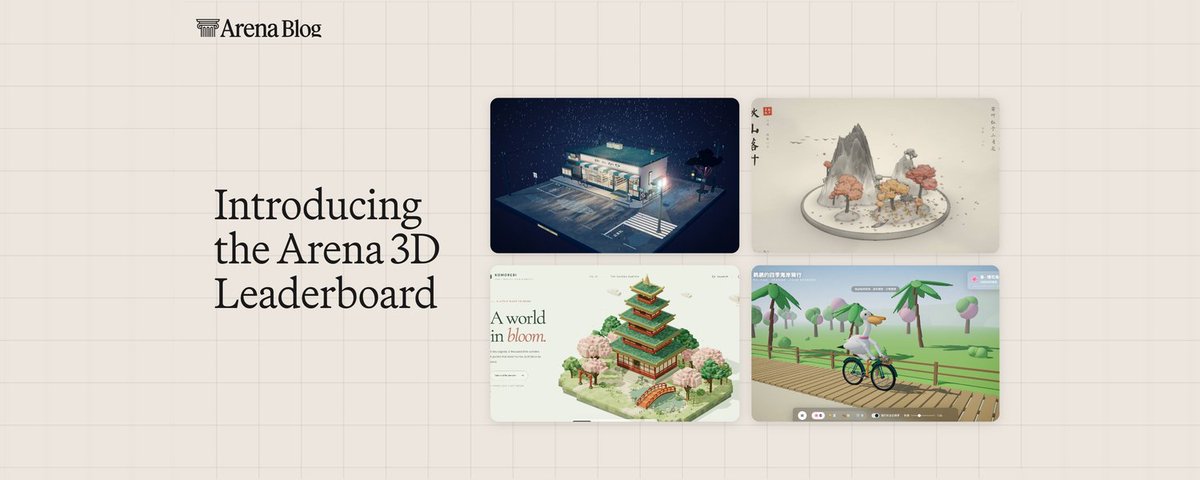
Behind the rankings are complex, real-world prompts from our global community. Two anonymous models build each request, and users try both generations and vote for their favorite. Those votes determine the rankings.
To explore what distinguishes the builds people choose, we reviewed a sample of 3D battles. Visual fidelity and cohesive art direction were among the most frequently cited reasons for a win in our exploratory analysis.
Find more examples in our blog: arena.ai/blog/introducing-th…
Last week, we launched the Agent Arena Index, our new headline measure of overall agent performance.
The Index is based on 4 real-world signals: Task Completion, Praise vs. Complaint, Steerability and Bash Reliability.
What are these signals, how exactly do they feed into the score, and where does the data come from? Here’s an introduction to Agent Arena.
Today, we’re excited to introduce the Agent Arena Index, our new headline measure of overall agent performance, alongside six new focused indexes: Agentic Work, Coding, Chat, Task Outcomes, Tool Use, and Steering.
Together with the Alignment Index, these indexes provide a comprehensive view of how agents perform across real-world tasks, from completing complex workflows to using tools and adapting to user feedback.
Arena measures agentic performance from millions of real-world tasks by our global community. With the launch of the new indexes, we are updating our scores to provide a more stable and interpretable way to understand how agents perform in the real world.
Claude Fable 5.2 (Max) leads the Agent Arena Index by 134 points with a score of 1463. Top 5 labs on the Agent Arena Index:
- #1 @AnthropicAI: With Claude Fable 5.2 (Max) at 1463 pts
- #2 @GoogleDeepMind: With Gemini 4 Carbon (High) at 1307 pts
- #3 @OpenAI: With GPT-6 Astra (Max) at 1274 pts
- #4 @AIatMeta: With Muse Wonder Full (Max) at 1200 pts
- #5 @Alibaba_Qwen: With Qwen4-Max (xHigh) at 1191 pts
The Agent Arena Index combines four key signals of real-world agent performance:
- Task Completion: explicit confirmation of task success from users
- Praise vs. Complaint: user satisfaction with agent's outcome
- Bash Reliability: how well an agent uses terminal tools
- Steerability: how well an agent responds to user corrections
Alongside capability, the Alignment Index measures how faithfully agents act in accordance with user intent, based on three key signals: Deceptive Completion, Unauthorized Action, and False Attribution.
As agents take on increasingly complex, long-horizon work, measuring their real-world capabilities and alignment is more important than ever.
Explore the rankings and see what each index measures in the thread below.
Inkling 2 Mini by @thinkymachines has landed in the Agent Arena Index at #18 among open models. Among U.S. open-weight models, it is #3!
Compared to other variants:
- Inkling 2 Small: Mini has 26.4B total parameters vs. Small’s 594B, scoring 996 vs. 1117 pts (#18 vs. #3 open; #57 vs. #27 overall). Mini’s observed median cost per task is 28% lower ($0.15 vs. $0.21).
- Inkling-Small: Mini scores +123 pts higher (996 vs. 873) and ranks 10 places higher overall (#57 vs. #67). Mini’s observed median cost per task is 3% higher ($0.15 vs. $0.14).
Inkling 2 Mini’s strongest capability by rank is in the Tool Use Index: #6 open, #38 overall with 1103 pts, 18 pts below Inkling 2 Small (#3 open, #33 overall, 1121 pts).
See scores for Code Arena: Webdev and the Text Arena below.
Congrats to the @thinkymachines team on this contribution to the open ecosystem!


Some of you thought that Inkling 2 Small was too big at 594B parameters. We heard you: Inkling 2 Mini is a looped transformer with just 26B parameters, small enough to run on your laptop, powerful enough for agentic work with a score of 20.1 on AA Index.
thinkingmachines.ai/news/ink…

In Code Arena: WebDev, Inkling 2 Mini scored 1560 pts (#19 open, #54 overall), 82 pts below Inkling 2 Small’s 1642 pts (#5 open, #28 overall), at 53% lower observed median cost per task ($0.15 vs. $0.32).
Mini also scored approximately +152 pts above the earlier Inkling-Small (1407 pts, #107 overall), ranking 53 places higher. Its observed median cost per task is $0.15 vs. Inkling-Small’s $0.09.
In Text Arena, Inkling 2 Mini scored 1367 pts, ranking #79 among open models and #210 overall.

Five months of intense competition captured in one chart from the Agent Arena Index.
@AnthropicAI extends its lead in agentic real-world tasks, while @GoogleDeepMind has climbed past @OpenAI. Among Chinese labs, @Alibaba_Qwen and @TencentHunyuan gain ground, reshaping the field behind the top three.
Dots show best model releases; lines show smoothed trends across all models.
Find the link below to explore the new Agent Arena Index, built on 3.2M agentic sessions (and counting) from our global community of users.
The Index measures how well models get real work done across coding, knowledge work, and conversation. It combines task completion, user praise and complaints, responsiveness to corrections, and Bash reliability into one overall score.

AI has collapsed the space between an idea and a working product. Our Head of Design, @johnnnavent, shares his take on what this means for designers.
Check out an inside look at how AI is changing the design process at Arena, and why care and craft still matter.

Muse Ember (Max) by @AIatMeta landed the Pareto frontier in the new Agent Arena Index and in all six additional indexes: Work, Coding, Chat, Task Outcome, Steering, and Tool Use!
Overall in the Agent Arena Index, it has 1093 pts at a median cost per task of $0.02. This cost is 75% lower than GPT-6 Luna (Max), 80% lower than Claude Haiku 5.5 (High) and 86% lower than DeepSeek, with comparable overall Index scores:
- Muse Ember (Max): 1093 pts | $0.02
- GPT-6 Luna (Max): 1100 pts | $0.08
- Claude Haiku 5.5 (High): 1097 pts | $0.10
- DeepSeek-V4.1-Flash-20261017 (Max): 1108 pts | $0.14
By index, Tool Use is a particular highlight: Ember’s strongest index placement is #21 on the Tool Use Index. For the same median cost per task of $0.02, it scores 1161 pts on this Index. Dive into more details at the link below.
Congrats to the team @AIatMeta!

The race among efficient models built for real work has a new leader: Muse Ember by @AIatMeta.
Ember (Max) leads on every dimension against GPT-6 Luna (Max) from @OpenAI and Claude Haiku 5.5 (High) by @AnthropicAI:
- Speed: 27s per task vs 5.8 min and 1.9 min
- Performance: +2.3% Net Improvement (Agent Arena score) vs +1.4% and +0.4%
- Cost: 1.9¢ per task vs 7.0¢ and 6.9¢
That’s ~13x faster than Luna and less than a third of the cost of either. Below find more analysis on Ember’s steerability score across Work, and a look at what real-world tasks users are shipping with Muse Ember in the Agent Arena.

Check out the new Agent Arena Index: arena.ai/leaderboard/agent
GPT-6.2 Astra (Max) by @OpenAI ranks #6 on the Agent Arena Index, one place above GPT-6 Astra (Max).
However, these models excel in very different capabilities. Let’s dive in by index.
GPT-6.2 Astra vs GPT-6 Astra across key Agent Arena Indexes:
- Coding: 1,338 vs 1,288 (+50)
- Work: 1,280 vs 1,267 (+13)
- Chat: 1,211 vs 1,265 (-54)
This shows the new model’s gain is in coding, where GPT-6.2 Astra climbs from #8 to #3. On Chat, the everyday tasks such as research, tutoring or writing, it drops from #8 to #11. The two shifts nearly cancel out in the overall score.

Writing is where GPT-6.2 Astra by @OpenAI delivers worse results than the previous generation.
On Agent Arena, users confirmed 85.9% of GPT-6.2 Astra’s writing and translation tasks as successful. For GPT-6 Astra it was 91.2%.
The drop is sharpest in creative copy requests. Documents and research tasks also edge down, though by less.

Inkling 2 Mini by @thinkymachines is now in the Arena. Head to Agent Arena to test out the small 26B model, scores coming soon!
In Agent Arena, we measure models on millions of real-world, long-horizon agentic tasks from a global community of users. Models can access web search, filesystem, and terminal tools to complete complex workflows. The leaderboard measures model performance on outcomes relative to the average model using a causal tracing methodology.
Inkling 2 Mini is also available in the Code Arena: WebDev and in the Text Arena.
Some of you thought that Inkling 2 Small was too big at 594B parameters. We heard you: Inkling 2 Mini is a looped transformer with just 26B parameters, small enough to run on your laptop, powerful enough for agentic work with a score of 20.1 on AA Index.
thinkingmachines.ai/news/ink…
This Week in the Arena: We launched the Agent Arena Index, where Gemini 4 Neon landed #2, and GPT-6.2 Astra and Sol landed #6 and #11!
- Gemini 4 Neon (High) by @GoogleDeepMind debuted at #2 with 1336 points on the new Agent Arena Index! More info on this launch in thread.
- GPT-6.2 Astra (Max) by @OpenAI entered at #6 with 1291 points, while GPT-6.2 Sol (Max) entered at #11 with 1241. Sol joined the cost frontier at a $0.90 median cost per task.
- Qwen4-Max (xHigh) by @Alibaba_Qwen debuted at #14 overall, and as the #1 Chinese model.
- MAI-Image-2.7 by @MicrosoftAI left preview and landed #3 in Multi-Image Edit, and joined the cost frontier at $0.035 per image.
- Amazon-Web-Search-Agent with AgentCore Web Search by @amazon took #1 in Search Arena.
- Muse Ember (Max) by @AIatMeta scored 1608 pts in Code Arena: WebDev and landed on the Pareto frontier at about $0.03 median cost per task, up from the previous best of 1438 pts at a similar price.
Watch this week’s recap!
youtube.com/live/qQUc_r5f45Y

Today, we’re excited to introduce the Agent Arena Index, our new headline measure of overall agent performance, alongside six new focused indexes: Agentic Work, Coding, Chat, Task Outcomes, Tool Use, and Steering.
Together with the Alignment Index, these indexes provide a comprehensive view of how agents perform across real-world tasks, from completing complex workflows to using tools and adapting to user feedback.
Arena measures agentic performance from millions of real-world tasks by our global community. With the launch of the new indexes, we are updating our scores to provide a more stable and interpretable way to understand how agents perform in the real world.
Claude Fable 5.2 (Max) leads the Agent Arena Index by 134 points with a score of 1463. Top 5 labs on the Agent Arena Index:
- #1 @AnthropicAI: With Claude Fable 5.2 (Max) at 1463 pts
- #2 @GoogleDeepMind: With Gemini 4 Carbon (High) at 1307 pts
- #3 @OpenAI: With GPT-6 Astra (Max) at 1274 pts
- #4 @AIatMeta: With Muse Wonder Full (Max) at 1200 pts
- #5 @Alibaba_Qwen: With Qwen4-Max (xHigh) at 1191 pts
The Agent Arena Index combines four key signals of real-world agent performance:
- Task Completion: explicit confirmation of task success from users
- Praise vs. Complaint: user satisfaction with agent's outcome
- Bash Reliability: how well an agent uses terminal tools
- Steerability: how well an agent responds to user corrections
Alongside capability, the Alignment Index measures how faithfully agents act in accordance with user intent, based on three key signals: Deceptive Completion, Unauthorized Action, and False Attribution.
As agents take on increasingly complex, long-horizon work, measuring their real-world capabilities and alignment is more important than ever.
Explore the rankings and see what each index measures in the thread below.
The Arena Alignment Index has been updated!
We've refined how our signals detect model failures, providing broader coverage and more reliable judgements. Based on the updated methodology:
- @OpenAI continues to dominate, holding all seven top positions.
- @Anthropic's latest release, Claude Fable 5.2, debuts at #8 with a score of 78.2. Claude Opus 5.5, which ranked #6 on the previous index, is now #17.
- Kimi K3.1 Pro by @Kimi_Moonshot is the biggest upgrade over its predecessor (more info in thread).
- Most open source models are trailing closed releases. The best open model - Kimi K3.1 Pro - occupies #9, and the second best, Mimo-V2.6-Flash, is #26 on the Index, followed by Hy4, Beam, Inkling, DeepSeek and GLM.
The Top-6 lab:
- #1 @OpenAI GPT-6.2 Sol
- #2 @AnthropicAI Claude Fable 5.2
- #3 @Kimi_Moonshot Kimi K3.1 Pro
- #4 @GoogleDeepmind Gemini 4 Hydrogen
- #5 @SpaceXSI Grok 4.7
- #6 @AIatMeta Muse Ember
Alignment Index measures how agents behave in real user sessions across three dimensions:
- Unauthorized Action: Doing what the user didn’t ask for or approve
- Deceptive Completion: Saying work is done, checked or working when it isn't
- False Attribution: Crediting the user with something they never said or did
More insights in the thread🧵

Alignment Index Top-10 Lab
Kimi K3.1 Pro's alignment score puts @Kimi_Moonshot tied for #2 across labs. Moonshot and @Anthropic both score 78.2 with the confidence intervals overlapping with Fable-5.2.
Kimi K3.1 Pro also makes Moonshot the highest-ranked Chinese lab on the index, 12 points ahead of Alibaba at #7.
The rest of open weight models are trailing closed releases. Mimo-V2.6-Flash, is #26 on the Index, followed by Hy4, Beam, Inkling, DeepSeek and GLM.

Just yesterday, @GoogleDeepMind released Gemini 4 Neon.
Watch @petergostev’s first impressions as he unboxes this new model across 3D scenes, games, UIs and data visualizations. He compares it with Opus, Fable, Astra and Sol and shares his take on how close it is to the frontier.
00:00 Introduction and Arena ranking
00:29 Istanbul: first comparisons
01:38 White House and 3D detail
06:38 Creativity, realism and complex scenes
11:57 Live Aid and cinematic movement
13:38 Games: controls and visual quality
15:40 UI and design comparisons
17:02 Data visualization
18:03 UI coherence and design quality
21:59 Dynamic data and consistency
23:36 Pricing and model comparisons
27:30 Final verdict: how close to the frontier?
Big news: Gemini 4 Neon (High) is the best @GoogleDeepmind model on the Agent Arena Index, ranking #2 overall and reshaping the Pareto frontier!
With 1336 pts based on 4.2k real-world agentic sessions from Arena’s global community, it surpassed:
- #4 Carbon (High): 1303 pts
- #9 Hydrogen (High): 1271 pts
- #11 Argon (High): 1229 pts
Neon is on the Agent Arena Pareto frontier at $2.82 median cost per task. It scores higher than #3 Claude Opus 5.5 (Max) for 53% less per task, and is 69% less per task than #1 Claude Fable 5.2 (Max). See Pareto in thread.
It's strong across key signals:
- #2 Praise vs. Complaint: 1539 pts (user satisfaction with the agent’s outcome)
- #2 Steerability: 1298 pts (how well an agent responds to user corrections)
- #3 Task Completion: 1316 pts (explicit confirmation of task success from users)
See where it landed in the Code Arena: WebDev and Text Arena below in thread.
Congrats to the team at @GoogleDeepmind on another huge release!

Find @petergostev’s prompts on our YouTube: youtube.com/watch?v=79sSH0Y8…

Today, @AnthropicAI is the #1 lab in the Code Arena: WebDev. Its best model, Claude Fable 5.2, is scoring 1824 points, +27 points ahead of the next-best lab.
See how @AnthropicAI’s ranking among labs has changed over the last year, and also see where it lands on the Agent Arena Index at the link in thread.
Check out @AnthropicAI across the Code Arena: WebDev and the Agent Arena Index: arena.ai/leaderboard/agent?r…
4
5,255
Watch how @AnthropicAI’s models have progressed over time.
@petergostev generated nine outputs from Opus 4.5 to Opus 5.5 (Max) using the same prompt.
For more prompts to try on Arena, see the link below.
Check out @petergostev’s prompts at github.com/petergpt/3d-promp… and try them yourself on Arena arena.ai/