

top 0.01% hackers break your codebase | Trusted by @centrifuge, @zama, @lifiprotocol
Joined March 2025
- Tweets102
- Following5
- Followers903
- Likes123








B612 security researcher built his own AI harness.
1. Infrastructure Matters More Than the Model
2. Don't Restrict AI Too Much
3. How You Ask AI to Find Bugs Matters
4. A Successful PoC Doesn't Always Prove a Real Bug
5. Use AI to Explore New Ideas and Amplify Findings
6. Give Agents Specific Roles and Goals
7. Always Verify AI's Claims
8. Finding Bugs Doesn't Mean You've Covered the Codebase
9. Let Agents Build on What They've Learned
10. Building a Powerful AI Harness Is Easier Than It Sounds
Full article dropping tomorrow.


Schnilch has made 6 figures on bug bounties.
Before any AI scan, he sets up the program locally with external dependencies.
He's built a custom tool that clones the contracts (open source - linked in the article).
Full breakdown 👇


Building a Move protocol on Sui, a liquid staking protocol, or an L1 client's consensus or transaction validation?
Reach out for a security assessment: b612security.com/contact
1
95
- $342K from the Ethereum Foundation's $2M Pectra competition, $203K from a single Lighthouse High.
- 2 solo Highs to win the Ethereum Fusaka contest.
- #3 all-time on Cantina, with $542K+.
You might think it's overnight success -- we don't -- years of experience coupled with persistence, curiosity, and the temperament to break super complex systems.
Read Alex Filippov's story 👇


Building or upgrading an Ethereum client, consensus or networking code, or a ZK or cryptography-heavy protocol?
Reach out for a security review: b612security.com/contact
63
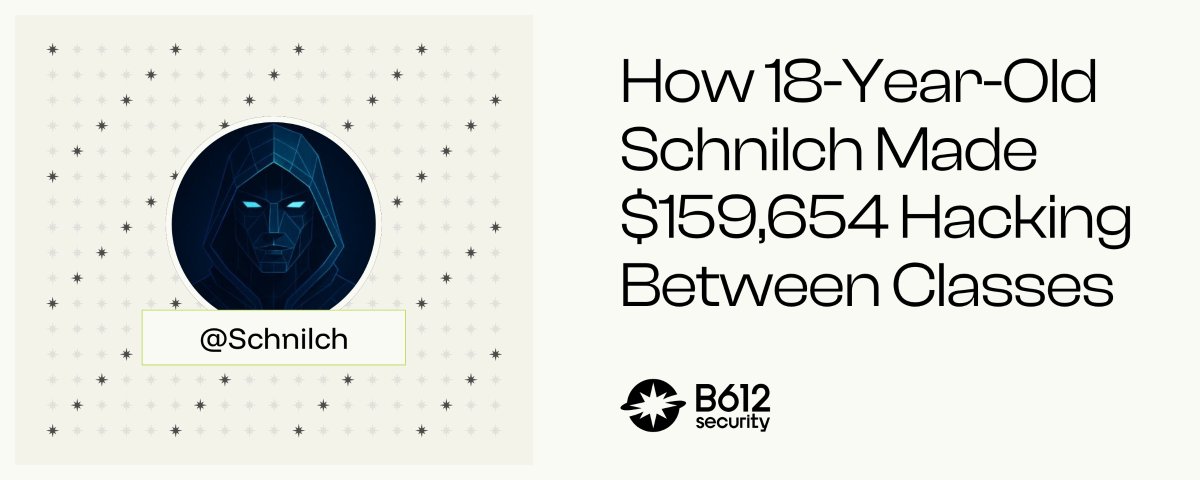
One of our researchers -- @Schnilch, made six figures from contests and bug bounties before turning 18. AI is a big part of his workflow, but he still spends significant time understanding the system.
Full writeup below 👇

Building a Move protocol on Sui, a liquid staking protocol, or an L1 client's consensus or transaction validation?
Reach out for a security assessment: b612security.com/contact
62

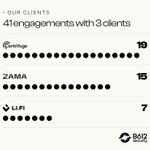
LI.FI: 7 reviews in 8 months.
We reviewed Relay, Garden, Eco and Mayan, each a new bridge integration into their router.

1
1
50

Reach out for a security assessment: b612security.com/contact
1
239

A 22 year old hacker stole over 50,000 Bitcoin from Silk Road by exploiting a flaw in its withdrawal system, then hid the fortune for years before investigators found BILLIONS in crypto inside a popcorn tin.
> In 2012, James Zhong discovered a weakness in Silk Road, one of the internet’s biggest dark-web marketplaces.
> Its withdrawal system could be manipulated to release more Bitcoin than a user had deposited.
> Zhong created around nine accounts and carried out more than 140 transactions in rapid succession.
> In one instance, he deposited 500 $BTC and made five withdrawals of 500 $BTC within the same second, netting 2,000 $BTC.
> Within days, he had stolen more than 50,000 Bitcoin, worth roughly $600,000 at the time.
> Then came the hard part of hiding the money.
> He moved the coins between addresses and used other methods to conceal where they came from.
> In 2017, Bitcoin Cash split from Bitcoin but because Zhong still held the original Bitcoin, he received an equivalent amount of Bitcoin Cash.
> He later exchanged the Bitcoin Cash for roughly 3,500 additional $BTC.
> For years, the stolen fortune remained hidden as its value climbed into the BILLIONS.
> But investigators kept tracing the missing Silk Road funds, using blockchain analysis and other evidence to connect the coins to Zhong.
> In November 2021, federal agents raided his home in Georgia.
> They found Bitcoin in an underground safe and on a small computer hidden inside a popcorn tin in a bathroom closet.
> The seized Bitcoin was worth more than $3.36 BILLION at the time.
> Zhong pleaded guilty to wire fraud and was sentenced to one year and one day in prison.
> He exploited a flaw in a system handling digital money, then spent years trying to keep the proceeds hidden. But the trail didn't disappear with the coins.

1
9
390
At B612, we make sure your bug never becomes a hack story.
Reach out for a security review: b612security.com/contact
1
86