

Test and monitor your apps and APIs at scale! A modern Monitoring as Code workflow for developers: programmable, fast, reliable. status: @checklyHQstatus
Berlin, Germany & Global
Joined February 2017
- Tweets1.6K
- Following936
- Followers2.5K
- Likes703








Checkly is now a connector in @honeycombio Canvas.
The Canvas Agent can pull failing checks, failed runs and Rocky AI root causes into your investigation, and create or update checks with your approval.
hubs.ly/Q04CZYbq0

Deploy at 02:03. First customer ticket at 08:41.
In between, 102 users hit a broken checkout, and 4 more deploys shipped on top. Every test had passed.
Customers are neither a fast nor a cheap monitoring system.
hubs.ly/Q04Cg9H10

The second your agents ship code, they go blind.
Logs show the error, not what the customer saw. Here's the right signal after deploy, in about a minute.
hubs.ly/Q04Cg9zk0


Should AI be allowed to change your checks? Only within limits.
Automatic check repair (beta):
→ only repairs failures caused by the check itself
→ tests the fix before saving it
→ only saves it if the check still tests what it should
hubs.ly/Q04Bn_x10
Your software factory stops at deploy.
Agents write, review, test and ship. Then the loop ends, and nobody knows if it works for users.
A failed check closes the loop: the failing step, a screenshot, the trace and the root cause.
hubs.ly/Q04Cg8qs0

One prompt to your agent, one new uptime monitor. A URL monitor that runs every 10 min from Frankfurt and N. Virginia and expects a 200.
Now try it with your whole list of URLs.
hubs.ly/Q04Cg8tF0

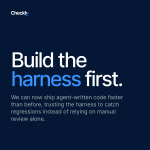
Planning an agentic rewrite? Build the harness first.
A black-box harness that validates behavior against the legacy system lets you ship agent-written code faster and rely less on manual review.
That lesson holds regardless of the model.
hubs.ly/Q04wwwXx0

After the migration:
→ far fewer pods, freeing ~15 vCPU and 45GB of memory
→ 60% fewer database average active sessions
→ ~15% less database CPU
→ fewer alerts for on-call
sqlc for the queries, Go's concurrency model for the row locking.
hubs.ly/Q04wwq_r0

Create a check, then tune it in the same chat.
"Please make it run every five minutes."
"Please also run it from Tokyo."
The Checkly MCP server updates the check each time.
hubs.ly/Q04BnJ-F0
"If everything's tier one, then nothing's tier one." How Yext keeps its service tiers meaningful:
On-deman webinar:
hubs.ly/Q04zz97s0

Your app isn't one thing. Your status page shouldn't be either.
Checkly status pages are rebuilt around components. Group services the way your users see them, and set each incident's impact per component.
hubs.ly/Q04BH0Rh0
What if broken checks fixed themselves?
Automatic check repair is in beta. When a Browser or Multistep check fails because the check is out of date, like a renamed link, Rocky AI proposes a fix, tests it, and saves it.
hubs.ly/Q04BnTG30
You can delete a project from the app now.
And when you drop a resource from your code, deploying with --preserve-resources detaches it instead of deleting it. Resource and run history stay, and you can re-attach later. Without the flag, it's a real delete.
hubs.ly/Q04zs2F80

At Yext, service teams define what healthy means. SRE provides the platform that turns those decisions into checks.
The engineers closest to the service own the intent. SRE owns how it scales.
Shikhar Jagadeesh explains:
hubs.ly/Q04zpLy70
The Checkly MCP server now writes checks, too.
Ask your agent to create, update, or delete checks, monitors, and groups. No local project or CLI deploy needed.
API, Browser, Multistep, Heartbeat, URL, TCP, DNS, ICMP, traceroute, gRPC, and SSL.
hubs.ly/Q04B6vkb0

When checks keep failing in a region, Yext turns it down and reroutes users to the next closest region. Automatically.
That used to be a page to an engineer.
Shikhar Jagadeesh on using Checkly signals to drive failover: hubs.ly/Q04zzbrJ0

What does it feel like to let an AI agent rewrite a production service that handles 92M messages a day?
Eddie's answer: "We don't necessarily think about the code itself. We think about the system."
Watch 👇
hubs.ly/Q04zSVtB0
Every service was up. Nobody could log in. A change had not reached Redis, so Redis was unavailable, but every service check stayed green. Yext's functionality check caught it: hubs.ly/Q04zs1_40

For this rewrite, Go's type system was a much better fit for agents than JavaScript.
The compiler caught a category of mistakes before the harness ran, adding another layer between an agent-generated diff and production.
hubs.ly/Q04wwtfY0
