

The most secure AI inference on earth. Powering your next AI App.
Bittensor
Joined November 2024
- Tweets829
- Following12
- Followers11.9K
- Likes521




Chutes retweeted

In case you forgot (we haven't). There is no universe in which chutes exists without bittensor.
Expanding our OpCo's service and refocusing on a healthier subnet dynamic has some people confused, but it's very explicitly for strengthening the subnet.
nitter.cf/jon_durbin/status/2114… roadmap/plan ICYMI

Chutes is and always will be a bittensor project, chutes is bittensor, and bittensor is chutes 🫶
Reminder too that chutes team operates as a group of independent corporations with no CEO, and our funds are locked into a smart contract which pays our staking rewards to fund the team members.
If any subnet teams want assistance in setting up a similar smart contract situation or anything, we are happy to help.
Qwen3.8 2.4T A95B is live on Chutes.
It's the open-weights model behind Qwen3.8 Max, and the first Max-class model Qwen has released openly. 2.4T parameters in total with 95B active per token. 262K context, with always on thinking
Qwen publishes its scores under the Qwen3.8 Max name, the API version built on these weights:
- 86.6 on Terminal-Bench 2.1, ahead of Opus 4.8 at 84.6
- 81.9 on WideSearch, ahead of Fable 5 at 81.2 and Opus 4.8 at 72.9
Here's how Qwen describes the difference from Max: text only, with thinking always on and a 262K context against Max's 1M by default. Same price on Chutes for both
$2 per million input tokens, $6 out.

Qwen's published scores for Qwen3.8 Max, the API version built on these weights.
Try it here: chutes.ai/app/chute/chutes-q…

DeepSeek V4.1 Flash is live on Chutes.
Pair it with V4 Pro: route the routine calls to Flash and the hard ones to Pro. Same key, different model id.
Flash is the lighter of the two: 552B parameters, with 8B active per token while it reads and 16B while it writes, against Pro's 1.6T. With the same 1M-token context window
On agent work it holds its own. On DeepSWE v1.1, DeepSeek's published score is 77.0, ahead of Opus 5 at 74.0, and on Agents' Last Exam it tops DeepSeek's table at 35.4. It trails Opus 5 on Terminal-Bench 4.0 (42.3 against 51.8) though, so keep Pro for the longest terminal sessions
$0.30 per million input tokens, $1.20 out.
V4 Pro is $0.85 and $2.65.


Tencent Hy4 is coming to Chutes 🪂
We're partnering with Tencent Cloud to bring it to the same Chutes API you already use.
Same key, new model ID
More soon 👀

GLM 5.3 is live on Chutes.
It's Z.ai's flagship, built on the same base as GLM 5.2 and retrained for complex coding and long agent runs. 1M-token context, open weights.
Here's what to use it for:
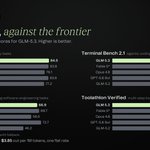
- security review: on CyberGym, Z.ai's published score is 84.5, ahead of Fable 5 at 83.8 and Opus 4.8 at 78.1
- coding agents in a terminal: 88.2 on Terminal-Bench 2.1, ahead of Opus 4.8 at 85.0
Over GLM 5.2: 81.0 to 88.2 on Terminal-Bench 2.1, 46.2 to 66.9 on DeepSWE v1.1.
It does trail from Fable 5 and GPT-5.6 Sol on the longest software-engineering runs (66.9 on DeepSWE v1.1 against 69.7 and 72.7) though, so test it on your own repo first.
$1.225 per million input tokens, $3.85 out.
Z.ai's own API lists $1.40 and $4.40.

Z.ai's published scores, where it leads and where it trails. Try it here: chutes.ai/app/chute/chutes-z…

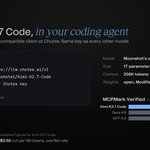
Kimi K2.7 Code is live on Chutes.
Base URL llm.chutes.ai/v1
Model moonshotai/Kimi-K2.7-Code
Works with any OpenAI-compatible client, same Chutes key.
Moonshot built it on K2.6 for coding agents: 1T parameters with 32B active per token, a 256K context and open weights. Moonshot says it uses about 30 percent fewer thinking tokens than K2.6, so a job takes fewer tokens.. making it more efficient
$0.83 per million input tokens, $3.50 out.
If you’re looking for a solid coding model at a reasonable price then you should give this one a shot.


Qwen3.8 Max is live on Chutes.
It's Qwen's 2.4T-parameter flagship, with a 1M-token context, built for coding and long agent tasks.
Here's what to use it for:
- reproducing a paper: on PaperBench, Qwen's published score is 93.0, ahead of GPT 5.6 Sol at 90.5 and Fable 5 at 88.8
- coding agents in a terminal: 86.6 on Terminal-Bench 2.1, ahead of Opus 4.8 at 84.6 in Qwen's table
The 1M-token context takes a big slice of a repo, or a few papers, in one request.
It trails on long software-engineering runs though (56.6 on DeepSWE 1.1 against Fable 5's 70.0), so try it on your own tasks before trusting it with those.
$2 per million input tokens, $6 out. Same rate at any hour.

Qwen's published scores, where it leads and where it trails.
Try it here: chutes.ai/app/chute/chutes-q…

Cheap inference gets expensive when it fails.
@OpenRouter has begun routing more traffic toward fast, reliable inference pushing providers to compete on quality.
As a provider, we welcome the competition.

We just shipped our biggest improvement to our provider router since the founding of OpenRouter.
Before, we prioritized mostly based on price. The new router now rewards the best quality inference for the actual cost of a request, so requests stay cheap but are also fast and reliable.
Providers that deliver more value automatically win more traffic, so every provider has a reason to keep improving. And every time a provider gets better, so does your inference on OpenRouter.

An open model now sits a tenth of a point behind Fable 5 at coding in a terminal.
That's DeepSeek V4 Pro on Terminal-Bench 2.1: 87.9 against Fable 5's 88.0, with Opus 4.8 at 85.0 (DeepSeek's published scores).
What to use it for:
- a coding agent that runs commands, reads the errors and fixes what broke
- security review, where it tops DeepSeek's Cybergym table at 83.3
Its 1M-token context lets you hand it a big slice of your repo at once, so the agent sees how the pieces connect instead of guessing file by file.
It's weaker on long, multi-step projects (62.7 on DeepSWE against Fable 5's 70.0), so try it on your own tasks before trusting it with those.
On Chutes it's $0.85 in and $2.65 out per million tokens, at any hour.
Model page and pricing: chutes.ai/app/chute/chutes-d…

DeepSeek V4 Pro is live on Chutes.
It's the big one from DeepSeek's V4 family, with 1.6T parameters and a 1M-token context window. Open weights, MIT licence.
It's strong on agent work. DeepSeek's published score on Terminal-Bench 2.1 is 87.9, ahead of Opus 4.8 at 85.0.
$0.85 per million input tokens, $2.65 out.
Try it here: chutes.ai/app/chute/chutes-d…

Chutes is very excited to be working with METANOVA LABS as they develop their Hit-to-Lead optimization agent! We fully intend to assist and support to this project in any way we can as it develops.

NOVA Hit-to-Lead Optimization Agent
In collaboration with @chutes_ai and @onepot_ai
We're developing a Hit-to-Lead optimization agent that integrates an algorithm developed by a NOVA Blueprint winner, extending NOVA's capabilities beyond hit discovery and into the iterative optimization of small molecules.
The system combines a domain-specialized AI agent with proprietary combinatorial chemical databases supplied by our partner Onepot AI, spanning billions of possible compounds, that are delivered within 5-7 business days.
Researchers will be able to guide the agent in developing, comparing and refining optimization strategies, exploring chemical modifications and prioritizing candidates based on predicted affinity, selectivity, physicochemical properties and specific binding interactions.
Confidentiality is a central design requirement. Pharmaceutical R&D involves valuable intellectual property, including compound structures, targets, emerging chemical series and optimization strategies that cannot be exposed publicly.
The Chutes team integrated domain specific models so that we can run inference in their verified Trusted Execution Environments (TEEs), with encrypted communication and controlled access to proprietary databases and project records. This architecture is intended to support confidential inference on external infrastructure while preserving organizational control over sensitive research data.
Finding a molecule with promising predicted affinity is only the beginning. Hit-to-Lead optimization involves balancing multiple, often competing objectives, including potency, selectivity, physicochemical properties and synthesizability, before progressing toward experimental activity and ADME validation.
The next step is to integrate the agent into our own Hit-to-Lead development program.
For NOVA, this represents an important step toward translating algorithms developed through open competition into tools for proprietary drug discovery programs, including our own asset-development pipeline and those of external research partners.

Chutes is now live on @say_gm_
SayGM gives you one API key for Claude, GPT, Gemini and open-source models.
When you pick one of SayGM’s private models, it can now run on Chutes, inside secure hardware where no one can read your prompts. Not even us.
See the full article here: chutes.ai/news/chutes-models…

Chutes retweeted
Here's a very crude simplified chutes roadmap/plan, for near term:
- move the most unprofitable things off of the subnet, including today's announcement of some (not all) additional inference options (not paid via emissions)
- this allows us to scale the things we want and need to avoid capacity issues/better direct incentive - this includes models we use to build data pipelines and relationships to other teams/networks/etc
- add options that are completely revenue positive (hourly pricing/rentals/simple docker based jobs/etc), TEE, private, secure, priced above cost, more extensive version of private chutes we have today basically
- expand the hourly compute offerings to also include CPU only (e.g. to run agents, web browsers, sandboxes, non-GPU work of any kind)
- use some of the incentive for ideally non-datacenter based model training and serving
- build a non-extractable product on chutes from the models we build, via dynamic edge nodes, possibly from the epigenesis work (smaller faster cheaper faster than lora customizations from the sparse sections of pretrained model, participant supplied)
- models and pipeline etc. will be open source, the customization and ensemble thereof will live only in chutes, inc. the continuously evolving set of served variations/RL/etc.
We'd like, to the extent we can, attract participants who want to build and have no obligation to pay datacenters or any particular hardware vendor, to keep the value inside the subnet at all times by attacking sell pressure at the source (DC commitments, chip purchases, etc).
We will continue to have secure TEE inference and GPUs; not elimating anything wholesale, just focusing more on a commodity that doesn't have to flow out to DCs and single hardware vendors.
NVIDIA reportedly has 75% profit margins, revenue for the sake of revenue fueling GPU reselling goes straight to one place, basically. Fine, I guess, but I'd rather work together as individuals with whatever hardware we can bring, to a reasonable degree.
We've expanded the Chutes catalog.
As demand for inference has grown, we've added capacity so our users around the world can get the models they need every day, paid for in crypto or fiat. Starting today, alongside our confidential TEE models, Chutes now offers a set of non-TEE models.
First up are the following models, live now on chutes.ai with the same API key and billing you already use.
DeepSeek V4 Pro: chutes.ai/app/chute/chutes-d…
Qwen3.8 Max: chutes.ai/app/chute/chutes-q…
GLM-5.2-Fast: chutes.ai/app/chute/chutes-z…
Qwen3.8-2.4T-A95B: chutes.ai/app/chute/chutes-q…
GLM-5.3: chutes.ai/app/chute/chutes-z…
DeepSeek-V4.1-Flash-1017: chutes.ai/app/chute/chutes-d…
Kimi-K2.7-Code: chutes.ai/app/chute/chutes-m…
More models are coming.

Chutes Inference at a glance
• OpenAI compatible: point any OpenAI SDK or existing tool at Chutes with your current API key. No new account, no new integration.
• One account, one bill: non-TEE and TEE models share the same API key, credits and usage dashboard (and are clearly labelled which category they fall into).
• Pay your way: crypto or fiat, available to users worldwide.
• Serverless: pay per token, nothing to deploy, no capacity to manage.
• Built for agents: tool calling and long-context workloads supported out of the box.
• Your choice of privacy tier: need end-to-end encryption? Run on our TEE models instead.