

One covenant, many orders. @tplr_ai + @basilic_ai + @grail_ai
Joined August 2025
- Tweets217
- Following4
- Followers5K
- Likes136






Pinned Tweet
Three production deployments in four months, each one strengthening the next. @FireworksAI_HQ cited PULSE for Cursor's Composer 2 training in March. Now @huggingface and @vllm_project are shipping it.
Open research compounds when adopters do the work of proving it at scale.

The HF science team just made async RL weight sync ~100x cheaper on bandwidth, and you don't need a shared cluster anymore.
The problem: every RL step, the trainer typically has to sync fresh weights to the inference engine. for a 7B in bf16 that's ~14GB. for a frontier 1T fp8 checkpoint, that's ~1TB; in bf16 it would be ~2TB. per sync.
The insight: between two RL steps, ~99% of bf16 weights are bit-identical. at RL learning rates, the optimizer is whispering and bf16 literally cannot hear most of it. the stored bf16 bits don't change.
What they shipped in TRL: only the changed elements get encoded as a sparse safetensors file, dropped into a Hugging Face Bucket, and fetched by vLLM. on Qwen3-0.6B, per-step payload goes from 1.2 GB to 20 to 35 MB. This is exactly what we built Buckets for: S3-like object storage on the Hub, Xet-backed (so even full snapshots only transfer the changed chunks).
The cherry on top: we ran a FULL disaggregated training where:
- the trainer lived on one box
- vLLM ran inside a Hugging Face Space
- the Wordle environment ran in another Space
- weights flowed through one Hub bucket
no shared cluster. no RDMA. no VPN. no NCCL across clouds. just HTTPS and a bucket.
one GPU + a Hugging Face account is now enough to do real disaggregated RL. multi-replica inference fleets across regions become a small devops exercise, not a research project.
Full write-up: huggingface.co/blog/delta-we…
Open source RL keeps eating the moat!

Concentrated control over AI is fragile.
A model you cannot train is one another party can switch off, whether that party is a company or a state. Safety authority needs evidence and accountability, and durable access starts with the power to train.

On June 12 the US ordered Anthropic to cut Fable 5 and Mythos 5 off to all foreign nationals. Citizenship can't be checked live, so they went dark worldwide in hours. The frontier has an off switch, and the state holds it.
So the case for a stack you control: open weights now within ~3 points of the best closed models (GLM-5.2 beats GPT-5.5 on SWE-bench Pro at a sixth of the cost), a 200B model running offline on a desktop, and post-training a trillion-parameter model on ~224 rentable GPUs with open code. The frontier stays ahead, but for the first time there's a second track underneath it that nobody can switch off.
New piece on what's actually escaping the labs, and what isn't.
open.substack.com/pub/robotw…
Most open model work competes on weights.
Covenant is competing on the training process itself.
PULSE is one proof point. PULSESync reduces 7B RL weight-sync communication by roughly 100x, losslessly, because most updates are invisible after the BF16 cast.
Open-source AI needs open training infrastructure too.
The stable AI economy is one where companies can own the systems that learn from their work.
Models will keep changing. The durable advantage is the improvement loop around them. Private evals, controlled post-training, auditable updates, and infrastructure that does not force institutional knowledge into someone else's closed system.

One directive, one afternoon, and global access to Anthropic's most capable models was gone. Sovereignty does not end at nations. The tools people think with should not sit behind one party's switch. This is why Covenant builds open, distributed AI infrastructure.

The US government, citing national security authorities, has issued an export control directive to suspend all access to Fable 5 and Mythos 5 by any foreign national, whether inside or outside the United States, including foreign national Anthropic employees.
The net effect of this order is that we must abruptly disable Fable 5 and Mythos 5 for all our customers to ensure compliance.
Access to all other Claude models is not affected.
We apologize for this disruption to our customers. We believe this is a misunderstanding and are working to restore access as soon as possible.
Read our full statement: anthropic.com/news/fable-myt…

The biggest single data centers will keep getting bigger.
The larger pool is still the long tail: GPUs spread across labs, companies, and individuals, connected over the internet.
The internet is the data center.


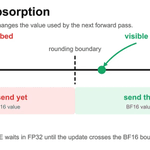
The key detail is BF16, the lower-precision format many rollout workers use for computation.
The trainer may update weights in FP32, but many small FP32 changes round back to the same BF16 value. If the value the receiver computes with would not change, sending it immediately does not help the receiver.
2/n
1
581
This is the PULSE idea in one rule.
If the receiver's BF16 computation would see the same value either way, do not send the update yet.
If the receiver's BF16 computation would change, send it.
That is how PULSE can reduce bandwidth without changing the computation the receiver actually performs.
Paper: arxiv.org/abs/2602.03839
Technical write-up: templarresearch.substack.com…
Covenant AI is hiring: tplr.ai/careers

1,141
Distributed RL post-training is powerful because many machines can help train the same model, even when they are not sitting next to each other in the same datacenter.
The catch is communication. The farther apart those machines are, the more important it becomes to send less data between them.
PULSESync reduces the data sent from trainers to rollout workers. PULSELoCo reduces the data exchanged between trainers.
Paper: arxiv.org/abs/2602.03839
Technical write-up: templarresearch.substack.com…
Covenant AI is hiring: tplr.ai/careers
1,135
The @cursor_ai team post-trained Composer 2 on an open-weight base model using @FireworksAI_HQ's distributed RL rollout infrastructure.
Fireworks links PULSE as the theory behind the BF16 sparsity that makes compact weight updates practical.

Published Feb 2026: PULSE showed that distributed RL post-training could move far less data without changing the receiver's BF16 computation.
In May, PULSELoCo extended the same idea to the second synchronization channel.
PULSESync addressed trainer-to-inference. PULSELoCo addresses trainer-to-trainer.
1/n
A variant of the previous method we introduced, PULSESync, is already proven at frontier scale: Cursor's Composer 2 transmits only ~2% of a 1T-parameter policy's weights per sync, with exact reconstruction, per @FireworksAI_HQ's "Frontier RL is Cheaper Than You Think."
PULSELoCo closes the loop on the other channel: trainer→trainer sync. With both, every node, trainers and rollout workers, can sit anywhere in the world.
2/n
Open AI infrastructure needs more shots on goal, and more capital willing to back the long thesis. cyber.fund's new Monastery accelerator is doing both. Twelve weeks, $2M uncapped, built around founders shipping in the open.
Worth a look if that is your work.



The TGIF #29 recap is up. @DistStateAndMe walks through the busiest month in Covenant history with @erfan_mhi and @Hevalon, covering everything from Covenant-72B to Grail's validation by @cursor_ai to what's coming next across the whole ecosystem.
youtu.be/Etz9KLqRjHc
All Covenant support and discussion now lives in one place. The Covenant Discord.
@tplr_ai, @basilic_ai, @grail_ai. The whole team, one server.
Come build with us.
discord.gg/QvXEtjNcah


