

Email intelligence engineered to optimize deliverability at scale.
Joined February 2017
- Tweets852
- Following265
- Followers224
- Likes1.7K





two weeks out from black friday is when the list should stop changing.
freeze imports now, then verify the list one last time after the freeze, so what you send to is what you checked. a last-minute partner file or lead batch waits until december.
a list that changes during the send window can’t be verified for the send.
worth saving for the week before the biggest send of the year.

4
the cheapest place to clean a list is the signup form.
check the address as it’s typed. suggest a fix for typos. block disposables. confirm the inbox belongs to the person who signed up.
every address fixed at the door is one you never have to explain to an inbox provider later.

2
we don’t have the time machine product yet, but you can make sure your email is landing in the right inbox.
verify the list. catch typos at signup. pass SPF, DKIM, and DMARC.
an email can’t be unsent, so the checks happen before it goes out.

2
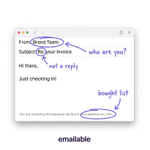
five email don’ts that inbox providers hold against you for months:
1. don’t buy a list, since purchased files are one of the most common sources of spam traps
2. don’t put “Re:” or “Fwd:” on an email that isn’t one, because deceptive subject lines break CAN-SPAM in the US and teach readers to distrust you
3. don’t send full volume from a brand-new domain, because reputation gets built over weeks, not on the first send
4. don’t keep mailing people who never open, since every ignored send lowers how much of the next one gets delivered
5. don’t leave hard bounces on the list, because every repeat send to a dead address counts against you again
all five are signals, and inbox providers keep a record of them.
worth saving before the next campaign is built.

5
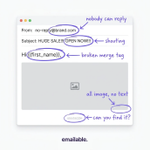
five email mistakes that take seconds to make and months to undo:
1. a no-reply sender address, which shuts off a reply, one of the strongest signals a recipient can send
2. a subject line in all caps with three exclamation points
3. a broken merge tag, so the greeting reads “Hi {{first_name}}”
4. one big image and no text, which often trips filters and shows up as a blank box for anyone with images off
5. an unsubscribe link nobody can find, when gmail and yahoo require one-click unsubscribe from bulk senders, and a hidden link turns an unsubscribe into a spam report
a sixth never shows up in the email itself: sending any of it to a list nobody verified.
worth saving before the next campaign goes out.

6
the third “last chance” email is where a sale turns into a complaint.
at three complaints per 1,000 sends, gmail, yahoo, and microsoft reject bulk mail outright.
one send a day to engaged contacts, one every other day to everyone else, and anyone who already bought comes off the list.

33
the black friday send isn’t finished when it goes out.
monday morning, check complaint rate by segment, bounces against normal, unsubscribes by campaign, inbox placement, and who clicked.
the segment with the most complaints gets verified or suppressed before the next promotion.

7
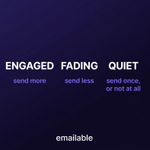
not everyone on the list should get the same black friday plan. split it into three groups before the send:
engaged in the last 30 days: your full cadence
engaged 31 to 90 days ago: fewer sends and your strongest offer
quiet for 90 days or more: one send at most, verified first, kept out of the biggest volume days
the quiet group tends to be where complaints come from, and complaint rate is what decides whether the rest of the list gets delivered.

9
verifying a list takes less time than the meeting where the team decides whether to verify it.
at 30,000 addresses a minute, the math looks like this:
10,000 contacts: about 20 seconds
100,000 contacts: about 3 minutes
500,000 contacts: about 17 minutes
1,000,000 contacts: about 33 minutes
emailable runs 40% faster than the next competitor, so the step that gets skipped for lack of time is the cheapest one on the Black Friday checklist.
three weeks out, the whole list can be done before lunch.

3
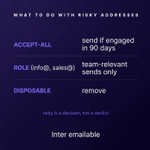
risky isn’t a verdict. it’s a decision, and each type has a default.
accept-all domain: the server says yes to everything, so the mailbox can’t be confirmed. send only to contacts who engaged in the last 90 days.
role address like info@ or sales@: a shared inbox with no single owner. keep it for sends relevant to a whole team and out of promotions.
disposable address: built to expire. remove it.
sorting risky before the send costs less than learning what’s in it from your complaint rate.

8
black friday is three weeks away, which is enough time to do this in the right order.
3 weeks out: verify the full list and decide what happens to the risky addresses.
2 weeks out: suppress anyone who hasn’t engaged in 90 days and start ramping volume.
1 week out: confirm SPF, DKIM, and DMARC pass on every domain you send from.
day before: pull complaint rate by segment so you know where the 0.3% line sits.
send day: watch complaints hourly and pause the weakest segment first.
the order matters because each step protects the next one.

18
a list decays at about 28% a year, and the warning signs show up in your reporting first.
check before Black Friday: soft bounces rising, oldest cohort going quiet, more role addresses, complaints concentrated in one source, clicks falling without an open rate explanation.
two or more means verify before the next big send.

8
more than 1 billion verifications a month, and every one answers the same six questions: syntax, domain, accepts mail, mailbox exists, disposable, accept-all or role.
the last two land in risky. risky isn’t an error. it’s a decision about how much uncertainty your next send can afford.

4
0.3% sounds like a rounding error until you do the math.
5,000 emails: 15 spam reports
20,000 emails: 60
100,000 emails: 300
since november 2025, gmail, yahoo, and microsoft reject bulk mail outright above that line.
check complaint rate by segment before black friday, not across the whole list.

55
your email list is haunted.
28% of it goes stale every year: zombies who never open, ghosts at addresses that no longer exist, and recycled inboxes that turn into spam traps.
verify before the Black Friday send so nothing jumps out at you.
happy halloween from Emailable 🎃

11
black friday is four weeks out.
above 5,000 sends a day, a complaint rate over 0.3% means Gmail, Yahoo, and Microsoft reject your mail outright. three complaints per thousand.
before the send: verify the list, treat Risky addresses as their own decision, suppress 90-day non-engagers, confirm SPF, DKIM, and DMARC, ramp volume gradually, and watch complaints hourly.

25
we verified 8 enterprise lists in September.
lowest deliverable rate: 61%. highest: 91%.
same process. same time period. 30 percentage points of difference.
there’s no universal benchmark for a healthy list. what matters is what makes up everything outside the deliverable bucket.
the number on the dashboard is the beginning of the question. not the answer.

2
the campaign that underperforms in november almost never has a november problem.
it has a september problem. six months of sends to a list decaying while the campaign calendar stayed full and the list health calendar stayed empty.
the pattern you’re walking into Q4 with was built send by send whether anyone was paying attention or not.

4
the deliverability problem most teams have right now wasn’t caused by a bad decision.
it was caused by the decision to deal with it later.
the list unverified since the last migration. the DMARC at p=none. the complaint rate nobody was watching.
inaction in email has a cost. it just doesn’t send an invoice.

1
21
there’s no such thing as a universal healthy list benchmark.
across 8 enterprise lists we verified in September, deliverable rates ranged from 61% at the low end to 91% at the high end.
same industry. same verification process. completely different results.
what makes a list healthy isn’t the deliverable rate alone. it’s what makes up everything outside it. and that looks very different from one list to the next.

7