

@EuclidProtocol
Account based inLebanon
About this account
- Account based in
- Lebanon
- Connected via
- Web
Account-level information from X, not a live location or the device used for a specific post.
The Full-stack Trading Infrastructure for the Next Generation of Finance
Lumen
Joined May 2024
- Tweets2.6K
- Following109
- Followers94.6K
- Likes2K







Pinned Tweet
The full Euclid Prime interview is here.
One Orderbook for every market on earth.
→ Crypto, equities, perps and indices.
Everything that's coming, straight from the team.
There are two kinds of liquidity.
Most platforms only give you one.
Tight prices when active traders are making markets.
Always-on depth that works even when no one’s watching.
Most places make you pick.
Euclid runs both on the same liquidity.
Prime for the order book. Swap for the pools.
They feed each other, so you get tighter prices and reliable depth, without having to choose.


Every trader has made this tradeoff.
Good execution. Low fees. Control of your funds.
Pick two.
A CEX gives you the book. The price is custody. Most days that is invisible. When something goes wrong, the withdraw button is the first thing to go.
A DEX lets you keep control. The price is the trade. Slippage. Gas. A book that isn’t really a book.
So traders split themselves in two. Size on the exchange. Conviction on chain.
Euclid Prime is built so you don’t have to choose.
A real order book. Fast matching. Low trading fees, no gas to place the trade. It settles on-chain. You fund it from the chain you’re already on.
CEX-grade execution. No CEX custody. Full self-custody. Always.
Prime opens to traders soon.

Everything you need to make an onchain trade.
A bridge. Another tab. Another login. Three gas tokens. A prayer the funds don’t get stuck.
Or one place. Deposit from where you are.

Prime has swaps built in.
Same liquidity. Same pools. No second app, no second login.
One referral code across both.
Swap without leaving.

The secret to a better order book isn’t in the order book.
It’s in the pools.
Most platforms run the book and the AMM as separate markets. Different prices. Liquidity that can’t cross. Two shallow books instead of one deep one.
On Euclid they feed each other.
A maker fills on the book and hedges in the pool immediately. Less risk, tighter quotes, bigger size.
When the pool drifts from the book, the book pulls it back. No stale price for the person trading the pool.
One liquidity layer. Each side turns the other.


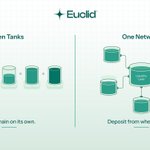
Most on-chain trading is ten towns with ten water tanks. One runs dry while the next is full. The tanks aren’t connected.
That’s why you bridge. You move the money to where the water is.
Euclid is the pipes. Deposit from the chain you’re already on, then trade.
You shouldn’t have to think about the pipes.

Nothing ages you faster than watching a bridge transaction say pending while the chart moves without you.


Cross-chain is usually a badge on the landing page.
We think that's backwards.
Nobody opens a trading app thinking about chains. They think about the asset, the price and how fast they can get in. The chain is just where their money happens to sit.
When cross-chain is a feature, you notice it. Pick a route, bridge, wait, check it arrived.
When it's the default, you don't notice it at all. You deposit from where you are and trade.
That's Euclid.

If you've ever nodded along to 'tight spreads' without being sure what it means, this one's for you.
Eight terms you'll see around Euclid.
→Order book: live bids and asks. That's Prime.
→AMM pool: trade against a pot of two assets. That's Swap.
→Spread: the gap between the best bid and the best ask. Smaller is better.
→Depth: how much you can trade before the price moves.
→Slippage: the price you expected versus the price you got.
→Limit Order: fills only at your price or better.
→Liquidity Layer: shared infrastructure, so markets aren't stuck on one chain.
→Supported chain: a chain you can deposit from.

Liquidity attracts more of itself.
Traders go where prices are good. Prices are good where there's depth. Depth follows traders.
The hard part is starting the loop.
Euclid starts it three ways.
Swap pools give a market flow from day one. Market makers on Prime hedge into those pools. And one liquidity layer means every supported chain feeds the same market rather than starting its own.

Which chain is that on? is a question that should expire.
Not because chains stop mattering, but because you stop having to think about them. Same as nobody asks which server a website runs on.
You'd pick a market for the price and the depth, not because of where your funds happen to sit.
Euclid connects liquidity underneath so the question stops being yours to answer.

Most of on-chain finance is workarounds stacked on workarounds.
Bridges, because chains can't talk to each other. Wrapped assets, because of the bridges. Each layer fixing a problem the last one created.
We started further down. One liquidity layer, with markets built on top.
Euclid. Fewer patches, better foundations.

