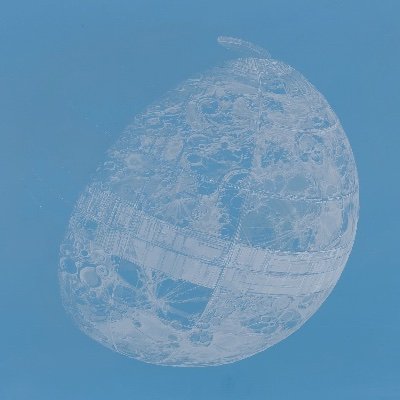
I just bought a SharpCap Pro lifetime license. (for capturing solar, lunar, etc astro)
It's good until Jan 31, 3027 (a little over 1000 years),
So, I need to live a long time to get the most out of my money as I can. Wish me luck.
Michael W. Dean retweeted
A comet and a meteor!
Comet C/2025 R3 (PanSTARRS) was captured from Hautacam, France in April 2026 by Eddy Metais via APOD-NASA website. See its impressive ion (blue) and dust tails‼️
Michael W. Dean retweeted
Guys! REF has put out a video on Luna and Shadow and their 4 babies we watched this year. 😍🥰OMG! I love them so much. Almost as much as our Barn Owls!
Good to see Luna the tawny owl with four healthy chicks 🦉- even if her new partner, the first time dad Shadow, is a little clumsy!
Watch the story unfold in my latest YouTube release 👉youtu.be/RP8lrYadiRM
pasha @pasha77280123
said "You don't get the joke, do you?" and blocks me so I can't answer.
I don't think anyone gets the joke. He sounds like a flat Earther type to anyone reading his post.
@madmanmikey @Gigantor44 @nuascannan
Replying to @pasha77280123
I was going to call you a retard.
But I'll hold off, since I can't tell if you're saying "astro photos are fake" (which is false), or if you're saying "Astro photos gather more light over time than your eye can see" (which is true)
I think it's not just lost in translation, I think you are inelegant with what you say.
Michael W. Dean retweeted
"I’m optimistic about the future because we have more people working on problems today than ever before.”
-Syd Mead
🎥: Joaquin Montalvan
Syd Mead: Future Pastime
Transamerica Pyramid Annex Gallery
535 Washington St., San Francisco
Weds-Sun, 11am-6pm
Now through December 17
futurepastime.net
Michael W. Dean retweeted
A beautiful open cluster in Cassiopeia: NGC 663 located 8,800 light years from us. It has about 400 very young stars (only 20-25 million years old). Most of them are blue massive ones.
I did this image with 45min exposure in each RGB filter and a 35cm telescope.
Michael W. Dean retweeted
NGC 4654 is a stunning intermediate spiral galaxy located about 72 million light years distant in the Virgo Supercluster. Trailing a ghostly gaseous tail, its slightly lopsided appearance is caused by a complicated process known as Ram Pressure Stripping. 📷 Noirlab #NGC4654
Michael W. Dean retweeted
🌗 Monday, Nov 2, 2026. I caught the Moon just after midnight as it cleared the horizon, barely three hours past last quarter, drifting through Cancer about 373,000 km from us with 49% of its face lit.
🌶️ Right along the shadow line, the crater chain Ptolemaeus, Alphonsus and Arzachel looks razor sharp in a telescope, while Copernicus, Plato, Tycho and huge Clavius are easy finds on the bright side.
🔭 Shot on a tripod with the Sony A7RV, the 70-200mm f/4 and the 2x teleconverter. #Moonphase
Michael W. Dean retweeted
Waxing Gibbous Moon
Since many people often ask with interest about the stack(s) and software used for my moon photos, I thought I’d put together a quick overview (see also ALT text).
1) Single frame;
2) Stack (plus aligned) of 50 exposure shots (frames);
3) Processed stack of 50 exposure shots, including color and contrast adjustment, and grayscale conversion of the moon;
4) Processed stack of 50 exposure shots: The colors were further adjusted using saturation to achieve the final “mineral moon” look, and sharpening techniques and other adjustments were also applied.
This is a follow-up to my posts on the Waxing Gibbous Moon 89%, nitter.cf/BeatriceHeinze/status/… and its mineral version, nitter.cf/BeatriceHeinze/status/….
Mineral Moon - Waxing Gibbous Moon 89%
I stacked 50 frames of old data from the waxing gibbous moon phase and processed them in Affinity V3 to create this mineral moon.
The images were taken with a Canon EOS 750D DSLR, paired with a Sky-Watcher Explorer Black Diamond N200/1000 (Newtonian telescope), mounted on a Sky-Watcher NEQ5 mount.
Michael W. Dean retweeted
Special: Asteroid Monrovia - discovered by our fellow astronomer Marian Rudnyk. Congratulations! 💫
Replying to @isastroatelier @xipteras
Hi Isa! ICYMI: I just officially named one of the asteroids I discovered while with NASA, in honor of my hometown:
nitter.cf/MarianRudnyk/status/21…
...☺️🎉
Michael W. Dean retweeted
🌖 Halloween morning, October 31, 2026: the waning gibbous Moon was still riding high in the southwest at dawn, drifting through Gemini about 8° from Castor and Pollux, with 69% of its face lit.
Our Moon is around 367,750 km from Earth's center right now, only three days past its closest point this month, so it still looks a little bigger than usual.
🌖🔭Through a telescope you'll spot Copernicus, Kepler and Aristarchus glowing on the bright side, Tycho and Clavius down south, and the crater trio Theophilus, Cyrillus and Catharina sitting right on the shadow line where lunar sunset is creeping in.
📷 Shot handheld with my Sony A7RV camera, the 70-200mm f/4 lens and the 2x teleconverter on a photo tripod. #Moonphase
Michael W. Dean retweeted
🌌✨ Tonight, high in the northeast, two jewel boxes of #stars hang side by side between the W of Cassiopeia and the hero Perseus, NGC 869 and NGC 884, known together as h + χ Persei, the Double Cluster, about 7,500 light-years away.
💎 Each cluster holds hundreds of young suns packed into a patch about as wide as the Full Moon, mostly hot blue-white stars, with a few orange giants glowing among them like embers left in a fire. Seen together, they look like twin cities of light shining across a dark valley, and people have wondered at them since the astronomers of ancient Greece first noted this soft glow in the sky.
🔭 No telescope is needed to begin. Under a dark sky, far from street lights, the eye finds the W of Cassiopeia, follows it toward Perseus, and catches a small misty smudge that seems to split into two, and that first moment of recognition stays with many beginners for years. Binoculars turn the mist into two glittering knots of stars, close to what this wide image shows, a perfect object for #stargazing even on nights when the Moon is bright.
👶 By cosmic standards, these stars are babies, only about 14 million years old, born long after the dinosaurs vanished and when apes still moved through Miocene forests, before any ancestor of ours had stood upright. The biggest of them burn so fast that they will explode as supernovae within a few million years, brilliant lives that are short because they are brilliant.
🕰️ The light reaching our eyes tonight left the clusters about 7,500 years ago, in the Neolithic, when the first farmers of Central Europe built long timber houses, sowed wheat and herded cattle, and in Mesopotamia villages learned to lead river water onto their fields, in a world without writing, without cities, without a single name history would remember.
🦣 Earth itself looked strangely different, because the Sahara was green with lakes and grasslands, the great ice sheets had melted away, and on a remote Arctic island the last woolly mammoths still walked beneath a sky that already carried this light.
#etexists 👽
Our first radio signals have travelled for about a century, so they still need some 7,400 years to reach the Double Cluster, where any planets around such young stars would still be hot, restless worlds, far too young for life. Our voices will arrive anyway, drifting past blue giants and dying red supergiants, carrying our news, our wars and our laughter into a place that cannot yet answer.
🎶💃🕺 Within that noise there would be music, rhythm made from chaos, songs written to outlast their singers, and the steady sign of a species that kept looking upward while still standing in the dust.
#WeWereHere
By the time the echo arrives, humanity may have changed as much as we have changed since those first farmers, and our signals will remain as the message of a civilization that was young, loud, curious and still deciding what it wanted to become.
#DeepTime #CosmicEchoes
Perhaps the quiet lesson of these twin clusters is that the brightest fires burn fastest, and that a young civilization able to understand this might learn to shine with wisdom, so that its light lasts a little longer than a supernova.
Clear Skies 🌠 #DoubleCluster #astrophotography
--
📷 Image: Takahashi FSQ-106ED telescope, Takahashi NJP-JPZ mount, Nikon D3100 camera, remote cord, image by Panagiotis Xipteras, Germany
Martin Scorsese's 10-minute 1963 film school film. It's really good, and I've seen a lot of student films.
youtube.com/watch?v=fdQTydBW…