Hypothesis (@hypothes_is) header
Hypothesis (@hypothes_is) profile picture

All knowledge, annotated.

Online
Joined June 2011
Photo by Hypothesis (@hypothes_is)Photo by Hypothesis (@hypothes_is)Photo by Hypothesis (@hypothes_is)Photo by Hypothesis (@hypothes_is)Photo by Hypothesis (@hypothes_is)Photo by Hypothesis (@hypothes_is)Photo by Hypothesis (@hypothes_is)Photo by Hypothesis (@hypothes_is)Photo by Hypothesis (@hypothes_is)Photo by Hypothesis (@hypothes_is)
Love note from @palen! “I LOVE HYOTHESIS and, more importantly, so do my students. I have used shared annotation software in the past, but Hypothesis is the best designed one by far. It is fluid and easy to use. And it integrates with Canvas SO WELL.” hubs.li/H0ZXLvH0
4
3
1
24
Students are using AI to generate study materials. AI mistakes don’t look like mistakes. Looks Right. Isn’t. 3 AI-made study sheets, 5 planted errors each. Free, CC BY 4.0. Image 2 has something wrong in it. Can you spot it? hubs.li/Q04DT8Bz0 #AILiteracy #HigherEd
197
At UAF, replacing discussion boards with Hypothesis changed how students participated online. Results included up to 2,100% more reading related interaction, higher grades, and fewer failures. Read the case study: hubs.li/Q04DlXBW0 #HigherEd #StudentEngagement
125
Paced Social Annotation began with a request from educators: let students develop their own ideas before revealing their peers’ annotations. See how feedback, interviews, and classroom needs shaped the feature: hubs.li/Q04Dg7-T0 #HigherEd #SocialAnnotation
153
A summary can tell students what a text says. It cannot replace the questions, uncertainty, and connections that emerge while reading it. In an age of instant answers, the reading process matters more, not less. #HigherEd #AILiteracy #TeachingAndLearning
3
220
AI literacy is not only about learning how to use a tool. It is also knowing when to question an answer, verify a claim, recognize what is missing, and bring your own judgment back into the process. That is the skill worth designing for. #HigherEd #AILiteracy #CriticalThinking
1
184
The strongest response to generic answers is specific thinking. When students identify evidence and explain their interpretation, their work reflects the learning behind it. AI may change the tools. It should not remove the thinking. #HigherEd #AILiteracy
203
Getting to an answer faster is not the same as understanding it better. Can students explain the reasoning, identify the evidence, and recognize what an answer overlooks? The goal is not simply producing an answer. It is making it their own. #HigherEd #AILiteracy
1
249
Reading is often treated as preparation for participation. But when students can question, interpret, and respond inside the material, reading becomes participation. The conversation begins before class does. #HigherEd #StudentEngagement #SocialAnnotation
2
228
Student engagement is not about generating more comments. It happens when a student questions an assumption, considers another perspective, or changes their mind. The goal is not more activity. It is more meaningful thinking. #HigherEd #StudentEngagement
1
231
Class participation should not belong only to the fastest speaker in the room. Students also participate when they question a passage, respond to a peer, or revise an interpretation. Engagement needs more than one doorway. #HigherEd #StudentEngagement #ActiveLearning
2
310
When polished answers are easier to produce, the learning process matters more. The questions students ask, the evidence they choose, and the connections they make reveal what a final answer cannot. How are you making thinking visible? #HigherEd #TeachingAndLearning #AI
173
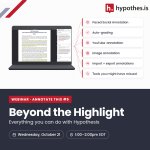
One week until Annotate This #5! Hypothesis can do more than annotate text: YouTube videos, images, paced readings and auto-grading. See it all live next Wednesday, Oct. 21 at 1PM ET. hubs.li/Q04z_NSh0 #HigherEd #SocialAnnotation #InstructionalDesign #ActiveLearning
177
If AI can produce the finished assignment, what should we assess? MIT's report asks higher education to rethink grading and look for broader evidence of learning. Our latest blog explores why the learning process matters. hubs.li/Q04zmz1k0 #HigherEd #SocialAnnotation
153
Community in an asynchronous course does not happen automatically. It grows when students can see one another's questions, respond to ideas in context, and recognize that learning is shared. Online learning should be flexible without feeling solitary. #HigherEd #OnlineLearning
261
Two weeks to go! Explore what’s possible beyond the highlight in Annotate This #5. See paced annotation, auto-grading, YouTube and image annotation, and more. Wednesday, October 21 - 1:00pm EDT hubs.li/Q04zmGdL0 #HigherEd #SocialAnnotation #FacultyDevelopment #EdTech
202
Want better discussions? Start with better annotation prompts. Ask students to question, connect, challenge, support, and extend ideas directly in the reading. Swipe through for 5 prompts to adapt for your next assignment. #HigherEd #TeachingAndLearning #SocialAnnotation
178
An AI policy is not the same as AI literacy. A policy can define what students may do. It cannot teach them to question an output, verify a claim, or recognize bias. Responsible AI use requires practice, not just rules. #HigherEd #AILiteracy
221
Think you know Hypothesis? There may be more to explore. Join Annotate This #5 for a tour of features that can help you structure and expand social annotation. 📅 Wednesday, Oct. 21 ⏰ 1:00pm–2:00pm EDT Register: hubs.li/Q04z3m8T0 #HigherEd #SocialAnnotation
1
284