

Whitehead Institute and Department of Biology, MIT. Lover of cell biology and cell division. Aspiring to do good science and to do good.
Cambridge, MA
Joined June 2012
- Tweets2.2K
- Following826
- Followers7.3K
- Likes2.7K




Pinned Tweet
With the new academic year starting, and many people beginning fresh as graduate students, post-docs, or junior faculty, I have been thinking a lot about the core philosophies that govern my own perspectives on science. So I thought I would share.
Welcome to The Tao of Cheese
Iain Cheeseman retweeted

Such a pleasure to finally meet @iaincheeseman (we think he should move here given all the 🧀🧀 in WI). Thanks for your visit and for giving such a beautiful, inspiring talk!

Iain Cheeseman retweeted

Iain Cheeseman spoke of the power of biology and collaboration across MIT and beyond. "Literacy in biology is central to everything we think about" and the new HEALS initiative has been successful because so much research at MIT touches the life sciences @iaincheeseman
From an accidental discovery of hidden biology to a new framework to understanding and diagnosing rare disease. Thrilled to share the most recent work from our lab and the amazing Jimmy Ly.
wi.mit.edu/news/alternate-pr…

Today @AnthropicAI released PubMed integration for Claude. No hallucinations. Just real science, real data. As a beta tester, this has been a game changer—like having a supercharged research assistant. Here are 6 prompts that will transform how you search the literature. A 🧵

7/ Beyond PubMed. Don't stop there. Combine with this with instructions to search UniProt, your own favorite databases, or your data. It can recapitulate 30 min of exploration in seconds.
1
5
3,286
New preprint! Graduate student Océane Marescal leverages quiescence- proliferative hibernation - to reveal unexpected dynamics for “constitutively”-localized centromere proteins. To understand the logic of mitosis, you need to consider non-dividing cells.
biorxiv.org/content/10.1101/…

Iain Cheeseman retweeted

Jimmy Ly, a graduate student in Whitehead Institute Member Iain Cheeseman's lab, has received the Porter Prize for Research Excellence from @ASCBiology. Congratulations, Jimmy! ascb.org/society-news/ascb-a… (@iaincheeseman)

New preprint! We solve a mystery you didn't know existed. Mitotic cells lack new transcription but require ongoing translation. Interphase mRNA half life is only 2-4 hrs. So how do cells arrest in mitosis for hours without depleting their transcriptomes?
biorxiv.org/content/10.1101/…
Graduate student Katya Khalizeva and team show that mRNA is robustly stabilized the moment that cells enter mitosis with >4x increase in half life. We see this for individual genes and across the transcriptome.


1
6
1,245

New pre-print! Ryan Kim et al distinguish the roles of the Spindle Assembly Checkpoint as a surveillance pathway only triggered by mitotic errors vs a mitotic timer that is required in every cell division.
biorxiv.org/content/10.1101/…

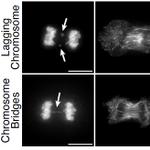
We leverage a separation-of-function allele for Cdc20 eliminating the checkpoint activity of its full-length translational isoform. Using functional genetics, we find synthetic lethality with cell division genes and increased anaphase errors consistent with a surveillance role.

