Co-founder of Avaris: Technical SEO, Content, Links & Strategy. Author of @kaiserthesage. Financial literacy advocate. Co-founder of Grit PH.
QC, Philippines
Joined March 2011
- Tweets15.2K
- Following274
- Followers11.7K
- Likes6.8K








Pinned Tweet
Wrote a quick guide on how to optimize new websites (based on how I'm optimizing our own sites) kaiserthesage.com/how-to-seo…

Jason Acidre retweeted

The November 2026 core update rollout was complete as of November 24, 2026: status.search.google.com/inc…
Jason Acidre retweeted

We looked at the most linked-to URLs across 100s of domains. What content types earned the most links?
Spoiler alert: It was (almost) never blog posts or guides.
As SEOs, we know generic blog posts are mostly dead. So what should you produce instead?
Turns out, writers and journalists like linking to the same types of content that AI answers like to cite: original data, reference material, and unique facts
In short, you're likely to get more bang for your buck making data easier for people + AI to digest than explaining simple things that AI can probably do better anyway.
You don't even need your own original data for many of these content types, as long as you add new insights or make the information easier to understand and digest.
For inspiration, we've identified 20 strong content formats that continue to perform well in 2026 and beyond:
1. Original Measurement & Tracking 📏
2. Reference Tables 📋
3. Ranked Benchmarks 🏆
4. Location Fact Pages 📍
5. Original Surveys & Experiments 🧪
6. Product Tests & Comparisons ⚖️
7. Industry Data & Trends 📈
8. Best-of Lists & Annual Rankings 🥇
9. Statistics Roundups 📊
10. Research Reviews 🔬
11. Expert Explainers 🎓
12. How-To Guides 🛠️
13. Historical Timelines 🕰️
14. Glossaries & Definitions 📖
15. Checklists & Printable Assets ✅
16. Tools & Calculators 🧮
17. Free Design Assets & Templates 🎨
18. Financial & Contract Data 💰
19. Software & Code Assets 💻
20. Interactive Maps 🗺️
Happy link earning!


Jason Acidre retweeted

Ten years ago, we were doing outreach for a large public e-commerce company and emailed the wrong person, who forwarded to PR.
The client was paying us $30K a month and fired us instantly.
These days, some SEO teams get digital PR approved, only for the PR team to find out later and put the whole thing on hold.
Smaller newsrooms and fewer external contacts means PR teams are more defensive than ever. This means alignment is absolutely critical before moving forward.
That’s why we now require that we talk to PR before signing a contract and get them on board from the start, knowing the alternative is setting things up for failure.

GEO vs. SEO: What actually works in AI search w/ @Page2Podcast
00:00 — GEO is changing the SEO playbook
02:39 — Writing a 320-page GEO book
9:50 — Best-of listicles and what Siege dropped
24:54 — The DataFlywheel and credibility statements
35:04 — Why Siege added paid Reddit
36:56 — Building a GEO-first organization
Jason Acidre retweeted

Google just exposed a huge SEO mistake 🤯
Exposed internal estimates for 23 crawling, indexing & search processes.
Some key numbers:
- Link signal processing: Up to 3 weeks
- Indexing after crawling: ~90 minutes
- Core update recovery: 3–6 months
- Existing page recrawls: ~30 days
- New URL discovery: ~20 hours
- Site migrations: 1–3 months
- Title changes: 1–2 days
Simply put, Google just gave marketers a better way to diagnose SEO problems before throwing more resources.
In case you’ve updated 20 pages but haven’t seen rankings move. Here’s what I’d do before rewriting anything:
1. Open Google Search Console. Use URL Inspection to check when Google last crawled your priority pages.
2. Compare crawl dates with your content update dates. If Google hasn't revisited a page, don't judge the rewrite by its rankings yet.
3. Once Google has recrawled it, compare impressions, queries & conversions against your baseline. If visibility improved but conversions didn't, investigate intent & the offer before creating more content.
Btw, I'd also maintain a simple change log: URL, update date, last crawl, indexing status & performance.
That way, you're not guessing whether an SEO change worked.
You're building a record of what Google has seen, what actually improved & where your next investment belongs.

Jason Acidre retweeted

Here’s a prompt I love for finding the most-linked-to content across dozens of sites at once.
(Not to copy anyone, but to get inspiration for your own efforts.)
"For these 20 [finance] sites, pull live crawled pages tagged as ‘Research’. Remove anything that isn’t an article, then use Batch Analysis to rank them by referring domains."
You can provide the sites yourself, or ask ChatGPT/Claude/etc. to pull organic competitors via the Ahrefs API.
For some sites, opinion pieces pick up the most links.
In industries with a lot of SaaS companies, you'll see a ton of original tools and research.
Check content sites in the beauty or fashion space, and you'll likely learn more about the research they report on rather than create.
Start small to make sure you're happy with the results.
On our cheapest plan with API/MCP access (Lite), you could check ~30K URLs this way if you only pull back referring domains, which could be hundreds of sites depending on how much they cover that specific page type.
Of course, not all links are created equal, so you can play around with different filters.
AI is then really good at finding commonalities, excluding topics you've already covered, and highlighting anything you might have unique insights on.
As I say, the goal isn’t to copy anyone, but to get inspiration on ways you can make something great.
Hopefully this is useful. Please let me know if you would like to see more of these 🙏

Jason Acidre retweeted
My ideal AI SEO tool isn't a prompt tracker. Instead, it:
1) Tests exactly what AI gets right + wrong about a company's brand facts
2) Measures overall AI recommendation rates for each company/competitor
3) Importantly, crawls and analyzes all pages to recommend specific content changes
So I built *exactly* that tool with @letaidocom
as an #ahrefspartner, using data from Brand Radar to generate client action plans
• Tracks what AI knows about the company, services, and brand facts
• Measures how often AI mentions the company 📈 or competitors 📉 for every service
• Analyzes WHY competitors get recommended
• Finally, identifies specific information gaps, weak on-page evidence, and pages to target
We can share this report with clients/stakeholders/content managers so they understand exactly what's really driving their AI answers - people *really* start to understand when you show them this.
Previously, I could get much of this data in
@ahrefs Brand Radar, but turning that data into specific fixes required more manual work
I've REALLY enjoyed building these tools
(Full prompt in thread so you can build this yourself)

Jason Acidre retweeted

How much AI traffic is hiding in the Direct column in Google Analytics?
I looked across 12 sites and couldn’t reliably isolate AI’s contribution. Between January and September, total Direct sessions on the pages I analyzed rose 141%. But engaged Direct sessions were roughly flat!
That matters because there’s a plausible explanation for missing AI referrals. I've seen this in my own studies: someone gets a recommendation, remembers the brand, and visits the website later.
Finding it in our analytics would help us understand how much those referral reports leave out. But the data doesn't give that away - yet.
Full write-up: growth-memo.com/p/does-ai-dr…

Jason Acidre retweeted

Spending a lot of time this week thinking through what our processes would look like without using data from @ahrefs or @semrush or @dataforseo to determine where there is traffic to go after, and I keep coming back to the, "it's toasted" scene from S1E1 of Mad Men.
If we have this problem, everyone else does. If we can't pull competitive intel reliably, no one can. This is the greatest thing to happen to search since the release of ChatGPT. If this data loss holds, we are no longer prisoner to search volume and keyword difficulty and can reinvent strategy from first principles.

Jason Acidre retweeted

Google announced that AI Overviews and AI Mode are going to do more when it comes to linking out to websites.
1. More inline links in AI answers. Plus they will be shown higher up in responses more frequently.
2. Displaying official websites up high in AI answers if they are the place where people usually go to complete a specific tasks.
3. New prominent carousels for timely news articles that will appear within the AI answers. These will highlight your Preferred Sources.
4. More links to websites at the end of AI answers, along with image thumbnails and a more clickable design.
5. Clickable creator and publisher names on video results that take you to their Search Profile.
blog.google/products-and-pla…


Jason Acidre retweeted
I don't think people realize the shape that SEO, as a channel, but also SEO as an industry, is in.
It's... not great.
That is not to say you can't gain traffic, but it's much more limited since more people use AI, Google rolled out AIOs more broadly and gives more surface to ads.
Jason Acidre retweeted
Since Google officially updated its docs on creating Helpful Content, lots of folks are talking about "Effort" (along with scaled content + fake author profiles - good!)
Google’s definition of Effort isn’t what most people think
Effort ≠ work
In the age of low-effort, scaled AI content getting algorithmically decimated, understanding “high-effort” is increasingly relevant to brands.
Most interestingly, the Google API leak exposed two data points that specifically reference Effort scoring:
1) contentEffort - LLM-based effort estimation for article pages
2) ugcDiscussionEffortScore - UGC page quality signals
Effort is not how much work you actually put into a page. It’s more about the evidence of useful work that ends up on the final page.
High-effort pages typically contain at least some elements that AI or automation can’t easily replicate, such as original facts (gained through your own experience) and unique perspectives/opinions.
I put all of this in a Substack recently, along with a template for auditing Content Effort

Jason Acidre retweeted

Since LLMs construct multiple fan-out queries and use search engines to conduct these searches simultaneously, doesn’t that kind of imply that SEO is actually *more* important than it was before? 🤔
(Better coverage = better visibility)
Jason Acidre retweeted
Early signs that the current Google Spam update is hitting sites with highly templated, programmatic, (probably) AI-generated pages, like one page for every phone number/area code


Jason Acidre retweeted

Important note. @ahrefs just posted that their new adaptive traffic model is now the default. You could select that recently, but it wasn't the default. Now it is. The adaptive model assigns refreshed weights for SERP features, including AIOs. So you could see changes in visibility based on that becoming the default. ahrefs should add a note there in the graph so users understand this...
From ahrefs:
"It assigns refreshed weights to SERP features, including AI Overviews, and the calculations behind those are updated monthly."

Jason Acidre retweeted

Tim Ferriss recently asked me on his podcast what the best business advice I've ever received was.
I didn't have to think about it.
Because I ended up building and selling two companies on the back of these five words.
Years ago, Noah Kagan told me: "Double down on what works."
That's it. That's the advice.
And when I first heard it, I did what most people do: I said "that makes sense," and went back to doing the exact opposite.
I totally get it:
When you're running a business there are a million distractions.
So when something finally works, most people go "cool" and immediately chase the next thing.
(I've done this more times than I want to admit.)
But here's the thing:
When you're starting out, nothing works. That's basically the definition of starting out.
So when something DOES work, that's a HUGE win. You actually want to double, triple and 10x down on it until it stops working.
For me, this played in two of my companies:
At Backlinko, I noticed early on that my long-form guides outperformed everything else I published.
So instead of treating those as occasional "special" posts, I made them my entire strategy. I stopped publishing weekly and only put out massive, definitive guides. Sometimes just one a month.
That one decision basically built Backlinko into one of the top marketing blogs on the planet.
Then at Exploding Topics we did basically the same thing: our data-driven content (trend reports and stats pages) CRUSHED our regular content.
So we stopped writing generic how-to posts and made original data the core of the whole site.
That's what turned Exploding Topics from "a random tech blog" into a site generating 700k+ visitors per month.
👍🏻
Jason Acidre retweeted
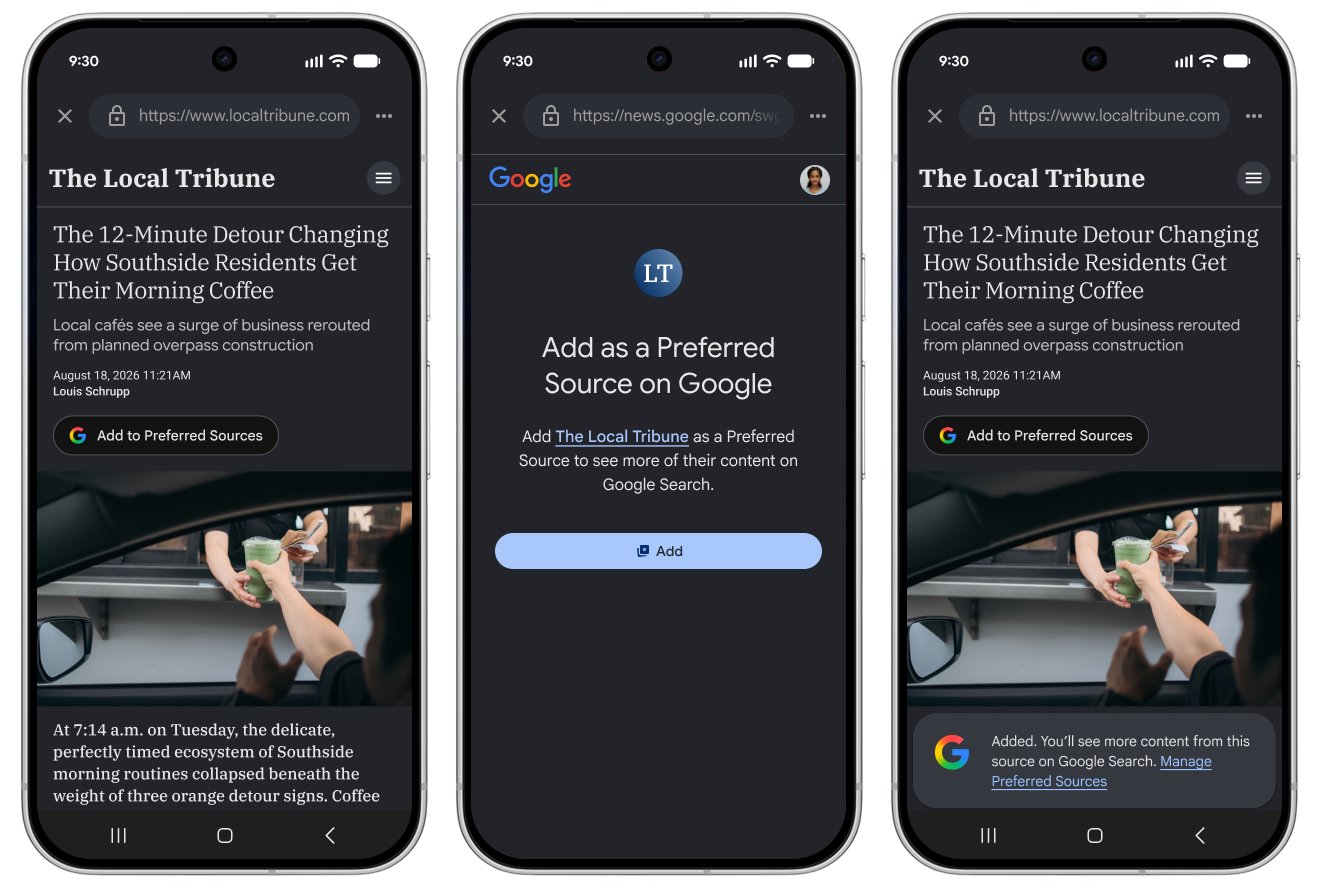
Oooh. Google just launched an embeddable "Preferred Sources" button for websites - and it directly impacts your visibility in AI Overviews and AI Mode.
Here's what you need to know:
▪️ You can now embed a simple <script> tag and <div> button directly on your site so visitors can add you as a Preferred Source.
▪️ When someone adds your site, you are more likely to appear in their Top Stories, AI Overviews, and AI Mode.
Also,
▪️ Discover Tuning: Users can also tune their Discover feed using natural language to see more or less of specific topics and sources.
There's info in Google's developer docs for the script implementation: developers.google.com/search…


A few updates today making it easier see the content + publishers you want across Search, News and Discover:
⭐ Click the Preferred Sources button to save your favorite websites
💬 Tell Google about the topics and links you want to see more (or less of) in your Discover feed - just like you’d text a friend
🎧 Stay up to date with custom daily audio briefings in the Google News app (Android)
Jason Acidre retweeted

.@TomekRudzki from @peec_ai sharing that Reddit and YouTube have dropped as ChatGPT citation sources since the GPT-5.6 rollout is yet another reason why we shouldn’t approach third-party citation optimization as a “one-trick pony.”
It’s also why AI search optimization should be aligned with community management, digital PR and broader digital marketing campaigns.
We can expect third-party platforms to gain or lose prominence as citation sources with every major model update…. these are out of our control as well.
What we can actually control is that our brand has a useful, relevant presence across the meaningful platforms and communities where our audience is actually active and where we can genuinely connect with them.
That’s what makes third-party optimization impactful regardless of citation volatility: building brand visibility and authority that’s aligned and can benefit it across search, AI platforms, communities and other referral channels, rather than optimizing for a single source because it’s highly cited now.

Jason Acidre retweeted
Google's biggest ranking "buckets", according to evidence collected at its antitrust trial, are:
1. Topicality: How relevant is the page to a topic/query. Heavily determined by the "ABC" ranking signals:
• Anchors - the links pointing to the page
• Body - the text on the page
• Clicks - user click signals to determine relevance
2. Navboost: a re-ranking system that uses 13 months of user click data to adjust search results (first/long/last clicks)
3. Quality (Q*): One of Google's most important signals, based on site authority + quality adjustments (e.g., Panda, Helpful Content, spam)
SEOs—including yours truly—often get distracted by shiny things. But focusing on these three ranking buckets will likely account for 80-90% of your Google visibility.