

API-first Agentic Document Intelligence platform built for accuracy, reliability, and governance at scale.
Mountain View, CA
Joined December 2017
- Tweets3.1K
- Following855
- Followers10K
- Likes1.2K




Pinned Tweet
Today, we are announcing the second generation of Agentic Document Extraction (ADE).
It is faster, more accurate, and more affordable than ever before. ADE Gen2 delivers higher performance while optimizing cost for every document.
Pricing has been completely overhauled. Customers running mixed workloads should see 25% to 80% cost reductions.
Groundings and citations now reach the word level following a page > block> line > word hierarchy. This allows every extracted value to point to the exact location on the page it came from.
The outputs from the v2 Parse and Extract APIs are fully agent-ready and agent-friendly. Your agents get a clear hierarchy, stable IDs, and clean, standardized Markdown designed just for them.
ADE Gen2 is a step change in document intelligence not an incremental update.
Read the full announcement on the blog (link in comments).
Create an account and get started for free at ade.landing.ai
Agentic Document Extraction Enterprise VPC is now on @AWS Marketplace.
Enterprise VPC is the same AI document processing platform we run as a cloud service, packaged to run entirely inside a virtual private cloud in your own AWS account.
It parses, extracts, splits and classifies complex documents into structured data, and links every extracted field back to its page and its position on that page, so each value can be checked against the source.
Earlier this year we brought Agentic Document Extraction to AWS Marketplace. This listing adds the private deployment, for teams whose documents can’t leave their own environment.
Read more here: landing.ai/news/agentic-docu…

ADE CLI: terminal-first document extraction for agents.
The Agentic Document Extraction (ADE) CLI ships as one standalone binary. No Python, no package manager, no virtual environment to manage. One line installs it and symlinks it onto your PATH.
ade parse turns a document into clean Markdown and structured, grounded JSON. ade extract pulls the fields you ask for, each value linked back to exact page bounding boxes, so your agent gets audit-ready citations.
Every run caches locally by a hash of the file, the parameters and the environment. Run the same command again and it serves from disk, with zero API calls.
Three more run locally at no cost: view opens an HTML viewer where clicking a value highlights its box, crop slices blocks out to PNGs, and find regexes across every block and reports the page of each hit.
And ade help --json gives your agents a stable command surface to read, so they never guess a parameter.
Walkthrough in the video. Install link in the comments.
1
5
320

A private equity data room holds thousands of files, filed in folders the seller named.
The average private target carries 7,583 of them: the CIM, audited financials, the quality of earnings report, the cap table and the contracts, side by side.
Revenue and EBITDA show up across the CIM, the monthly P&L, the audited statements and the QoE report, laid out four different ways. Associates rekey all of it into the model by hand.
Agentic Document Extraction (ADE) reads the whole data room in one pipeline. It classifies each file, parses every page, and returns adjusted EBITDA, share counts and lease terms as JSON that matches your schema.
Every value comes back linked to the page it was read from. So an associate checks a figure on the source before it reaches the investment committee memo.
That traceability carries into the working capital peg, where 57% of deals open with a buyer-favorable claim after close.
The full due diligence breakdown is in the comments.

Read the full use-case here: landing.ai/use-case/private-…

63
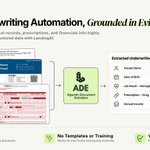
A single life insurance file holds medical records, lab results, prescriptions and financials.
The attending physician statement alone can run dozens of scanned pages, and its length and scan quality drive review time more than the medical case does.
The rating depends on those documents agreeing. Tobacco use, income and net worth on the application get checked against the labs, the prescription fills and the tax returns.
That reading is what separates a 5 day accelerated decision from a full underwrite that averages 23 days.
Agentic Document Extraction (ADE) reads every document in one pipeline, scans and handwriting included, with no templates to build. It returns the fields an underwriter rates on, each lab value, fill and income figure linked to the exact page it came from.
So the evidence behind a rating can be shown on the original record. That matters when 86% of carriers already run or plan pre and post issue audits.
The full life underwriting breakdown is in the comments.


An agentic AI system for loan processing and fraud detection.
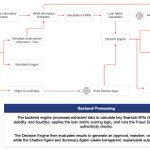
LoanLens takes a borrower’s six documents, the bank statements, credit reports, pay stubs, tax returns, passport and utility bill, and runs the whole first pass of underwriting on its own.
It starts by reading them. Agentic Document Extraction (ADE) pulls the fields that matter from each document, the account holder, the income, the balances, and ties every value back to the spot on the page it came from.
Reading is not enough on its own, so the system also looks. Agentic Object Detection (AOD) inspects the passport, locates the photo, the MRZ and the eagle, and checks whether they sit where a real document would place them.
Now it has clean, checked data, so it can judge the loan. It scores the case on credit, debt to income, income and liquidity, and a name that disagrees across the files or a tampered passport pushes the file to review or rejection.
What the reviewer gets back is the whole story: the decision, the annotated documents, a summary and a chatbot that answers questions about that one file.
Full write-up and code in the comments.

Built by Tanika Gupta.
Write-up: landing.ai/developers/how-we…
Code: github.com/rrahul1011/loanle…

1
106
Our engineering team got together to work on one thing: DPT-3 Verity, our new parsing model in Agentic Document Extraction (ADE).
It is built for transcription you can trust at scale. Every word Verity reads comes back grounded to its exact spot on the page, with a confidence score that flags the words it is less sure it read correctly.
The team spent the week sharpening it and moving it toward general availability.
It is open in beta today, tuned for digitally created documents. Give it a run, more is coming soon.
Link in the comments.


In a few hours, we take the stage at the Data Science Dojo Agentic AI Conference.
Jaya Vivekanandan, our Applied AI Engineer, speaks at 11:00 AM PT. Her session is “Show me where it says that: Agents that cite every word in a document.”
The hard part of document extraction was never pulling the value. It was proving the value is right.
Her talk covers extraction agents that ground every answer to its exact spot. Each field traces back to the page it was read from.
📅 Today, 11:00 AM PT
Register free in the comments, before it starts.

1
5
258

Our Senior FDE Mark Ghannam is joining a panel at the Data Science Dojo Agentic AI Conference next week.
The topic: Secure AI needs forward deployed engineers.
Most teams try to make AI safe from a distance. They write the policy, then hand it down to whoever ships the system.
This panel makes the case for the opposite. Compliant, secure deployment happens up close, through engineers embedded in the organization, sitting with the people who carry the risk.
📅 Monday, November 9
🕒 12:00 PM PT
Register free in the comments.

1
3
231
27 complex invoices became 494 Snowflake rows in 73 seconds.
No manual keying, no one-document-at-a-time queue. One pipeline reads the batch and lands clean rows in the warehouse.
Here is the run. 27 invoices, 34 pages, parsed and extracted at once, then streamed into Snowflake in real time.
Agentic Document Extraction (ADE), on the DPT-3 model, parses each document into Markdown. Every heading, paragraph and table keeps its exact page location, so each value traces back to where it was printed.
Four tables come out the other side. Full document text, parsed blocks, invoice fields and line items, all query ready.
The speed is the concurrency. Processed one at a time, this batch runs 829 seconds. Run together, 73 seconds. An 11.3x speedup.
Invoices are the example here. The same pattern fits loss runs, bills of lading, lab reports, any document type.
You hold the schema. Define the fields in a few lines of Pydantic, or add them in plain language in the playground and test live.
Full code in the comments.
Our engineers are in one room this week, building as fast as they can ship.
What they are shipping is DPT-3 Verity, our new parser in Agentic Document Extraction (ADE). It reads any document and gives you data you can actually trust.
Most parsers hand back a clean transcript with no way to check it. Verity grounds every word to its exact place on the page, inside table cells too.
Each word also carries a confidence score, so you see which ones the model was unsure about. We named it after the Latin word for truth for that reason.
Fast and affordable too, at under $5 for 1,000 pages.
DPT-3 Verity is in public preview today, and the team is driving it toward general availability this quarter.
Try the beta now. Link in the comments.

1
9
349
A single commercial auto submission can list 13 drivers across four vehicles.
Each driver brings a motor vehicle report, and each prior carrier brings a loss run. No two states print that report alike, and neither do the carriers’ loss runs.
So the underwriter reads every page and rekeys drivers, VINs and loss totals by hand. A 2021 survey put 40% of an underwriter’s time on administrative work like this.
The real work starts after the typing. Underwriting rates each risk by checking the application answers against the evidence. An unlisted driver or misstated garaging prices the policy below its risk.
Agentic Document Extraction (ADE) reads the whole submission, whatever the state or carrier. It needs no templates, so a new form works on its first call.
ADE Parse turns applications, schedules and loss runs into structured Markdown. ADE Split separates the pack by driver and by carrier. ADE Extract returns the drivers, violations and loss totals as JSON.
Every value traces to the page it came from. The underwriter checks a violation or an open reserve against the original page. The unlisted driver now shows up before the policy binds.
The full auto underwriting breakdown is in the comments.

