

LifeHack: Your 24/7 AI Life Coach 🎯 Helping busy people achieve goals faster with actionable systems that multiply results. FREE assessment below ⬇️
Joined September 2007
- Tweets34.5K
- Following1
- Followers94.9K
- Likes165


When a job offer comes in below the posted range, don't negotiate the number first. Ask what changed between the listing and the offer.
Their answer tells you how the company handles commitments when it has leverage. That's part of the offer too.
Adult friendship can survive a quiet month. The useful question isn't “Why didn't you text?” It's “Can we pick up without keeping score?”
Give busy people room. But when silence becomes one-sided, ask about it instead of calling neglect maturity.
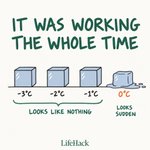
If the habit is sound and it's only been a few weeks, you may be at -1°C.
What are you close to giving up on?
Then it hits 0°C and melts. It looks sudden. It isn't. Every degree before it counted.
A lot of rebuilding works like this. Sleep, strength, savings, a relationship you're repairing. The change builds out of sight long before anyone can see it.
Six weeks of earlier nights and evening walks, and the scale hasn't moved. This is where a lot of people quit.
Picture an ice cube in a cold room. You turn up the heat. -3°C, -2°C, -1°C. Still ice. Nothing seems to happen.

ALT Approved LifeHack graphic
Rich Roll photographs his gym clock every morning, and the photo can't repeat the day before. Posting it keeps him from flaking on the workout.
His full routine, with sources, is in the first reply.
Mel Robbins charges her phone in the bathroom. Her alarm is on it, so when it rings she has to get out of bed to turn it off.
Her full routine, with sources, is in the first reply.
Zoomed out, the question changes. You see health, money, family and work side by side, and you notice which one has been drifting.
You need both. Zoomed in is where the work gets done right. Zoomed out is where you check it's the right work.
What you can't see from there is whether it's still the right thing. Whether the work, the hours and the routine still point where you want your life to go.

So when you're new at something, start by noticing what went right. The detailed notes can wait until you have some wins behind you.
What are you new at right now?
Research on feedback points the other way. People new to a skill get more out of praise, because the real question for them is whether they can do it at all. Experienced people get more out of critique, because they already know they can and want to know how to get better.
After twenty years of being good at your work, starting something new means being a beginner again.
The hard part is that you still judge yourself like an expert. Every clumsy first attempt gets a full critique.

ALT Approved LifeHack graphic
Outgrowing a job does not mean you need to start job hunting tonight.
Build an exit ramp: spend one lunch a week talking to someone who does work you might want. After four conversations, you'll have a clearer view of the role and four warm contacts when you're ready to move.