

trade whatever wherever whenever
orderbooks
Joined March 2025
- Tweets3.1K
- Following1.2K
- Followers47.8K
- Likes19K





Pinned Tweet
Over the last week, we’ve been talking a lot about Liquid as the next great retail trading platform, but that’s only part of the story.
Our founder was the former Head of AI Research at Two Sigma and also worked at Citadel and D. E. Shaw. He left after seeing firsthand how Quant firms extract from retail through payment for order flow, opaque options pricing, adverse execution, and leveraged ETFs whose daily resets and fees can quietly erode returns.
The idea behind Liquid came directly out of that experience: if retail traders are going to compete, they need market infrastructure that is more transparent, easier to understand, and built around their interests rather than hidden layers of intermediation.
We built Liquid as a decentralized, non-custodial venue on perpetual futures because we think that levels the playing field. Perps give traders a more direct way to express a view, with clear exposure, no expiry, no options-style time decay, and access to markets that traditional brokers often make difficult or impossible to trade. The goal isn’t to encourage people to take more risk. It’s to give them a cleaner instrument, better access, and more control over how they trade.
Why perps:
> No expiry, no theta decay, no IV crush.
With options, being right on direction isn’t always enough. You’re also paying for time and implied volatility, which often gets especially expensive around events like earnings. That means you can get the stock right and still lose money if the move isn’t big enough or implied volatility collapses after the print.
With a perpetual future, your exposure is much more direct: if the underlying moves, your position moves with it. There’s no expiration clock and no IV premium to get crushed after the event.
> Access.
Oracle-based pricing allows perpetuals to track markets that are difficult or impossible to access through a traditional U.S. brokerage account. That’s how Liquid can offer exposure to private companies like Anthropic and OpenAI, as well as international names like $SKHY and $CXMT before they become available on platforms like IBKR or Robinhood.
> Cost.
Options embed market maker hedge costs into the premium. Perpetuals keep you near the underlying and charge a small, transparent funding rate on the position instead of an opaque options package. Directional risk without buying a volatility product.
But better market infrastructure is only half the equation.
Retail traders also need better tools to understand what they’re trading. That’s why we built @coinvestai our free AI trading companion that helps users research markets, understand positioning and risk, and pressure-test a trade before they put capital behind it.
The goal isn’t to have AI make decisions for you. It’s to give retail access to the kind of research and analytical support that has historically been reserved for institutions.
> Better markets.
> Better information.
> Better tools.
Retail deserves markets that don’t hide the bill and tools that help them compete. That’s what Liquid is for.


Absolutely CRAZY day in the market today:
1. $GOOGL sank about 12.6% to roughly $283.75, its worst day since going public in 2004, wiping out about $500 billion of market value.
2. $NOW plunged about 27% to $109.65 on weak subscription guidance and a bookings and profit miss, and $FTNT fell about 20% to $139.08 on a product revenue shortfall and weak guidance, pressuring software stocks.
3. $MRVL fell about 13% to roughly $218 after Bloomberg reported advanced talks to acquire $LITE. $LITE jumped as high as about $978 intraday, then faded its entire gain to close up just 0.6% at about $920, with no deal announced yet.
4. $ICE agreed to become the exclusive operator of a new U.S.-regulated perpetual futures market built on Hyperliquid with Trade[XYZ], the largest builder of real-world-asset perpetual markets on Hyperliquid, and is making a strategic investment in Trade[XYZ], subject to regulatory approval. $ICE closed up about 4.6% at $163.06.
5. Polymarket's international exchange paused trading Thursday afternoon after unauthorized wallet withdrawals tied to a breach at a third-party vendor, with at least $2.7 million traced to one account. T
6. After the close, Binance was hacked for nearly $5.6 Billion with the hack reportedly still ongoing.
7. $LLY rose about 6.6% to $1,372.99 after a Q3 beat and a raised full-year revenue outlook.
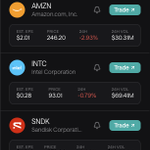
8. $AMZN shares fell roughly 6% after hours after Trailing 12-month free cash flow came in at negative $42.4 billion
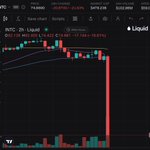
9. $INTC fell roughly 16% to 17% after hours as Q4 guidance fell well short of expectations.
10. $SNDK shares wavered as the company announced an 8-for-1 stock split and reported bumper earnings.
11. In other earnings news: $RBLX down about 17%, $RDDT down about 16%, $TWLO down about 15%, $PINS down about 12%, $ILMN and $SYK each down about 12%.


Imagine you go long 10x $AAOI and this is who you're trading against


Trader Spotlight: @DiligentPlane
@DiligentPlane recently started trading on Liquid and is up $11.6k all time, with an average leverage of 3.5x per trade.
His top 3 trades:
$NBIS (Nebius) — +$4,980 @ 4x — Oct 27
$GLW (Corning) — +$4,753 @ 3x — Oct 28
$MU (Micron) — +$1,027 @ 3x — Oct 9
DP is a great example of how you don’t need high leverage to win on Liquid.
You can follow each of his trades as they happen on Liquid.