

@MFordFuture
Account based inIndonesia
About this account
- Account based in
- Indonesia
- Connected via
- Indonesia Android App
Account-level information from X, not a live location or the device used for a specific post.
Futurist & NY Times bestselling author. New edition of #RiseoftheRobots (https://nitter.cf/t.co/C30wvush11) about how
Silicon Valley, CA
Joined June 2011
- Tweets8.6K
- Following131
- Followers44.4K
- Likes1.7K





Pinned Tweet
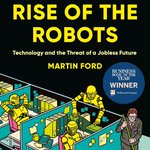
The new edition of "Rise of the Robots: Technology and the Threat of a Jobless Future" is now available!
I have extensively updated the book to cover the latest advances in generative #AI and robotics and to examine the future economic and job market implications of the unfolding AI disruption. The book focuses on what we can do as individuals, and as a society, to successfully navigate the looming transition into the age of AI. Order from the link in the reply!
@BasicBooks #RiseoftheRobots

I'm listening to the audiobook now. Definitely worth your time!

It's pub day for The AGI Chronicles!
Impossible to convey how hard this thing was to write. I locked myself away for a year, and interviewed more than 150 AI insiders to try to get the full story of the race between OpenAI, Anthropic, and Google DeepMind, because it felt so important to have an accurate record of how we got here.
But it's done, and it's out, and you can start reading it today! (Or listening -- I recorded the audiobook myself.) I'm very happy with the finished product, and I hope it will serve as both a durable artifact of this era and a sense-making instrument for people who are getting up to speed on AI.
I'm not very good at street-team promo, but if you buy a copy and reply with your receipt, I will generate a beautiful personalized thank-you poem as a token of my gratitude.

Martin Ford retweeted

The first jobs for many college grads are disappearing.


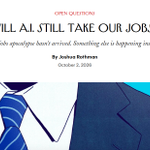
A great overview of argument that #AI will not be able to do "Messy Jobs" (jobs that rely on things like tacit knowledge) by @joshuarothman at the @NewYorker, based on the book coauthored by the economist @lugaricano.
The "messy jobs" thesis is really just an observation of what we have seen so far. Clearly, human beings can learn to do messy jobs. Therefore, if we have true human-level AI, it will also be able to learn to do messy jobs. I think it's easy to point to at least one of the key missing ingredients: continual (or on-the-job) learning. Surely, this is how humans learn to do messy jobs. Even the best AI models do not have this capability over significant periods of time. Humans, on the other hand, can learn over the course of months, years and decades. Once continual learning is solved, it seems likely that the messy jobs will begin to fall to the machines.
I don't know how much research effort is currently being directed at continual learning by the frontier labs. I'd certainly be interested in comments from anyone with expertise in this area. I have read that some open model Chinese developers are making it a focus of research. It seems likely that continual learning will emerge as an important nexus of competition in the not too distant future, and that this will drive rapid progress.
So hold on to your messy job while you can...
(Link to the New Yorker article in the reply)


Martin Ford retweeted

We compared 12 licensed accountants against frontier AI models on realistic accounting tasks.
The models were faster and more accurate than every accountant in our study.
18 months ago, the best models scored below the average accountant's ~37%. Today, models ace the same tasks.
This doesn’t mean accountants are replaceable. But it does suggest the job will change significantly, even if model progress stalled today.
Read our full study: mercor.com/blog/human-baseli…

Martin Ford retweeted

Very excited to announce Gemini 4 Argon, our new Frontier AI model, and a huge step forward across key capabilities. We’re focused on rolling it out responsibly starting with government and trusted cyber defenders through our Fairwind Program today, before wider availability soon

Martin Ford retweeted

Today we announced the Claude-led discovery of a molecular machine that we suspect could represent a new gene editing mechanism. Its precise function, biotechnological utility (if any), or level of significance is not yet clear, but at minimum it is work I would have been proud to do as a PhD student. The work was done mostly, though not entirely, by Claude: our life sciences team suggested a broad area of research, Claude read through the literature and a bunch of genome data and discovered something interesting, then Claude proposed experiments to verify the discovery and our team carried them out.
It’s easy to dismiss this as a one-off or curiosity, but we’ve repeatedly seen a pattern where AI performance in new intellectual domains goes from weak to superhuman in a matter of a few years. In 2023 models struggled to do math at the level of an average high-school student. In 2024 they started to do well on math competitions for the best high-schoolers in the country, in 2025 they started to solve minor open problems, in early 2026 more significant open problems, and in late 2026 they are beginning to solve the top few open problems in all of mathematics. We believe AI for biology is on a similar exponential trend.
The main difference between biology and mathematics, of course, is that math can be done purely theoretically, while biology requires experimentation. Some have used this to draw the conclusion that AI’s utility in biology will be limited. We think this is wrong. As we’ve demonstrated today, humans can collaborate with AI to perform the experiments, validate key results in a few weeks and, if necessary, work with the AI to iterate on what they find. Eventually it may even be possible for Claude itself to safely perform the experiments by autonomously controlling lab equipment, with appropriate safeguards in place, but we aren’t doing that today (our lab is also a BSL1/BSL2 facility that doesn't handle materials dangerous to humans).
More broadly, biomedical advancement has many stages — from fundamental biology discoveries, to translational research, to drug discovery, clinical trials, and finally the actual delivery of medicines and health care to patients. We are also interested in these later stages, but even simply accelerating the first stage of fundamental biological discoveries has the potential to speed up and broaden the entire pipeline. Improving our understanding of biology and sharpening biologists’ tools can drive forward all of the later stages, for example by identifying new drug targets, finding new therapeutic modalities, allowing for more precise measurement, and speeding up the experimental loop which itself further accelerates our understanding of biology. This will not in itself speed up clinical trial times, but if it succeeds it could greatly increase the number of promising candidates that go into the pipeline — an increase in throughput even though latency remains.
In Machines of Loving Grace, I wrote about AI’s potential to “cure most diseases in 5-10 years” — a goal that sounds impossible, but one I believe is just barely possible if AI is applied to every stage of the pipeline. The first step is showing that AI can first help with, and then drive, biological discoveries.
Claude’s discovery is the latest in a line of related prior work that goes back decades, beginning with systems like CRISPR, and continuing with discoveries like the bridge recombinase and VIPR in the past few years. Recently, there has been heightened interest in systems based on reverse transcriptase (RT) enzymes, the enzyme underlying the system Claude identified. And most recently, a Stanford team working independently described a novel RT system with an associated non-coding array that is in some ways similar to the one Claude found, though they are distinct systems that evolved independently from each other. I believe that we’re at the very beginning of finding such systems and developing them into powerful tools for biotechnology.
I’m proud of the resources Anthropic has invested in accelerating the public benefits of AI through the life sciences, and we’re aiming both to grow our life sciences team and to work with other scientists to extend this approach to a broad range of problems. If you have a proposal for a research collaboration or are interested in joining our life sciences team, please reach out.

Claude has discovered a previously unknown enzyme system hidden in the DNA of bacteriophages. Beside the enzyme’s gene sits a long array of repeating DNA—a structure that looks somewhat similar to CRISPR.
We don’t yet understand what this system does, but only a handful of known systems share its features, and all of them are able to cut, copy, and paste DNA. Historically, the discovery of such programmable systems has helped revolutionize medicine. CRISPR, for instance, is now the foundation of genetic medicines. But it will take much more work to learn what this system does, and whether it can be put to similar use.
Read more: anthropic.com/news/claude-di…

I enjoyed this long conversation on the GAEA Talks podcast about the future impact of #AI on the economy and the new edition of my book "Rise of the Robots: Technology and the Threat of a Jobless Future" youtu.be/XB5Ut44lNhs?si=4VX4…
#RiseoftheRobots
Martin Ford retweeted

13. Baskı / ROBOTLARIN YÜKSELİŞİ- MARTIN FORD (@MFordFuture)
Robotların Yükselişi, teknolojinin hızlanmasının bizim ve çocuklarımız için doğuracağı ekonomik sonuçları anlamamız için zorunlu okuma kitabı niteliğinde.
🔗: kronikkitap.com/kitap/robotl…

Does Astra have human-like continual learning capability over long periods? If not, it's not AGI. Even a system that could pass @demishassabis's new "Turing test" where it has to independently discover general relativity is still a jagged intelligence without human-level "on the job" learning capability. You would have a system that could discover relativity but probably couldn't automate Einstein's job in the Swiss patent office. Lack of continual learning capability is probably an important part of the reason that, so far, we don't see a big impact on white collar jobs beyond entry level.

Hot take on OpenAI GPT-6 Astra*, with a challenge to @gdb’s claims about it being AGI toward the end:
• Looks to be pretty impressive. Multiple reports suggest it is a genuine advance.
• As someone who has campaigned for nearly a decade for (neuro)symbolic world models, often to exceptional hostility, it is extraordinarily vindicating to see that a product from OpenAI explicitly creates and manipulate symbolic world models in the course of some of its computations.
• What we don’t know is how robust that capability is. That is THE key question.
• Success on ARC-AGI is great and impressive, but not —despite the name of the task—proof of AGI; I suspect we will see loads of problems with open-ended real world tasks. As with other recent models I would suspect best performance in verifiable domains.
• And as a scientist, it’s disappointing that we don’t (yet) know much about how the system actually works.
• As ever, enthusiasts got an advance look; skeptics did not. That’s a sound marketing strategy, but it often turns out to be misleading. What we have often seen is initial enthusiasm that gets tempered over time. I suspect we will see that here as well.
• The new system appears to be *less* monitorable than prior systems, which is not great from a safety perspective. One really doesn’t want more capability in conjunction with less monitorability.
• Would be great to see whether Astra can make progress on any of the ten tasks that Miles Brundage and I bet on at the end of 2024. (No AI to date has succeeded on any, AFAIK; link: garymarcus.substack.com/p/wh…)
——————-
*This hot take is VERY tentative, pending more information about how it works and what its limitations are.
Martin Ford retweeted

AI tools are being developed for specialized work in law, finance, customer service and more, alongside advances in workplace robotics.
In a passage from “Rise of the Robots,” @MFordFuture examines the potential effects on white- & blue-collar jobs.
inthesetimes.com/article/ai-…

An excerpt from the new edition of my book "Rise of the Robots: Technology and the Threat of a Jobless Future"

AI tools are being developed for specialized work in law, finance, customer service and more, alongside advances in workplace robotics.
In a passage from “Rise of the Robots,” @MFordFuture examines the potential effects on white- & blue-collar jobs.
inthesetimes.com/article/ai-…
.@BillGates warns that #AI will cause mass unemployment in both white and blue collar jobs: "When '#AI can produce error-free work, 'it will be able to function on its own without a human checking in on it, and companies will have every economic incentive to let it'" -- @lindsayaellis @WSJ (link in the reply)
There's a @NYTimes bestselling book about this! New edition updated for the latest advances in #AI and robotics focusing on the impact AI will have on the economy and job market... Now available in both US and UK.
#RiseoftheRobots


.@BillGates has changed his mind and now says #AI will lead to mass unemployment:
#AI "will wreak economic catastrophe, with 'far fewer' jobs than exist today, thanks to the speed of AI’s advancements and what he calls a non-existent response from government and tech leaders." -- @ReedAlbergotti @semafor (link in the reply)
There's a @NYTimes bestselling book about this! New edition updated for the latest advances in #AI and robotics focusing on the impact AI will have on the economy and job market... Now available in both US and UK.
#RiseoftheRobots

Order the new edition of Rise of the Robots on Amazon:
amazon.com/Rise-Robots-Techn…

Martin Ford retweeted

Many years ago, Martin Ford @MFordFuture captured this with his 2009 book “The Lights in the Tunnel.” amazon.com/Lights-Tunnel-Aut…


Two economists mathematically proved that AI will destroy the economy.
Researchers from Wharton and Boston University published a terryfiying paper called "The AI Layoff Trap."
They mapped out the economic end-game of the AI transition, and it exposes a fatal flaw in competitive capitalism.
When a company replaces a worker with AI, it captures 100% of the wage savings.
But that displaced worker is also a consumer. When they lose their job, they stop buying things.
The company gets all the savings, but the loss of consumer demand is spread across the entire economy.
If there are 20 competitors in a market, a CEO only absorbs 1/20th of the economic damage their layoffs just created.
So every single rational CEO has a mathematical incentive to automate as fast as possible.
They can literally see the cliff approaching, and they still step on the gas.
It triggers an unavoidable Prisoner’s Dilemma. If you don't automate, your competitors will, and they will crush you on price.
It doesn't just hurt workers. It destroys the businesses, too.
The economy gets trapped in an automation arms race. Companies fire their workforce to stay competitive, until the entire consumer base is completely hollowed out.
At the limit, the paper concludes: “Firms automate their way to boundless productivity and zero demand.”
And the scariest part?
The researchers mathematically tested every popular fix.
Universal Basic Income? Fails. It raises the living standard but doesn't change the corporate incentive to cut jobs. Retraining? Fails. Worker equity? Fails.
The paper proves that more competition actually makes the collapse happen faster. And "better" AI makes the damage worse.
The only thing that mathematically stops the collapse is a targeted automation tax, forcing companies to pay for the purchasing power they destroy before they automate the job.
