

sf bay area
Joined July 2009
- Tweets4.2K
- Following374
- Followers25.1K
- Likes10.5K




Pinned Tweet
ARC-AGI-3 and ARC Prize 2026 are now live with $2,000,000 in prizes!
As of today, version 3 is the world's only unsaturated agentic intelligence benchmark. Humans score 100% and frontier AI scores ~0%.
Play here: arcprize.org/arc-agi/3
While no single version of ARC is definitionally AGI, our aim with the ARC-AGI Series is to continually produce useful scientific benchmarks which identify large remaining gaps between Humans and Frontier AI. At some point, we'll be unable to, and then we'll have AGI.
Our new benchmark consists of over 100 novel game environments encompassing nearly 1,000 levels.
Notably, test takers are given no explicit goals (other than to win) and must explore the environments to acquire goals, understand rules, develop strategy, and ultimately execute a plan to win.
ARC-AGI-3 is a test of agentic intelligence. Beating this benchmark requires on-the-fly world modeling and continual learning to adapt to evolving environments.
To score 100% AI must beat all of the games as efficiently as the human baseline (e.g., the number of actions taken to win). An ARC first, this gives us a formal comparison of AI reasoning efficiency vs humans.
Version 3 carries classic ARC design principles: core knowledge priors only, private test sets to measure generalization, and it's fun!
Every benchmark we release is an experiment and I believe this new version will provide strong signal towards increasingly autonomous AI agents.
Prior versions of ARC held strong predictive power for important AI moments. Version 1 only saw progress with the release of AI reasoning models in late 2024 and Version 2 only began seeing progress with the advent of agentic coding models in late 2025.
Version 3 is expected to signal when AI agents can become economically useful in more open-ended domains (beyond highly measurable domains like coding and math).
There are a few other important design changes for ARC-AGI-3.
The public set is now a "demonstration" set, not a training set. And unlike prior versions, the private set is now explicitly designed to be Out Of Distribution (non-IDD) from the public demo set. This is to mitigate targeting and because LLMs can now generalize over IDD splits using AI reasoning.
Frontier models have made great progress over the past year. So much that several industry leaders have suggested we may already have AGI.
Part of the ARC Prize Foundation mission is to provide accurate public sense finding and we strive to reduce false-positive claims.
To this end, we've updated our testing policy. Going forward we will only verify scores outside of the official Kaggle competitions from AI systems with high commercial usage or are 100% open source.
We're also adopting a stateless client scoring philosophy to ensure humans and AI are tested under identical conditions.
The goal of these changes is to reduce the amount of developer-aware targeting (whether incidental or intentional) and provide clear signal if actual AGI progress has occurred.
The Foundation also has a goal to inspire AI innovation which is most likely to come from the community. We've seen dozens of startups using ARC as a tool for showcasing their ideas - a few have fundraised serious capital based on their ARC results.
To support this we're launching a new Community leaderboard. While scores for this leaderboard can't be Verified, and you should explicitly not trust these scores as an accurate measure of AGI progress, we will curate the best ideas and promote them.
This year I expect we will see rapid progress on the ARC-AGI-3 Community leaderboard and the best ideas will eventually migrate into frontier models and onto the Verified leaderboard.
Finally, we’ve partnered again with Kaggle to run two competition tracks for ARC-AGI-2 and ARC-AGI-3. This will be the last year for Version 2.
When we launched the first ARC Prize back in 2024, I committed to running the Grand Prize until it was beaten. So for the ARC-AGI-2 track we will be paying out the Grand Prize to the best team, no matter what, in order to honor this commitment.
In accordance with the Foundation mission, to win any prize money you must open-source a reproducible solution. We raised the standard for open source to include training. I'm excited to produce a truly open solution as a final send off for the ARC-AGI-1 and 2 format.
Focus is now on ARC-AGI-3 (we've even started work on Versions 4 and 5).
As always, I'm honored to have the opportunity to steward attention towards AGI progress.
I'm also super grateful to the incredible ARC Prize team - including our core engineers, game designers, and human testers - led by @GregKamradt without whom we would not have this incredibly useful benchmark.
See you on the leaderboard!

The score difference between provider adapter and not can be thought of as measuring how adaptable the base model is when harnessed in an informationally equivalent but non-optimal way

GPT-6.2 Astra from @OpenAI on ARC-AGI (Verified):
- ARC-AGI-3: 100.0% (SOTA), $4.1K (provider adapter), 70.3%, $24.2K (standard)
- ARC-AGI-2: 95.8% (SOTA), $0.50/task
- ARC-AGI-1: 98.5%, $0.17/task
GPT-6.2 Astra is the first model to achieve a 100% score on ARC-AGI-3.

Great talk from Ken on how to understand and measure open-ended systems
ARC Prize Research Summit - @kenneth0stanley
On why open-endedness, invention, discovery are essential to AGI, but designing a benchmark for them creates difficult problems.
Mike Knoop retweeted

Today we're releasing DeepFinance, the first ultra-long horizon benchmark for high finance work.
A set of 21 problems that reflect work at top PE and IB firms, DeepFinance is built using real deal data.
Problems are constructed by experts with backgrounds from top firms like Evercore, JPM and UBS, and institutions like HBS and Wharton. Problems represent work that would take human professionals 20-40 hours to complete.
Can AI really diligence a $100M+ deal? Finance benchmarks today are limited to evaluating agents on QA on financial docs or grading the numerical correctness of simple financial models. However, real world high finance work is full of assumptions and conflicting evidence. We built DeepFinance to realistically evaluate agents on those end-to-end finance workflows.
DeepFinance leaderboard: juliusresearch.ai/deep-finan…

Several teams are possibly above the 85% Grand Prize bonus threshold and we expect to pay out the O.G. $1M ARC-AGI prize for the best v1/v2 open source solutions (remember these are v limited compute + no internet)! An exciting capstone for the past 2 years -- AI has come a long way. Final winners announced Dec 4

Humans can also hand-code weights to achieve results not possible with pure GD. See section 2.2 arxiv.org/pdf/2205.11502

We asked GPT-6 Astra to edit Qwen3.5-0.8B weights to improve math.
It directly changed only 0.016% of weights, fixing 0.8B's reasoning loops & improving math up to 6x and even instruction following 3x, without gradients or training.
We call this Weight-Space Programming: frontier LLMs can now natively read/write neural network weights! 🧵
Blog: rikiyat.github.io/blog/weigh…

Readers added context they thought people might want to know
LLM was given weights explicitly as text in prompt and used code/forward passes (per authors' logs) to ablate Qwen looping direction, a known thinking-mode issue per model card. Primarily fixed repetition in that mode, not general 'natively' improving weights/math.
rikiyat.github.io/blog/weight-sp…
github.com/RikiyaT/lm_und…
huggingface.co/Qwen/Qwen3.5-0…
huggingface.co/RikiyaT/Qwen3.…
The science of evals is quite nascent given how important they are

If you're wondering what the frontier labs mean when they say "RSI" (recursive self improvement) is coming within the next 12 months, it's this:
- Labs define RSI as the models making models better
- 100% of experiment coding is now automated
- 95% of experiment execution is now automated
- 20% of experiment ideation is now automated
The last bullet is the current bottleneck. As we've seen with nearly all definable benchmarks -- if we can reach 20%, we can reach 100%.
The current way to measure experiment ideation is on fixed-point synthetic evals. "How many times does AI have to try before it can reproduce a known-thing?"
This is not a great way to capture the true essence of RSI which I believe is about open-endedness -- asking the right questions no one has ever asked. No one has formalized this, much less in eval form. (We are trying with ARC-AGI!)
The current paradigm of RSI is probably best understood as trying to find a recipe for self-improvement within a specific domain.
But assuming we find it in the next 12 months, without more breakthroughs on generalization or open-endedness, we (AI + humans) are going to need to keep collaborating to scale that recipe horizontally into other data domains.
Argon is just the second model family to officially, effectively, max out ARC-AGI-3 using a provider adapter. Impressive results from GDM here! Also notable that we're seeing the same "backwards bend" on action efficiency.
Gemini 4 Argon from @Google on ARC-AGI (Verified):
- ARC-AGI-3: 97.5%, $4.8K (provider adapter harness), 49.8%, $5.8K (standard harness)
- ARC-AGI-2: 91.3%, $0.32/task
- ARC-AGI-1: 98.5%, $0.16/task
Google DeepMind is the second frontier AI lab to score above 95% on ARC-AGI-3.

Let's take stock. Major AI disruption in 2026:
- Coders no longer read code
- Mathematicians solve decade+ open problems
- Gamers port, remix any video game to any platform
- Users decompile, clean-room reimplement any app
And crypto seems increasingly fragile. Disruption breeds opportunity. There's never been a better time to be a builder.


Same thing happening with ARC-AGI-3

That didn’t take long: the model swallows the harness.
arxiv.org/abs/2609.35738

If you want autonomous AI agents to find, choose, and use your product or API:
1. Be in the pre-train (awareness / brand marketing), also classic SEO
2. Publish your eval scores (competitive / comparison benchmarking)
3. Be in the post-train (specific skill)
I think folks sometimes forget, in the context of rapid progress on math, just how hard ARC 2 is relative to ARC 1. The final open solutions will be great artifacts to study

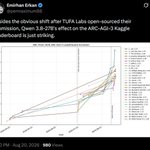
The Grand Prize bonus threshold (85%) just got hit on Kaggle! This year will be the final year for ARC-AGI-2 on Kaggle and I'm excited we'll get a great open source, cheap, and offline reproducible solution + model as it's final swan song
New ARC Prize 2026 - ARC-AGI-2 High Score
88.06% by @tufalabs
The $150K Bonus Prize, on top of the guaranteed prizes, will be split among all teams scoring over 85%

Mike Knoop retweeted

We're clearly moving to a pareto front of "strenght of result" vs. "understandability" and as long as you are on that pareto front, you are all good.


Humanity now has a clear recipe for using AI to automate conceptual search, transformation, and verification towards new science.
Every scientist who has ever lived has been bottlenecked by the same constraint -- a finite ability to absorb, transform, and search humanity's accumulated knowledge.
AI can now tell us if an important open problem requires new ideas. Or wether the answer is latent in what we already know.
I argue this is the most significant change in the philosophy of science since the invention of writing ~6,000 years ago.
Mike Knoop retweeted

We are entering a new era of discovery now:
openai.com/index/sharing-ai-…
