

Insights for your work from MIT experts
Cambridge, MA
Joined September 2007
- Tweets36.7K
- Following1.1K
- Followers308K
- Likes2.9K




Ferrari expects EVs to make up 20% of its lineup by 2030, with the remaining 80% split between hybrids and internal combustion engines. mitsloan.mit.edu/ideas-made-…

Before asking AI to gather copious information and then asking questions, do the cognitive work of identifying the questions you need to answer, and then use AI to help get the answers quickly. mitsloan.mit.edu/ideas-made-…+

MIT Sloan School of Management retweeted

Systems thinking at MIT Sloan had a huge impact on Priya Bhasin, MBA ’23.
Listen to the full podcast episode at bit.ly/47WVURS
Given the up-front cost of training models, AI’s advantage is best realized when production occurs at a large scale. As a result, bigger enterprises are far more likely to be early adopters than smaller companies with fewer resources. mitsloan.mit.edu/ideas-made-…

Humans tend to conduct work sequentially, one task at a time. Agentic AI requires a shift to working in parallel — managing agents that can perform many tasks at the same time. mitsloan.mit.edu/ideas-made-…

Companies building and marketing digital advisers can win users’ trust by positioning AI as a safe, judgment-free tool. mitsloan.mit.edu/ideas-made-…

Artificial intelligence is fueling innovation across industries, but it’s also introducing unanticipated risks and consequences for organizations. In this landscape, traditional enterprise risk management frameworks are no longer sufficient. mitsloan.mit.edu/ideas-made-…

“Two-sided markets, network effects, and governance — none of these things are particularly new, but there are things happening to make the platforms of today both more interesting and more complex.” — @pierre_azoulay mitsloan.mit.edu/ideas-made-…

In his new book, MIT Sloan professor Eric So examines the ways artificial intelligence is reshaping human cognition and offers advice on protecting your uniquely human skills while using AI. mitsloan.mit.edu/ideas-made-…

As more organizations begin implementing agentic AI at scale, the way we manage employees will need to change. During a recent MIT Sloan alumni event, MIT Sloan School of Management professor Katherine Kellogg described a world in which we might be managing AI agents more than we manage people.
Learn more: bit.ly/4iMYznq

ALT Photo of MIT Sloan School of Management professor Katherine Kellogg with quote: "I don't want to get too futuristic on you, but you will become managers of agents, not people."
Many of the past decade’s great business ventures were platform plays. As entrepreneurs and businesses consider this strategy for their next endeavor, they need to understand the platform’s role and how AI agents might shake up this field. @pierre_azoulay @johnjhorton mitsloan.mit.edu/ideas-made-…
Researchers at the MIT Sloan School of Management identified four domains that warrant guardrails: architecture compliance, innovation management, workforce enablement, and supplier governance. mitsloan.mit.edu/ideas-made-…

For most use cases, AI models aren’t plug-and-play. They require a great deal of customization for an individual company. mitsloan.mit.edu/ideas-made-…
Leading agentic AI transformations requires deep understanding of the technology. Having the right mental model of how AI works under the hood helps leaders move beyond automation to reimagining their business. mitsloan.mit.edu/ideas-made-…
Course offerings like AI-Augmented Work, Economics of Ideas and Entrepreneurship, and Leading Agentic AI Transformation in Organizations anticipate businesses’ future needs. mitsloan.mit.edu/ideas-made-…

Researchers from the MIT Sloan School of Management argue that as AI tools become more widely available, competitive advantage will depend on the trust, data, expertise, operating capabilities, and work redesign that companies build around them. mitsloan.mit.edu/ideas-made-…

Artificial intelligence will transform more jobs than it eliminates outright. The biggest productivity gains will come not from incorporating AI into existing workflows but from redesigning those workflows entirely. mitsloan.mit.edu/ideas-made-…

Organizations are under pressure to innovate amid changing customer demands and continuously fluctuating markets. Artificial intelligence can help — serving as a catalyst for changing work patterns and enhancing innovation and creativity processes. mitsloan.mit.edu/ideas-made-…

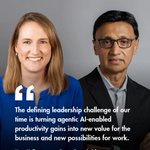
In a recent article, MIT Sloan’s Katherine Kellogg and Rama Ramakrishnan examine what it takes to redesign workflows, prepare employees for evolving roles, and turn AI-enabled productivity into sustainable business growth in the age of agentic AI.
Learn more: bit.ly/3WEjjF0

ALT Photos of MIT Sloan School of Management professor Katherine Kellogg and professor of the practice Rama Ramakrishnan with quote: “The defining leadership challenge of our time is turning agentic AI-enabled productivity gains into new value for the business and new possibilities for work.”
In his new book, “Boundaries of Tolerance,” MIT Sloan’s Jeffrey Saviano says that AI’s novel risks and “ethical infirmities” have made governance and strategy a leadership necessity. mitsloan.mit.edu/ideas-made-…