
The Official *NASA* Webb X account. The world's most powerful space telescope. Launched: Dec. 25, 2021. First images revealed: July 12, 2022.
- Tweets11.6K
- Following63
- Followers3.5M
- Likes4.5K
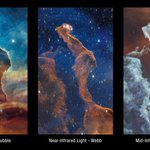






ALT Mid-infrared image of the Cat’s Head Nebula by Webb. A bluish-gray filament of dust is in the center, stretching from the bottom to almost the very top. It has a narrow, irregular shape that resembles a cat sitting with its back toward the viewer and a tail extending downward. The cat’s head is turned toward the right, revealing a white glowing eye. (middle) Near-infrared also by Webb. An orange-brown filament of dust is in the center, stretching from the bottom to almost the very top. On the cat’s left are ghostly filaments of dust. (center) Visible-light image by Hubble. A dark brown, opaque filament of dust is in the center, stretching from the bottom to almost the very top. Approximately halfway down, cutting diagonally across the frame, the background color changes from blue to yellow, orange, and finally red near the bottom.


ALT Image description: A quote by Captain Jean-Luc Picard, played by Patrick Stewart. "I've come to believe that the stars have always been in my favor." - Jean-Luc Picard. The image shows a dense cluster of bright stars, each with six large and two small diffraction spikes, due to the telescope’s optics. They have a variety of sizes depending on their brightness and distance from us in the cluster, and different colors reflecting different types of star. Patches of billowing red gas can be seen in and around the cluster, lit up by the stars. Small stars in the cluster blend into a background of distant stars and galaxies on black.


ALT This is a composite image of a small portion of the Carina Nebula reveals a striking golden-orange cloud of gas and dust that loosely resembles a ghostly figure. Its glowing hooded head and a sweeping cape-like tail stretch through a star-filled background of rich blues, reds, and greens. Brilliant blue-white stars sparkle in the scene, while bright pink dots of X-ray light reveal young stars scattered across this eerie stellar nursery.

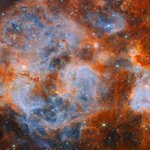
ALT A nebula made of clouds of gas and dust with stars forming within. In the center and out to the left it is filled with thin, wispy blue gas that forms delicate layers. Around this are thicker orange clouds with dark ridges. Thin red filaments of gas cross the center of the nebula. Glowing bubbles in the gas contain dense, very bright clusters of stars. In the edges, distant stars are visible as bright points on a dark background.
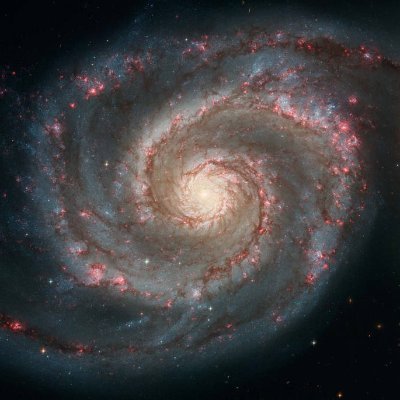

ALT On an abstract purple space-inspired background, illustrations of 11 space telescopes form the shape of a heart around another. Each telescope is shaded in a monochrome blue palette, and they have a variety of different shapes and features. These spacecraft are not depicted to scale. Credit: NASA

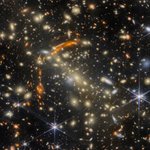
ALT A field full of small galaxies of all shapes against the blackness of space. A few bright white stars show 8 prominent diffraction spikes. A small galaxy at lower right is highlighted with a white box. A shaded triangle extends upward to the corners of a larger box showing a zoom in of the region. Two fuzzy, light blue blobs are at center, with a larger and brighter one at top. Just above the top blob is a white crosshair showing the location where a fast radio burst was detected.


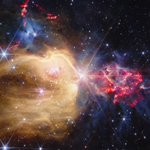
ALT A young star cluster filled with many stars that display Webb’s unique eight-pronged diffraction pattern. At its center is a yellow star which sports the largest diffraction pattern. To the left of the star, there is a region filled with yellow dust and gas that extends from the star to the left border of the image. This yellow region extends from the bottom, covering about two-thirds of the image. The yellow region has several blue stars of different sizes embedded within. The top third, which lies outside of the yellow region, holds a few bright protostars, within dense gray gas. Those stars illuminate the gas, making it appear blue. A few red outflows from other protostars are visible above this grayish-blue region. To the right of the central star, there is a clumpy, flame-like plume of red dust and gas with protostars that emit a soft white light within. The plume is surrounded by more dense gray gas and dust. Image credit: NASA, ESA, CSA, STScI, Processing: Alyssa Pagan.
ALT A young star cluster filled with many stars that display Webb’s unique eight-pronged diffraction pattern. At its center is a yellow star which sports the largest diffraction pattern. To the left of the star, there is a region filled with yellow dust and gas that extends from the star to the left border of the image. This yellow region extends from the bottom, covering about two-thirds of the image. The yellow region has several blue stars of different sizes embedded within. The top third, which lies outside of the yellow region, holds a few bright protostars, within dense gray gas. Those stars illuminate the gas, making it appear blue. A few red outflows from other protostars are visible above this grayish-blue region. To the right of the central star, there is a clumpy, flame-like plume of red dust and gas with protostars that emit a soft white light within. The plume is surrounded by more dense gray gas and dust. Image credit: NASA, ESA, CSA, STScI, Processing: Alyssa Pagan.

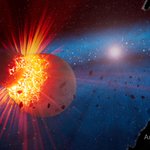
ALT Artist’s concept of a star and its debris disk against the black background of space. The star is in the background, right of center, and depicted as a small, luminous sphere. The debris disk is a large blue ring that encircles the star. The debris disk is angled toward the viewer, so that the portion nearest to the viewer extends beyond the bottom frame of the illustration. Many dark, rocky fragments are scattered throughout the debris disk. In the foreground, toward the left, is a small planetary embryo colliding into the left side of a larger spherical object. The impact site glows bright yellow and orange and has a mottled appearance, as though chunks of both colliding bodies are breaking up and being destroyed. Orange-yellow streams of vapor extend outward from the collision area. Behind the debris disk and its star are many small stars in the background. A label in the bottom right corner reads “Artist’s Concept.”

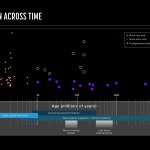
ALT Extreme Debris Disks, Composition Across Time plot and corresponding timeline of the solar system. The plot’s y-axis is labeled Silica with an up arrow labeled rich and a down arrow labeled poor. X-axis is labeled Age (millions of years) and starts with 1 at the left and increases by factors of ten, ending with 1000 at right. A key at right has 3 symbols: black dot is Silica-rich disk, purple is Silica-poor disk, and orange is Protoplanetary disk. All 27 orange dots are within the first 10 million years and range in silica composition. The 8 black and 13 purple dots begin to appear around 10 million. The black dots stop around 100 million. The purple dots continue right. The timeline below has the same labels as the plot’s x-axis. A gray band before 100 marks the Moon-forming impact. A gray band before 1000 marks the Late heavy bombardment. 3 blue bands stretch from left to right: Giant planet formation, Terrestrial planet formation, and Giant planet migration/orbital instability.