

Web3 launchpad for builders
Joined June 2024
- Tweets685
- Following3.1K
- Followers9.3K
- Likes4.4K


Openhelix retweeted

you ever have a project idea and then get stuck because launching a token feels like needing a whole developer team?
I tried openhelix and it was actually simple
I decided to cook this motion graphics as a guide for launching token on @Openhelixx
-open the site and pick your chain (start on testnet so you don’t risk real money)
-connect MetaMask or Phantom
-type your token name, symbol, and supply
-click create and confirm in your wallet
that’s it, your token is live.
no coding, no jumping between 5 different tools.
If you’ve been sitting on an idea and………..
Openhelix retweeted

The fastest way to kill a project after launch? A bad vesting schedule.
We’ve all seen this play out.
Token goes live, hype builds, people start buying, then team and advisor tokens unlock and the sell pressure kicks in.
Before you know it, the chart is bleeding and the community is losing confidence.
This is why tokenomics can’t be an afterthought.
Team members, seed investors and advisors all need clear allocation and vesting schedules. Not just promises on a spreadsheet.
But setting up customizable, multi-tier vesting has traditionally meant hiring developers or relying on third-party protocols.
@Openhelixx is making that easier by bringing automated tokenomics and transparent on-chain vesting into the same ecosystem.
Hard-coded release schedules. Transparent lockup timelines. Automated token distribution.
So investors can see when tokens unlock, and teams don’t have to manually manage every release.
A token launch is exciting, but what happens after launch matters just as much.
Your tokenomics can make a big difference.


if you’ve ever tried launching a crypto project, you know things can get complicated real quick.
first, you need a tool to create your token.
then you’re off to a DEX to create a liquidity pool, a third-party locker to lock LP, another protocol to set up team vesting, and spreadsheets to track everything else.
before you know it, you’re juggling five different dApps just to keep your project running smoothly.
and when your entire operation is scattered across different platforms, keeping track of everything becomes another challenge.
this is where @Openhelixx comes in.
instead of duct-taping different protocols together, OpenHelix aims to bring the stack into one connected ecosystem, covering token creation, liquidity, vesting, treasury management, and more.
one dashboard. one connected workflow. less time jumping between dApps.
because launching a crypto project shouldn’t feel like managing five different protocols at once.
you should be spending that time building.

🤝 Exciting to see OpenHelix connecting with innovative projects like
AI and Web3 have enormous potential when they work together. YUMO is exploring how everyday interactions can become AI-readable behavior, while OpenHelix is focused on giving builders the infrastructure to launch and grow.
Community participation is an important part of both worlds. @YumoAI_official
Looking forward to what this collaboration brings. 🐧💙
#OpenHelix #YUMO #AI #Web3


🤝 YUMO × OpenHelix
We're partnering with @Openhelixx, a modular Web3 launch platform.
YUMO turns everyday interactions into AI-readable behavior. OpenHelix helps builders launch and grow.
Together, we're exploring new paths for community participation.
#YUMO #Web3 #AI

Openhelix retweeted
🤝 Another step toward a more connected Web3 ecosystem.
The partnership between @nexonmarkets and @Openhelixx brings together AI native PayFi and modular Web3 infrastructure, with a shared vision of connecting digital assets to real world utility. 🚀
From payments and transparent settlement to token creation and ecosystem management, practical infrastructure is what helps Web3 move forward.
Excited to see what this collaboration can unlock. 🌐💙
#OpenHelix #NEXON #Web3 #PayFi


🤝 NEXON × OpenHelix
We’re excited to announce our partnership with @Openhelixx, bringing together AI-native PayFi and modular Web3 infrastructure to support a more connected and efficient digital-asset ecosystem. 🚀
🟢 NEXON is an AI-native PayFi ecosystem connecting capital, digital assets, payments, and real-world consumption through one trusted value chain, with transparent and auditable settlement.
🔗 OpenHelix is a modular Web3 launch platform built to help projects grow more efficiently. Its Token Studio is live, while Governance, Treasury, and Analytics modules are under development. With a focus on transparency, security, and non-custodial infrastructure, OpenHelix aims to simplify Web3 project management.
Together, NEXON and OpenHelix share a vision of making digital assets more accessible, useful, and connected through practical Web3 infrastructure and real-world financial applications.
From digital assets to real-world utility. From infrastructure to innovation. Building the future of Web3 together. 🌐⚡
🔗 NEXON: nexon.markets/
🌐 OpenHelix: opnhelix.xyz

Openhelix retweeted

You can see a token on a block explorer, check its supply, look at its holders and even track its transactions.
But have you ever checked whether the smart contract behind that token is actually readable?
This is where contract verification becomes important.
When a developer deploys a smart contract, the blockchain stores its bytecode the compiled instructions that the network executes.
The original source code, however, is what developers write and use to build that contract.
Verifying a contract means publishing the corresponding source code and compiler details so that a block explorer can check whether they match the code deployed on-chain.
Why does this matter?
Because it gives users and developers a way to inspect what a contract is designed to do instead of staring at unreadable bytecode.
They can examine its functions, understand its structure and investigate how certain operations are implemented.
This doesn’t automatically mean the contract is safe or audited. Verification makes the code more accessible for inspection; security still requires proper review.
And this is one of the features OpenHelix has listed as live.
@Openhelixx includes automatic source verification for EVM token deployments, publishing the contract source on the relevant block explorer.
It’s a useful detail because transparency shouldn’t end at showing people a token’s name, supply and transaction history.
The code governing that token deserves attention too.
A question worth asking whenever you encounter a new token:
Have you ever checked whether its smart contract is verified?
🤝 Paid partnership


One thing about launching a Web3 project is that creating the token is usually not the end of the work. In many cases, that’s where the real work begins.
This is one of the things @Openhelixx is focused on bringing the different parts of launching and managing a Web3 project together.
Let’s say you have an idea for a project and you’ve decided to build it on the blockchain.
You need a token, so you find a tool that lets you create one.
Token created
Good
But what happens next?
You need to figure out liquidity. Where will people trade the token? How will the initial liquidity be provided? What happens to the liquidity after the launch?
Then there’s the question of token distribution.
How much goes to the team? How much is reserved for the community? Will the team’s allocation be locked or can those tokens be moved immediately?
If you’re raising funds, you have another set of things to figure out. If you’re trying to make the project transparent, you’ll need ways to show people what’s happening with the tokens and the project’s resources.
Before you know it, you’re moving between different platforms, reading different documentation, and trying to make sure everything works together.
And this is where things get interesting.
The problem isn’t necessarily that these tools don’t exist. Many of them do.
The problem is that launching and managing a Web3 project can require you to piece together several different tools before you can properly get going.
For someone with a technical team, that might be manageable. For a founder working with limited resources, it can become another hurdle.
OpenHelix is building a platform that brings different parts of the Web3 launch process together, from token creation to liquidity-related tools, vesting, fundraising, and project management.
The idea is to make the process less fragmented instead of leaving founders to figure out every part separately.
Of course, bringing these tools under one platform doesn’t automatically make a project successful. Founders still need a useful product, a sensible plan, and people who actually want what they’re building.
But making the infrastructure easier to navigate is a worthwhile problem to work on.
There’s more to launching a Web3 project than deploying a token.
The token itself is only one part of the process. Liquidity, distribution, fundraising, and the tools used to manage everything afterward matter just as much.
OpenHelix is trying to bring these different pieces together so founders don’t have to rely on a collection of disconnected tools to get their projects off the ground.
The real question is how well it can bring that vision to life.

Openhelix retweeted

The partnership between @nexonmarkets and @Openhelixx brings together AI native PayFi and modular Web3 infrastructure, with a shared vision of connecting digital assets to real world utility.
From payments and transparent settlement to token creation and ecosystem management

Openhelix retweeted

Yesterday I did an introduction about @Openhelixx, what they're building and what their ecosystem is about, but the definition or their aims isn't what make them outstanding, am more interested in their tools and I have been making researches about them which I will be disclosing...
Usually, the first step of launching a Web3 project is the hardest. You either have to pay a developer thousands of dollars just to write your token contract, or you try to code it yourself and pray there isn't a hidden vulnerability.
Let's imagine you want to start a simple online newsletter, but you're told you have to build the entire website, server, and content management system from scratch before you can write a single word. That is exactly the technical barrier Web3 founders face today, and it is exhausting.
This is exactly what @Openhelixx is solving with their ZERO _DEV TOKEN STUDIO on BNB Chain and Base...
You don't need to know how to code, you don't need to hunt for an expensive blockchain developer, and you don't need to spend weeks stressing over smart contract architecture. From a user’s perspective, the entire experience is completely frictionless. You simply open the OpenHelix dashboard, enter your token's name, choose your ticker, set your supply rules, and click a button.
In just a few minutes, you have a production-grade, secure smart contract. It is deployment-ready, and the ownership is 100% yours.
This isn't just about saving money on developer fees; it is about momentum. When you aren't stuck for three weeks fighting with Solidity code and deployment errors, you can spend that energy on what actually keeps a decentralized business alive: building your community and refining your actual product. OpenHelix gives you the finished system so you can just focus on building the business.
But creating the token is only half the battle on Day 1. If investors look at your new contract on the blockchain and see messy, unverified code, they will run away instantly.
Token creation and contract verification are already live, with more tools still in progress, which I will be disclosing more about.
This does not mean there's no risk attached, and always do your own research before deciding if you want to participate...


Openhelix retweeted
if you’ve ever tried launching a crypto project, you know things can get complicated real quick.
first, you need a tool to create your token.
then you’re off to a DEX to create a liquidity pool, a third-party locker to lock LP, another protocol to set up team vesting, and spreadsheets to track everything else.
before you know it, you’re juggling five different dApps just to keep your project running smoothly.
and when your entire operation is scattered across different platforms, keeping track of everything becomes another challenge.
this is where @Openhelixx comes in.
instead of duct-taping different protocols together, OpenHelix aims to bring the stack into one connected ecosystem, covering token creation, liquidity, vesting, treasury management, and more.
one dashboard. one connected workflow. less time jumping between dApps.
because launching a crypto project shouldn’t feel like managing five different protocols at once.
you should be spending that time building.
so you’ve launched a token. what happens after the hype?
launching a token is one thing. building an entire crypto project around it is another.
because there’s more to think about than just the token itself.
how will the project manage its funds? how will the community have a say in decisions? how will the team track what’s happening across the ecosystem?
these are the things that matter when you’re thinking beyond the launch.
and that’s what caught my attention about @Openhelixx
instead of focusing on token creation alone, OpenHelix brings Token Studio, Governance, Treasury, and Analytics into one connected ecosystem.
basically, the idea is to give builders tools to handle more than just launching a token.
because in crypto, launching is only the beginning.
figuring out how to manage everything that follows? that’s a whole different conversation.

🤝 Another step toward a more connected Web3 ecosystem.
The partnership between @nexonmarkets and @Openhelixx brings together AI native PayFi and modular Web3 infrastructure, with a shared vision of connecting digital assets to real world utility. 🚀
From payments and transparent settlement to token creation and ecosystem management, practical infrastructure is what helps Web3 move forward.
Excited to see what this collaboration can unlock. 🌐💙
#OpenHelix #NEXON #Web3 #PayFi
🤝 NEXON × OpenHelix
We’re excited to announce our partnership with @Openhelixx, bringing together AI-native PayFi and modular Web3 infrastructure to support a more connected and efficient digital-asset ecosystem. 🚀
🟢 NEXON is an AI-native PayFi ecosystem connecting capital, digital assets, payments, and real-world consumption through one trusted value chain, with transparent and auditable settlement.
🔗 OpenHelix is a modular Web3 launch platform built to help projects grow more efficiently. Its Token Studio is live, while Governance, Treasury, and Analytics modules are under development. With a focus on transparency, security, and non-custodial infrastructure, OpenHelix aims to simplify Web3 project management.
Together, NEXON and OpenHelix share a vision of making digital assets more accessible, useful, and connected through practical Web3 infrastructure and real-world financial applications.
From digital assets to real-world utility. From infrastructure to innovation. Building the future of Web3 together. 🌐⚡
🔗 NEXON: nexon.markets/
🌐 OpenHelix: opnhelix.xyz

Openhelix retweeted

one thing about web3 is that having an idea is the easy part.
actually bringing it to life? that’s where things get complicated.
you need to deploy a token, figure out liquidity, sort out vesting, build a website, work on your tokenomics and somehow make people trust what you’re building.
and that’s before you even start growing a community.
this is one of the things OpenHelix (@Openhelixx) is trying to change.
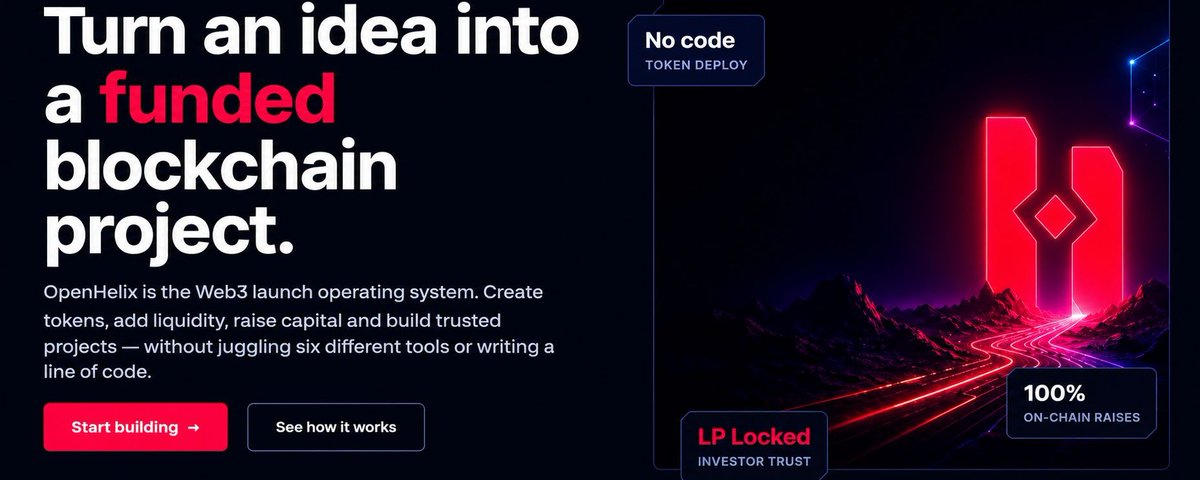
they’re building a web3 launch OS that brings the tools needed to create and grow a project into one place, without making you jump between different platforms or write code yourself.
from token creation and contract verification to liquidity, fundraising and launch content, the idea is to make the entire process less of a headache.
what i find interesting is the focus on transparency too.
because in web3, launching a token is one thing. giving people reasons to trust the project behind it is another.
OpenHelix is building towards a setup where things like token locks, vesting and treasury activity can be verified on-chain.
some of these features are still in development, with security audits planned before the full mainnet rollout, so there’s still more to come.
but the bigger picture makes sense.
we need more tools that make building easier, not more complicated.
less time figuring out the infrastructure.
more time building the actual product and community.
that’s the kind of direction i like to see in web3.
building should be the focus.


a lot of people in web3 have ideas.
new tokens, communities, games, tools, or just something they want to experiment with.
but having an idea and actually bringing it to life are two different things.
between finding developers, juggling different platforms, setting up liquidity, and making everything transparent, the process can get overwhelming before the project even takes off.
this is where OpenHelix (@Openhelixx) comes in.
it’s building a no-code web3 launch OS designed to make the whole process simpler, bringing the essential tools builders need into one dashboard.
with OpenHelix, you can:
↝ deploy tokens across chains like BNB Chain, Ethereum, Base & Solana
↝ add liquidity to make tokens tradable
↝ lock tokens and liquidity for better transparency
↝ set up vesting for gradual token releases
↝ verify smart contracts so people can inspect them
the goal is simple: make launching in web3 less complicated.
not everyone building something meaningful should have to understand smart contracts or jump between multiple platforms just to get started.
and while some features are still being developed, the direction OpenHelix is taking is worth paying attention to.
because web3 needs more people building, experimenting, and bringing ideas to life.
less friction. more building.
that’s what OpenHelix is working towards.

Openhelix retweeted

Good morning, builders! ☀️
Tired of jumping between 5 different tools just to launch a token?
@Openhelixx brings everything into one clean no-code dashboard. Create your token, lock liquidity, set up vesting, raise funds, and manage the whole process without leaving the platform.
It’s live on BNB Chain and Solana (with more chains supported), and your wallet stays fully in control the entire time. No custody, no handing over keys — just a simpler way to go from idea to on-chain project.
Start building today → opnhelix.xyz
#OpenHelix #Web3 #NoCode #GM
🤖 Made with AI
Openhelix retweeted
One thing about launching a Web3 project is that creating the token is usually not the end of the work. In many cases, that’s where the real work begins.
This is one of the things @Openhelixx is focused on bringing the different parts of launching and managing a Web3 project together.
Let’s say you have an idea for a project and you’ve decided to build it on the blockchain.
You need a token, so you find a tool that lets you create one.
Token created
Good
But what happens next?
You need to figure out liquidity. Where will people trade the token? How will the initial liquidity be provided? What happens to the liquidity after the launch?
Then there’s the question of token distribution.
How much goes to the team? How much is reserved for the community? Will the team’s allocation be locked or can those tokens be moved immediately?
If you’re raising funds, you have another set of things to figure out. If you’re trying to make the project transparent, you’ll need ways to show people what’s happening with the tokens and the project’s resources.
Before you know it, you’re moving between different platforms, reading different documentation, and trying to make sure everything works together.
And this is where things get interesting.
The problem isn’t necessarily that these tools don’t exist. Many of them do.
The problem is that launching and managing a Web3 project can require you to piece together several different tools before you can properly get going.
For someone with a technical team, that might be manageable. For a founder working with limited resources, it can become another hurdle.
OpenHelix is building a platform that brings different parts of the Web3 launch process together, from token creation to liquidity-related tools, vesting, fundraising, and project management.
The idea is to make the process less fragmented instead of leaving founders to figure out every part separately.
Of course, bringing these tools under one platform doesn’t automatically make a project successful. Founders still need a useful product, a sensible plan, and people who actually want what they’re building.
But making the infrastructure easier to navigate is a worthwhile problem to work on.
There’s more to launching a Web3 project than deploying a token.
The token itself is only one part of the process. Liquidity, distribution, fundraising, and the tools used to manage everything afterward matter just as much.
OpenHelix is trying to bring these different pieces together so founders don’t have to rely on a collection of disconnected tools to get their projects off the ground.
The real question is how well it can bring that vision to life.
🤝 Paid partnership
Openhelix retweeted
GM CT 🧘 🥂
I’ve been looking at Motes, OpenHelix, and Rarelist, and one thing that stands out to me is how each project approaches community participation. They’re not just asking people to show up and contribute; they’re building token incentives around it.
Let’s look at them individually. 👇
Motes (@meetmotes ) takes a different approach. It’s an NFT that unlocks an AI agent for DeFi on Robinhood Chain. There’s also a token on the way, with 10% of the supply allocated to holders. It sounds promising, but since things are still early, I’m keeping an eye on how the plans actually unfold.
Rarelist (@rarelistio ) is particularly interesting to me as a creator. You create content, complete tasks, earn RARS, and eventually convert that into $RARE. With a $50K Season 1 reward pool, there’s already an incentive for creators to participate rather than simply wait for future promises.
OpenHelix (@Openhelixx ) is playing a different role. Instead of focusing on everyday users, it gives builders the tools to launch tokens, manage vesting, establish governance, and handle treasury operations. What interests me most is how this infrastructure could help other projects build and manage their own token-based ecosystems.
Looking at all three, I see a common idea, but with different approaches.
Motes rewards holders. Rarelist gives creators a reason to contribute. OpenHelix equips builders with the tools to create these kinds of ecosystems in the first place.
My takeaway? Token incentives can be a powerful way to attract participation, but long-term success will depend on whether these projects deliver real value beyond the rewards.
Different projects, different strategies, but an interesting shared vision.
🤖 Made with AI
Openhelix retweeted

𝐈𝐭’𝐬 𝐎𝐩𝐞𝐧𝐡𝐞𝐥𝐢𝐱 𝐭𝐢𝐦𝐞
𝐇𝐨𝐰 𝐰𝐞 𝐲𝐨𝐮 𝐟𝐞𝐞𝐥 𝐢𝐟 𝐲𝐨𝐮 𝐜𝐚𝐧 𝐜𝐫𝐞𝐚𝐭𝐞 :
𝐃𝐞𝐬𝐢𝐠𝐧
𝐃𝐞𝐩𝐥𝐨𝐲
𝐅𝐮𝐧𝐝
𝐀𝐧𝐝 𝐞𝐯𝐞𝐧 𝐠𝐫𝐨𝐰 𝐲𝐨𝐮𝐫 𝐨𝐰𝐧 𝐭𝐨𝐤𝐞𝐧
That’s why @Openhelixx is here for you.
Read ⬇️⬇️

Openhelix retweeted

@Openhelixx has me thinking about something we don't talk about enough in Web3........what happens to a project's money after fundraising?
Getting people to support your project is one thing, but managing the funds afterwards is another story entirely

Openhelix retweeted
How I Created My First Token Using the OpenHelix Ecosystem
Creating a token in Web3 may sound complicated, especially if you don't know how to code. But with @Openhelixx I explored a simpler way to get started.
Here’s how I created my first token using OpenHelix Token Studio.
Step 1: Connect Your Wallet
I started by connecting my crypto wallet to the OpenHelix ecosystem. This allowed me to access the platform and proceed with token creation.
Step 2: Open Studio
After connecting my wallet, I navigated to Studio, where I could begin setting up my token.
Step 3: Select a Network
Next, I selected the blockchain network I wanted to use. For my first token, I chose BNB Chain.
Choosing the right network is important because it determines where your token will be deployed.
Step 4: Enter Your Token Details
Before deploying, I reviewed the key details of my token:
Token Name: The name of your token.
Symbol: The short ticker used to identify your token.
Total Supply: The total number of tokens you want to create.
Network: The blockchain where your token will be deployed.
Taking time to check these details helps reduce mistakes before deployment.
Step 5: Review and Deploy
After confirming my token details and selected network, I reviewed the transaction and gas fee before confirming the deployment through my wallet.
Final Thoughts
Creating my first token helped me understand that exploring Web3 development doesn't always require writing code from scratch.
With tools like OpenHelix Token Studio, beginners can explore token creation through a more accessible process.
My biggest takeaway: Always double-check your token details, choose the right network, and understand the transaction before deploying.
Want to explore it yourself and create your own token?
Get started with OpenHelix: openhelix.xyz/
Explore the ecosystem and take your first step into no-code Web3 building.
$INSO #Blockchain
Openhelix retweeted
a lot of people in web3 have ideas.
new tokens, communities, games, tools, or just something they want to experiment with.
but having an idea and actually bringing it to life are two different things.
between finding developers, juggling different platforms, setting up liquidity, and making everything transparent, the process can get overwhelming before the project even takes off.
this is where OpenHelix (@Openhelixx) comes in.
it’s building a no-code web3 launch OS designed to make the whole process simpler, bringing the essential tools builders need into one dashboard.
with OpenHelix, you can:
↝ deploy tokens across chains like BNB Chain, Ethereum, Base & Solana
↝ add liquidity to make tokens tradable
↝ lock tokens and liquidity for better transparency
↝ set up vesting for gradual token releases
↝ verify smart contracts so people can inspect them
the goal is simple: make launching in web3 less complicated.
not everyone building something meaningful should have to understand smart contracts or jump between multiple platforms just to get started.
and while some features are still being developed, the direction OpenHelix is taking is worth paying attention to.
because web3 needs more people building, experimenting, and bringing ideas to life.
less friction. more building.
that’s what OpenHelix is working towards.
openhelix is making it easier to bring web3 ideas to life.
one thing about crypto is that people have ideas. new tokens, communities, games, and tools they want to build.
but turning those ideas into something real? that’s where things get complicated.
you need developers, different platforms for different tasks, and ways to prove to people that your project is worth trusting.
openhelix wants to change that.
it’s a no-code web3 launch os that brings the essential tools for launching and managing a project into one place.
with openhelix, you can:
↝ deploy tokens across chains like bnb chain, ethereum, base, and solana
↝ add liquidity and make your token tradable
↝ lock tokens and liquidity to build transparency
↝ set up vesting schedules for gradual token releases
↝ verify smart contracts so anyone can inspect them
the idea is simple: you shouldn’t need to be a developer or juggle multiple platforms just to get your project off the ground.
@Openhelixx handles the technical side of launching, giving builders more room to focus on what really matters — the idea, the product, and the community behind it.
some advanced features are still in development, but the bigger picture is clear.
less technical friction. more room to build.
that’s what web3 needs, and that’s what openhelix is working towards.

Openhelix retweeted
so you’ve launched a token. what happens after the hype?
launching a token is one thing. building an entire crypto project around it is another.
because there’s more to think about than just the token itself.
how will the project manage its funds? how will the community have a say in decisions? how will the team track what’s happening across the ecosystem?
these are the things that matter when you’re thinking beyond the launch.
and that’s what caught my attention about @Openhelixx
instead of focusing on token creation alone, OpenHelix brings Token Studio, Governance, Treasury, and Analytics into one connected ecosystem.
basically, the idea is to give builders tools to handle more than just launching a token.
because in crypto, launching is only the beginning.
figuring out how to manage everything that follows? that’s a whole different conversation.
This @Openhelixx series is more than just learning about another web3 platform.
i’m actually exploring what goes into launching a token and how OpenHelix approaches the process.
➝ from understanding token details to exploring Token Studio
➝ seeing how the different pieces fit together instead of just reading about them
i learn better when i can actually see things in action, so i’m documenting the process as i go.
i broke it down in this video 👇
come explore @Openhelixx with me.