

Let’s skip witty banter & talk deep Qs. Books: https://nitter.cf/t.co/hpZgEm5DBI https://nitter.cf/t.co/iFs9C3J2Ek Advisor @_futarchy @MetaDAOProject @butterygg
Fairfax, VA
Joined July 2007
- Tweets73.5K
- Following792
- Followers128K
- Likes106K






The US is in deep trouble if we ever have a big extended downturn. Other nations are more used to resilience in defeat, while we tend to fall apart and quit.

"Among prisoner of war communities, the prisoners who behave worst are Americans." Kurt Vonnegut, 1970. #DeadWrongHistory


Robin Hanson retweeted

Very important point. Cf the bias towards longer intellectual output.
Most readers get sidetracked and spend too little effort on scrutinising the central argumentative moves.
This was a motive behind my work on argument-checking.


While intellectuals mostly get prestige for the impressive details of their work, simple abstract arguments influence their opinions more than they admit. But such abstract effort is neglected, as better versions don't look much more impressive.
overcomingbias.com/p/prestig…

While intellectuals mostly get prestige for the impressive details of their work, simple abstract arguments influence their opinions more than they admit. But such abstract effort is neglected, as better versions don't look much more impressive.
overcomingbias.com/p/prestig…
"they exercise skepticism in a motivated way, that is, in a way that depends on the desirability of the conclusions that skeptical inferences lead to" d.repec.org/n?u=RePEc:hal:jo…
Robin Hanson retweeted

AI researcher @herbiebradley explains why automating most AI research might still not trigger an intelligence explosion:
"I have always viewed the very fast takeoff scenarios as a small probability piece of the possibility space."
"The evidence that we have so far on self-sustaining RSI happening very, very soon, and especially leading to very fast increases in capability, is quite limited, compared to the alternative hypothesis of, oh, we're going to automate most of AI R&D, and capability going further than that becomes more limited by diffusion, limited by other bottlenecks."
"We can't really tell which of these worlds we're in, but I do think people should have a lot of weight on nothing-ever-happens style priors, or priors about things being limited by data or limited by diffusion."
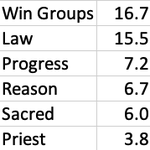
"we found small to moderate positive associations between religiosity and compassionate responding, which were statistically accounted for by perceived psychological closeness to suffering targets" psycnet.apa.org/record/2028-…

"when facing decisions involve edge cases in which sacred boundaries are ambiguous, sacralizers are responsive to consensus information" psycnet.apa.org/record/2028-…
As once different cultures merge, I think what people want in the other gender changes faster than the matching desired styles n behaviors. Lacking many unhappy with local mating options.
Median ~0.7% chance aliens visiting Earth would change how they treat us if our elites came to admit they here.
Assume some UFOs are aliens, visiting Earth for centuries; they have long had options to destroy, intervene w/, or show clearly to us, but don't do so. What is chance they'd change how they treat us if human elites came to widely admit that they are here?
53%<1%
16%1-5%
14%5-20%
16%>20%
395 votes • Final resultsMost deep disagreement seems to be due to people using different standard sets of abstractions and supporting tools. Polymaths who learn multiple such sets could thus help us to resolve such disagreements.
overcomingbias.com/p/could-p…

Some say is reasonable to fear social disruption from disclosure that some UAPs are aliens. This just seems wrong to me. Aliens could have done lots for many decades, but chose not to. Why would that change just because NYT or US govt declares them real?
overcomingbias.com/p/uap-dis…

Assume some UFOs are aliens, visiting Earth for centuries; they have long had options to destroy, intervene w/, or show clearly to us, but don't do so. What is chance they'd change how they treat us if human elites came to widely admit that they are here?
53%<1%
16%1-5%
14%5-20%
16%>20%
395 votes • Final results"how predictive algorithms have helped create what she calls a homogeneous 'monoculture' … uses … algorithms, digital mapping and text analysis to show how large language models are making consumer culture, wherever it happens to be, feel the same."
nytimes.com/2026/10/31/arts/…
