

The Rural Power Coalition is campaigning to ensure the future of rural electric co-ops is grounded in justice, democracy, and resilience.
Joined April 2021
- Tweets576
- Following275
- Followers391
- Likes199


Pinned Tweet
⚡Our new animated short, “Power to the People: The Story of Rural Electric Cooperatives,” illustrates how rural America can learn from the past and lead the clean energy transition to a greener, more equitable future. 💡#RuralPower
youtube.com/watch?v=10O2yaYk…

In mid-October, USDA changed the rules around how it implements the Rural Energy for America Program (REAP), which makes it significantly harder for REAP funds to be used by farmers for solar deployment.
1/3
ruralpower.us/news/protect-r…

This is the latest in the Trump Administration’s creation of obstacles for this program, after previously freezing REAP funds and cancelling an application period.
We understand that the latest change to the program will make the program less accessible.
2/3
Here, we have published the comment that we will be sending to the USDA.
If you would like to offer a comment of your own, you can do so by Monday, November 2. See the link in our post to submit your comment.
3/3
ruralpower.us/news/protect-r…
Important to keep an eye on large load transmission tariffs, like this one.
"The new provisions include a requirement that new or transferred large loads pay a “committed revenue contribution” equal to 75% of the megawatt value for..."
utilitydive.com/news/ferc-du…

Check out this exploration of how to co-locate solar generation with livestock from @AppVoices.
This piece gives voice to farmers and ranchers & gets into the nuances and possibilities of how to make #agrivoltaics work for all parties involved.
appvoices.org/2025/04/02/agr…

As electricity demands grow, why not invest in energy efficiency in homes and workplaces, instead of relying on old or expensive sources of generation? That's what our friends at @cleanenergywrks argue in @UtilityDive
utilitydive.com/news/virtuou…

In September, @EnviroProtNet (EPN) released a report titled The Hidden Health Costs of AI Data Centers.
So join us on Wednesday, Oct 14 for a presentation & discussion with Marc Boom of EPN on this report.
Register for the call here:
zoom.us/meeting/register/Uri…
In cases of extreme heat, shutoffs can be very dangerous for folks. This is why RPC supports programs the lower energy costs and policies that disallow utility disconnections, especially during very hot or very cold months.
theguardian.com/environment/…

Check out this article from @RockyMtnInst on the role electric co-ops play in wind & solar deployment.
Co-ops account for 15% of energy sales, but RMI finds that two out of every five projected wind & solar projects are in co-op service areas.
rmi.org/resources/rural-elec…

If you're opposing a data center, you don't want to miss Wednesday's call!
zoom.us/meeting/register/Gxg…

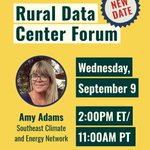
We had to cancel last month’s call with Amy Adams of @scennetwork1 but we are fortunate enough to have rescheduled this call!
Join us on Wed. September 9th for a presentation and discussion with Amy Adams, Deputy & Programs Director of SCEN.
Register:
zoom.us/meeting/register/Gxg…

We had to cancel last month’s call with Amy Adams of @scennetwork1 but we are fortunate enough to have rescheduled this call!
Join us on Wed. September 9th for a presentation and discussion with Amy Adams, Deputy & Programs Director of SCEN.
Register:
zoom.us/meeting/register/Gxg…
The current administration has repeatedly tried to defund LIHEAP and had previously laid off the staff at the Department of Health and Human Services (HHS) that administers this federal program.


LIHEAP provides states with block grants administered by local organizations, enabling households to afford for heating and cooling homes, preventing utility disconnections.


Energy shocks resulting from the U.S. war on Iran has caused Alaskan communities to turn to renewables, while state & federal decision makers double down on fossil fuels.
Read more in this deep dive in the Alaska Beacon:
alaskabeacon.com/2026/07/29/…

“What Alaskans need is solutions that are going to be fast and that are going to be efficient,” says Jennifer Hyde, federal engagement coordinator for @AKCenter “Alaska just has so much to offer in terms of free, unlimited renewable potential.”
Did you know that without our current efficiency standards, American households would have spent an addition $780 billion in costs over the past decade?
Lower #efficiency means less money in your bank account, not more.
ruralpower.us/news/beyond-th…
1/2


The Department of Energy (DOE) is considering ending efficiency requirements for household appliances. Read more on our blog, where we also link to giving feedback to DOE on this issue:
ruralpower.us/news/beyond-th…
2/2
