

Sainsbury Laboratory Cambridge University (SLCU) is a research institute of the @Cambridge_Uni dedicated to plant developmental biology.
- Tweets6.4K
- Following379
- Followers10.8K
- Likes3K

ALT Professor Jim Al-Khalili pictured with an hourglass and black background. Text overlay Christmas Lecture 2 - come and untangle the mysteries of time with Jim Al-Khalili and dates and time of event (also included in post caption). Supported by CGI

ALT Confocal microscopy image of a shoot apical meristem showing different hormones highlighted in yellow and blue. Text overlay: From 5pm, explore hands-on plant science activities. Led by scientists from the Sainsbury Laboratory, who investigate how plants grow, develop and respond to their environment.

ALT Morphographics time sequence images showing an Arabidopsis leaf over four time points in age with different coloured cells tracking the trajectory of specific cells. Text overlay: Event timings 5.00pm - 6.00pm Plant science activities in the atrium 6.00pm - 8.30pm Christmas Lecture livestream. Drinks and snacks available.

ALT Text: Where to watch other Christmas Lectures in Cambridge: Cavendish Laboratory, Lecture 1 on Tuesday 8 December 2026 with image of front of Cavendish Laboratory building. Cambridge Museum of Technology, Lectures 2 and 3 on Thursday 10 December 2026 and Saturday 12 December 2026. with image of large machine featured in museum


ALT Dr Heather McLaughlin (in the Sainsbury Laboratory Microscopy Facility) speaking to Carol Klein (in her North Devon garden). They are talking over a video call on laptops and both are holding a purple cabbage cut in half to reveal the location of meristems at the top of the cabbage and at the axil of every leaf.

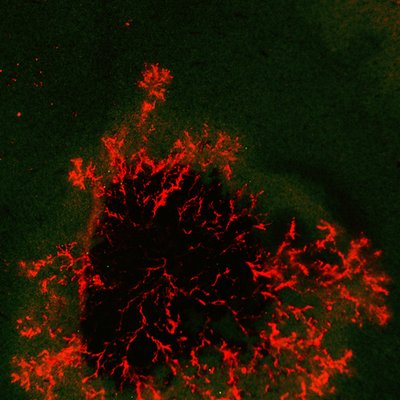
ALT Dissected Arabidopsis thaliana shoot apical meristem. Image by Heather McLaughlin.

ALT Scanning electron microscope image of Arabidopsis thaliana meristem. Image by Raymond Wightman.

ALT Arabidopsis thaliana meristem image under a microscope with colourful cell markers. Image by Heather McLaughlin.


ALT Schematic of the general mixed positive/negative feedback loop model. Here, a single component (σ) both activates and deactivates its own production. The activation depends on the presence of an input, and the deactivation is subject to a time delay. 10 line graphs showing Simulations for 10 different parameter sets, demonstrating the 10 different behaviours the model can achieve. Initially, the system remains inactive; upon triggering the input (marked by the red dashed lines), distinct behaviours emerge: a No activation. b Stochastic pulsing. c Oscillation. d Stochastic anti-pulsing. e Homogeneous activation. f Heterogeneous activation (three different simulations displayed). g Stochastic switching. h Stable bistability. This panel depicts two simulations. The first (dark blue) is initiated at the initial (inactive) state at the same time as the simulations in the other panels. The second (purple) is initiated at the time of the input (dashed red line) in the active state.


ALT Accessible Science at the Norwich Research Park event poster celebrating 10 years, showing the date Tuesday 17 November 2026, bold title, colorful science icons (DNA helix, flask, test tubes, microbe) and partner logos including UEA, Earlham Institute and Norwich Research Park.




ALT Regenerating Scots Pine in the Cairngorms. The team used a new method to visualise the data from laser scans made from a plane flown across a huge swathe of the Cairngorms National Park in Scotland. The resulting images show each tree - and its height - revealing millions of young trees and the beginnings of large-scale recovery of native woodland. Credit: Aland Chan / University of Cambridge.

ALT Group photo of attendees at #SLS26

ALT Ari Pekka Mähönen presenting at #SLS26


