

We provide you full access to the Halal Crypto & Stocks (US & HK only). Visit our website now. Click link below!
- Tweets800
- Following129
- Followers592
- Likes197


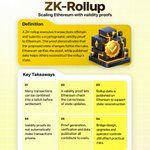


ALT SharLife infographic: ZK-Rollup. A ZK-rollup executes transactions offchain and submits a cryptographic validity proof to Ethereum. The proof demonstrates that the proposed state changes follow the rules. Ethereum verifies the proof, while published data helps others reconstruct the rollup's state. Key takeaways: Many transactions can be combined into a batch before settlement. A validity proof lets Ethereum check the correctness of state updates. Rollup data is published on Ethereum to support state reconstruction. Validity proofs do not automatically make transactions private. Proof generation, verification and data publication all contribute to costs. Bridge design, upgrades and operator controls still affect practical risks.

ALT SharLife infographic: Optimistic Rollup. An optimistic rollup is a Layer 2 system that executes transactions outside Ethereum's main execution layer and posts data to Ethereum. Proposed results are accepted unless successfully challenged within a defined period. Fraud proofs help detect incorrect state changes. Key takeaways: Transactions are processed in batches to reduce work on Ethereum. Transaction data is published so the rollup's state can be checked. Results are treated as valid unless challenged through the proof system. An honest challenger helps detect and contest invalid results. Standard withdrawals to Ethereum can require a challenge-period wait. Security also depends on the rollup's implementation and operating controls.

ALT SharLife infographic: Seed Phrase. A seed phrase is a sequence of words used to derive and recover a wallet's accounts. Anyone who obtains it can usually control the accounts derived from it. It is different from a public wallet address and must be kept private and protected. Key takeaways: Many wallets use a recovery phrase containing 12, 18 or 24 words. The words and their order are both important for recovery. A wallet password and a recovery phrase have different security roles. Never share a recovery phrase with support agents or through messages. Keep a secure backup; an exposed online copy can be stolen. Recovery methods vary by wallet. Understand your setup before you need it.

ALT SharLife infographic: Token Approval. A token approval gives a smart contract permission to spend a specified token from your wallet, up to an allowed amount. It is separate from simply connecting your wallet to an app. Understanding these permissions is an important part of managing a self-custodial wallet. Key takeaways: Approvals are commonly used when an app needs to move your tokens. Check the spender contract, token and spending limit before approving. Unlimited allowances can increase exposure if a spender is compromised. Disconnecting an app does not automatically revoke its token approvals. Unused allowances can be reviewed and revoked with a trusted tool. Revoking an onchain approval generally requires a transaction and gas.

ALT SharLife infographic: Blockchain Bridge. A blockchain bridge enables assets or messages to move between networks. Different bridges use different mechanisms, such as locking assets on one chain and issuing a corresponding representation on another. The security of a bridge depends on its contracts and trust assumptions. Key takeaways: Bridges help separate blockchain ecosystems exchange assets and data. Some designs lock assets and mint a corresponding token on another chain. Other designs use burning and minting or liquidity-based transfers. Bridge transactions can involve multiple fees and waiting periods. Smart contract flaws and compromised operators can put assets at risk. Verify the destination network, asset representation and bridge design.

ALT SharLife infographic: Blockchain Oracle. A blockchain oracle supplies external information to smart contracts. This lets applications use data such as market prices or weather observations that is not available directly onchain. An oracle's data sources and verification process are essential to its reliability. Key takeaways: Smart contracts cannot directly fetch arbitrary real-world information. Oracles can deliver external data that triggers a contract's programmed logic. Price feeds are one common use; other applications use event or sensor data. Oracle designs can depend on one provider or a distributed network. Incorrect, delayed or manipulated inputs can produce harmful outcomes. Reliable data sources, timely updates and robust validation all matter.

ALT SharLife infographic: Block Explorer. A block explorer is a search interface for public blockchain data. It helps users inspect transactions, blocks, addresses and smart contracts. On Ethereum, an explorer can show transaction status, fees and token transfers, making onchain activity easier to understand. Key takeaways: Search a transaction hash to inspect its recorded status and details. Check sender, recipient, token transfers and the network used. Gas used and transaction fees help explain the cost of an action. An address page can show balances and past onchain activity. Public blockchain records can expose activity linked to an address. Explorer data helps verification; it does not certify an investment's safety.

ALT SharLife infographic: Transaction Nonce. A transaction nonce is a sequential counter associated with an Ethereum account. It helps the network process transactions from that account in the correct order and prevents the same transaction from being processed repeatedly. A nonce is different from a transaction hash. Key takeaways: Each Ethereum account has its own transaction sequence. Transactions from the same account are processed in nonce order. A pending transaction can hold up later transactions from that account. Replacing a pending transaction uses the same nonce and an adequate fee. A nonce is an ordering counter; a transaction hash identifies a transaction. Check your wallet's transaction history before resubmitting a pending action.

ALT SharLife infographic: Transaction Finality. Finality is the stage at which a block is secured against reversal by Ethereum's consensus rules and economic penalties. A transaction appearing in a block is not the same as that block being finalized. Finality provides stronger confidence in settlement. Key takeaways: A transaction can be included in a block before it is finalized. Ethereum validators vote on checkpoint blocks to help secure finality. Checkpoint votes need support from at least two-thirds of the staked ETH. Reversing finalized history would require a major slashable violation. Network disruption can delay finality; inclusion alone is not enough. Check a transaction's finality status before treating settlement as complete.

ALT SharLife infographic: Slashing. Slashing is a penalty for specific validator rule violations in Ethereum's Proof of Stake system. It destroys part of a validator's staked ETH and forces the validator to exit. It helps discourage actions that could undermine the network's consensus. Key takeaways: Signing two different blocks for the same slot can trigger slashing. Conflicting validator votes can also be a slashable offence. Ordinary downtime can incur penalties, but is not itself slashing. A slashed validator loses staked ETH and must leave the active set. Losses can grow when many validators are slashed around the same time. Staking carries operational risks. Rewards should never be treated as guaranteed.

