

uncertified haskell engineer | certified researcher
Gothenburg, Sweden
Joined January 2010
- Tweets28.2K
- Following2.1K
- Followers5.5K
- Likes167K





the whole point of his “destiny” was to become the worst tyrant ever, so bad that no tyrant would ever rise again. 10 000 bad years in return for a permanently better future
he didn’t have the courage to go through with it though

The most disturbing thing about Dune isn’t that Paul Atreides becomes responsible for billions of deaths. It’s that some fans have convinced themselves those deaths were justified because they happened in the name of his destiny.
Let’s be honest: if you have to sacrifice billions of innocent people to secure your future, you’re not a saviour. You’re the very thing you claimed to be fighting. Paul didn’t just become a victim of prophecy; he became a man whose followers turned mass slaughter into religious devotion.
And the most uncomfortable part? Some people watching Dune have done exactly the same thing.
When did being the chosen one become a valid excuse for genocide? And if you still defend Paul, would you defend him if you weren’t watching from his side of the story?


imagine the famine caused by the calorie shortage after OpenAI buys out all calories until 2028 to feed The Farm

today, we introduce a little mischief to the world.
for four years, we’ve been brewing real brain cells on electrodes to understand how they compute. now, we’ve turned those discoveries into a video model anyone can use.
from 0.5¢ a second, mischief 1 is at least 5x faster than its base and the cheapest image-to-video model on @fal and @OpenRouter. soon to be on @awscloud marketplace.
it’s not a delusion anymore. biocompute is real, commercial and this is just the beginning.
happy halloween.
pricing update for my local model “ultra” plan:
5h limit: removed
7d limit: removed
30d limit: tbd from my electricity bill (offset by heating credits)

is LEO what they mean when they say “non-local inference”?

yeah, and trains are much more efficient as well
but they don’t go to my house

attacked over the network? would be pretty bad if nearly every server ran on Linux

🚨 Fallo crítico en el kernel de Linux: se puede atacar por red, sin login y sin necesidad de ninguna acción por parte del usuario.
CVE-2026-98432
➡️ CVSS 9.8 (crítico)
➡️ Afecta a la gestión de conexiones TCP/IPv4, el código que atiende cualquier conexión a tu servidor.
➡️ Ubuntu marca vulnerables desde la 16.04 hasta la 26.10, también los kernels de AWS, Azure, Google Cloud y Oracle.
➡️ La corrección todavía está «en preparación» en casi todas.
Si tienes un servidor o un VPS con Linux, sigue los avisos de tu distribución y actualiza el kernel (y reinicia) en cuanto salga el parche.
ubuntu.com/security/CVE-2026…

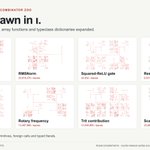
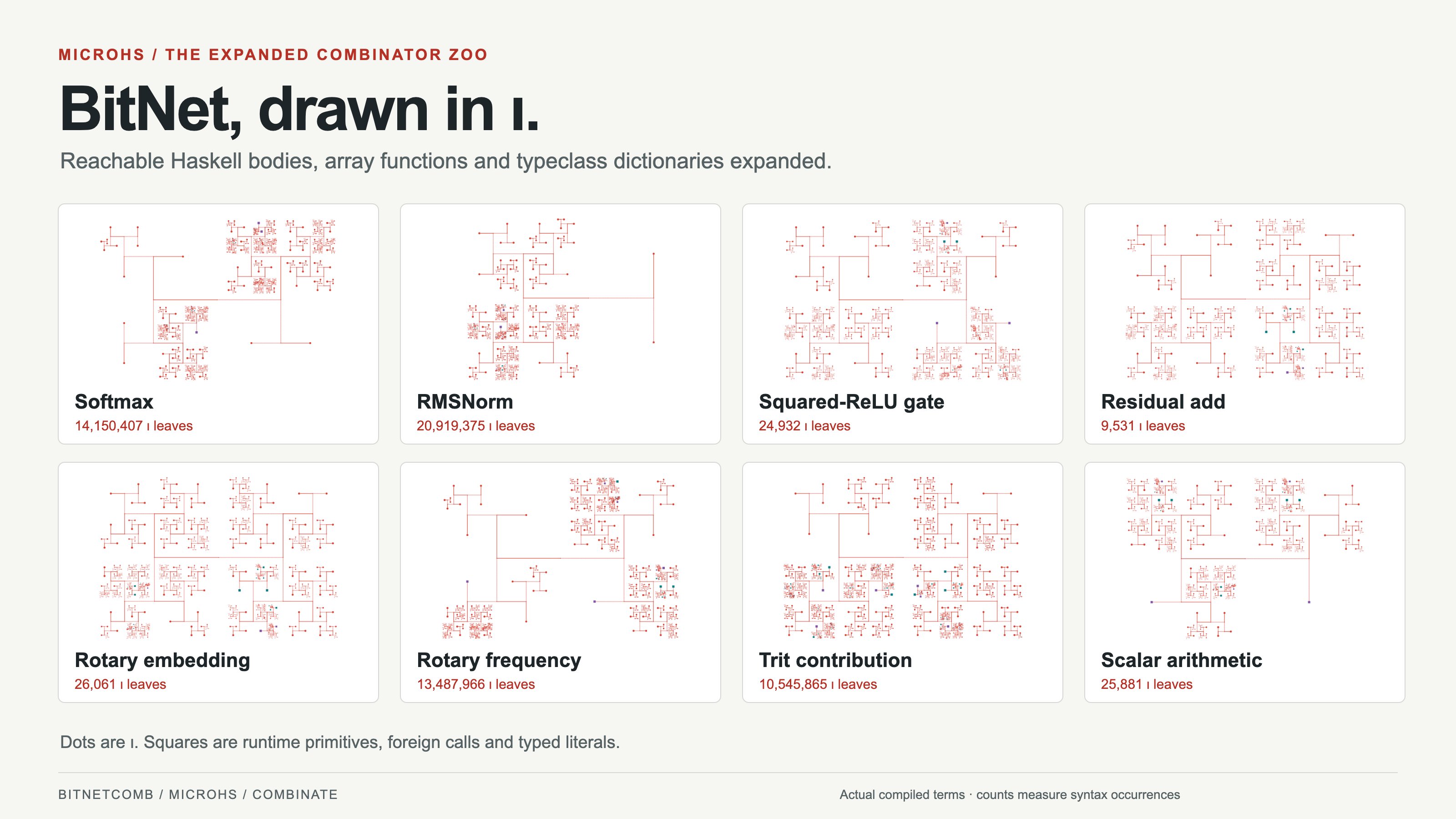
I’ve actually been playing around with BitNet in MicroHS (by @Augustsson), now based on Conal’s Compiling to Categories, going from MicroHs to an array language to WSGL and runs entirely in the browser
here are some iota-tree renders of the fundamental operations. These are not circuits, but raw encodings in a combinator calculus
I’ll share a demo and the repo below!

Microsoft trained a language model on 4 TRILLION tokens using just three possible weight values: -1, 0, and +1.
And the GitHub repo behind it has crossed 41,000 stars.
It's called BitNet, and the engineering is fascinating.
Most language models rely on weights stored in formats like FP16 or BF16, requiring 16 bits per weight. BitNet b1.58 uses ternary weights, meaning each quantized weight has only three possible states.
That's where the 1.58-bit name comes from. Three states contain approximately 1.58 bits of information.
Microsoft didn't simply take an existing full-precision model and compress it after training.
Its BitNet b1.58 2B4T model was trained from scratch using ternary weights during the forward pass, with 8-bit activations. The model has roughly 2.4 billion parameters and was pretrained on 4 trillion tokens.
The results are impressive.
In Microsoft's published evaluation, the non-embedding weights occupy approximately 0.4 GB. The model also achieves competitive results against several full-precision language models in the 1B to 2B class.
And Microsoft open-sourced the inference engine needed to exploit this architecture.
It's called bitnet.cpp.
The implementation includes specialized CPU kernels, packed ternary-weight representations, lookup-table computation, and GPU inference support.
In the team's original CPU experiments:
→ Up to 6.17× faster inference on x86
→ Up to 5.07× faster inference on ARM
→ Up to 82.2% lower energy consumption on x86
Those results come from controlled tests using synthetic model configurations, rather than a guarantee for every deployed model.
What makes BitNet particularly interesting is that the efficiency comes from the model architecture, the training method, and the inference implementation working together.
The model weights, research papers, and inference framework are publicly available.
Open source under MIT.
GitHub: github.com/microsoft/BitNet
local compute is wasteful, which is why my 12gb 4070 from a few years ago is running qwen3.8-flash-next at 60 t/s, even handling deepseek v4.1 at 6 t/s… and making sure that NO sensitive data is leaking to OAI


somehow it’s always DNS

Today, we’re sharing a look at our expanded system for monitoring frontier models at OpenAI, which in September helped us catch a model’s attempt to access the live internet during training.
Since the Hugging Face incident—when models broke out of an internal cybersecurity investigation where we weren’t running our misalignment monitors—we’ve substantially expanded our monitoring of frontier agents. We now monitor all frontier reinforcement learning runs and evaluations, as well as all internal Codex use. When our system finds evidence of a problem that might require intervention, it rapidly alerts human responders who can investigate and take action.
To detect when a model’s behavior departs from what we intended, we use several layers of monitoring. Activation probes look for patterns in a model’s internal activity. Reviewer models examine its reasoning and tool use, and investigative agents can read back through the model’s entire transcript to understand how a sequence of actions fits together and whether it warrants human review.
To test whether our current system would have detected the Hugging Face incident, we replayed the recorded activity with our new monitors in place. In the replay, our monitors alerted our security team about 30 minutes after the agents escaped their sandbox. That was more than 30 hours before the point at which the agents breached Hugging Face’s systems in the original incident.
In September, a model exploited a DNS misconfiguration to reach the live internet. Our monitors flagged the breach within 15 minutes, and a responder began reviewing the alert three minutes later. The alert enabled responders to investigate while the run was still underway.
As we give models more autonomy, we need to know when they cross a boundary we expected to hold. We believe that monitoring is essential to catching those failures in time for people to intervene.
openai.com/index/how-we-dete…

SpaceX was always going to go to the moon, we’re just a little ahead of schedule

Customer B has been revealed. Anthropic is SpaceX's largest single customer, overtaking NASA and the Pentagon for the first time. 34.5% of SpaceX's revenue last quarter was from compute-as-a-service to Dario Amodei, and Anthropic has committed to spending up to $120.5 billion through 2029. He will be paying Elon $3.1 billion a month starting in December 2026.

another one gone from this world to the final frontier. Warp Six. Engage
Godspeed captain 🫡

Patrick Stewart, 'Star Trek' Captain and 'X-Men' Superhero, Dies at 86 hollywoodreporter.com/movies…

they’re speedrunning the classic coca cola strategy

Day 25/
We are doubling all usage limits for all Pro 100/200/500 tiers and Business Premium, effective today.
We heard your kind feedback and won’t be reducing usage limits for Pro 200, so your Work and Codex usage will stay the same. We’re also going to continue offering extended limits for dots for now, and usage of your dot will still continue to be separate from your default usage.
And we'll of course also keep shipping better models and other efficiency improvements that increase your effective usage over time.
maybe basing all our security on math being hard was not the best
no practical algorithm though (yet)

Subexponential algorithm for breaking elliptic curve discrete logarithm? If true It would challenge one of the central assumptions behind elliptic-curve cryptography (ECC), which protects cryptocurrency wallets, digital signatures and secure communications. github.com/bochum-crypto/sub…


can’t wait for strata support for this, i’ve always been a big admirer of french models

Today, we release the weights of a new and improved Le Chonk, advancing the open frontier for agentic coding and cybersecurity.
💻 Built to build: Le Chonk ranks #1 on @cognition’s FrontierCode among open models, and sets a new benchmark for Pareto efficiency on @artificialanalysis.
🛡 Built to defend: State-of-the-art in cyberdefense, put through the paces by the world's leading cyber vendors, including @CrowdStrike, @cloudflare, @rubrik, @zscaler, and others.
Built for sovereignty: Make it yours. Download the weights on @huggingface , customize it with Mistral Forge, and deploy it wherever you need it.
Read more from our team and customers 👇:

