




Pinned Tweet
What’s Happening in the AI Trade: Anthropic IPO All-Day Livestream nitter.cf/i/broadcasts/2AMWlPqZJ…

STANLEY DRUCKENMILLER BOUGHT BACK INTO TECH AN HOUR BEFORE THE 2000 TOP
In January 2000, he sold all his tech stocks, about $6 billion worth.
Then he watched two small teams inside his fund keep making 4% to 5% a day. By March, he couldn't take it anymore.
"I buy everything back. I think I missed the top by about an hour."
Within a week, his Quantum Fund went from up 14% to up 1% on the year. He walked into George Soros's office and told him he was quitting.
One of the greatest investors ever, on his most emotional trade 🎥
$100 INVESTED IN THE S&P 500 IN 1928 GREW TO ABOUT $1.16 MILLION BY THE END OF 2025
Here's what $100 turned into from the start of 1928 through 2025, per NYU Stern professor Aswath Damodaran:
S&P 500, with dividends: about $1.16 million
Gold: about $21,000
10-year Treasury bonds: about $7,700
3-month Treasury bills: about $2,600
Those figures aren't adjusted for inflation. The stock market went through the Great Depression, World War II, the 1970s, the dot-com bust and 2008 along the way.

WARREN BUFFETT BOUGHT HIS FIRST STOCK AT AGE 11
In 1942, he bought 3 shares of Cities Service Preferred at $38 a share.
The stock quickly dropped to about $27. When it climbed back to $40, he sold for a small profit.
Not long after, it went above $200 a share.
Buffett has said that early mistake taught him to stop obsessing over the price he paid and to be patient with good investments.

BILL MILLER BEAT THE S&P 500 FOR 15 STRAIGHT YEARS. TWO YEARS AFTER THE STREAK ENDED, HIS FUND LOST -55.1%
From 1991 through 2005, his Legg Mason Value Trust averaged +15.7% a year, compared with +11.8% for the S&P 500, per Financial Planning.
The streak ended in 2006. The fund gained +5.9% that year, while the S&P 500 gained +15.8%.
In 2008, the fund lost -55.1%, per The Motley Fool. The S&P 500 lost -37% that year, including dividends.

HOWARD MARKS WROTE ONE OF THE MOST FAMOUS INVESTING MEMOS EVER IN NOVEMBER 2001
The market was in the middle of the dot-com bust, just weeks after 9/11, and everyone wanted to know what would happen next.
He titled the memo "You Can't Predict. You Can Prepare."
Marks co-founded Oaktree Capital, and his memos are so respected that Warren Buffett has said they're the first thing he opens when they show up in his mail.
Nobody knows what the market does next month. You can control how much risk you take, how much cash you keep and whether you're forced to sell at the wrong time.

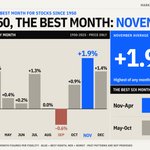
NOVEMBER HAS BEEN THE BEST MONTH OF THE YEAR FOR THE 🇺🇸 STOCK MARKET SINCE 1950
The S&P 500 has gained an average of +1.9% in November, the most of any month, per Carson Group.
Based on S&P 500 price data, the weakest month has been September, at an average of -0.6%.
November also kicks off what Wall Street calls the "best six months." Since 1945, the S&P 500 has gained roughly +7% on average from November through April, compared with about +2% from May through October, per Fidelity.
Past patterns don't guarantee future returns.

🇺🇸 PRESIDENT TRUMP SAYS HE HAS OFFERED UFC CEO DANA WHITE THE JOB OF WHITE HOUSE PRESS SECRETARY
Trump also asked White to bring several UFC fighters with him as assistants, including Islam Makhachev, Khabib Nurmagomedov, Justin Gaethje, Daniel Cormier, Amanda Nunes and Kayla Harrison.


Berkshire Hathaway $BRK.B brings in $848 Million per year in JUST dividends from its Coca-Cola $KO holdings

Berkshire Hathaway gets $848 Million per year in dividends from JUST it’s holdings in Coca-Cola $KO stock
Berkshire just confirmed it owned 400 Million shares of Coca-Cola which was worth $32.5 Billion as of the end of Q3
Coca-Cola currently pays a quarterly dividend of $0.53 per share ... so $2.12 per year
400M * 2.12 = $848 Million

This has been a tough earnings season so far
The numbers overall for the quarter have been solid
But misses have been punished much harder than beats have been rewarded
A few names that break this trend like AppLovin
But overall this has been a harder earnings season so far when it comes to stock prices

🚨 ERSHARES CIO @eva_ados ON WHY BEATING EARNINGS WON'T SAVE TECH THIS SEASON:
"Strong results are not going to be enough. The market is hypersensitive when it comes to AI spending."
The Meta proof:
"It beat last week. It was up after hours, and the next day was down about 6% because they are targeting $825 billion when it comes to AI spending."
What set the table:
"CoreWeave… has bonds yielding at 15% at about an 11% spread. So I think this is going to be the theme this earnings season."
Her trade:
"You want to invest in companies that are going to benefit regardless of who the AI winner will be, such as companies that create batteries like Micron or companies that have to do with connectivity like Astera Labs."
Chris Camillo, the social arbitrage investor profiled in Jack Schwager's Unknown Market Wizards, describes his method as spotting change in the world a little quicker than everyone else.
"The larger the change, the more opportunity," he says. The faster the change, the larger the opportunity.
No fundamental analysis. No technical analysis. "You're not even looking at stock price."
WOLF retweeted
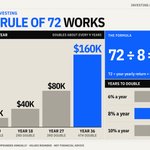
THE RULE OF 72 IS THE SIMPLEST MATH IN INVESTING
Divide 72 by your yearly return, and you get roughly how many years it takes your money to double.
- 6% a year: doubles about every 12 years
- 8% a year: doubles about every 9 years
- 10% a year: doubles about every 7 years
Here's $10,000 growing at 8% a year:
Year 9: about $20,000
Year 18: about $40,000
Year 27: about $80,000
Year 36: about $160,000
The first double takes 9 years and adds $10,000. The fourth double takes the same 9 years and adds $80,000.
That last stretch adds more money than the first 27 years combined. That's why time is the biggest advantage most investors have.
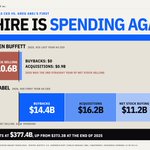
GREG ABEL IS PUTTING BERKSHIRE'S CASH TO WORK
In 2025, Warren Buffett's last year as CEO, Berkshire was a net seller of stocks for the third straight year and didn't buy back a single share.
Under Greg Abel, it has turned net buyer.
In his first 9 months as CEO, Berkshire has:
- Bought back $14.4 billion of its own stock
- Bought $11.2 billion more stock than it sold
- Spent $16.2 billion on acquisitions, led by OxyChem and Taylor Morrison
That's about $42 billion of cash put to work.
And despite all that spending, Berkshire’s cash pile still sits at $377.4B, up from $373.3B at the end of 2025.

MICHAEL DELL STARTED HIS COMPANY WITH $1,000 AT AGE 19, AS A PRE-MED FRESHMAN AT THE UNIVERSITY OF TEXAS
In 1984, he registered PC's Limited, the company now called Dell Technologies $DELL, and sold computer disk drives out of his dorm room.
By spring break, the business was bringing in $80,000 a month in sales, per the Academy of Achievement.
He left the dorm at the end of his freshman year to run it full time.
In 1988, at 23, he took the company public and raised $30 million.
In 1992, at 27, he became the youngest CEO of a Fortune 500 company at the time.

BERKSHIRE IS STILL SITTING ON $377.4B IN CASH
Even after a record $9.6 billion buyback, Berkshire's cash and Treasury bills grew by $11.9 billion last quarter.
The pile has more than doubled from $167.6 billion at the end of 2023, and it peaked at a record $397.4 billion in March.
Almost 90% of it, $336.7 billion, sits in short-term U.S. Treasury bills.
That money is earning less, though. Berkshire's insurance investment income fell 14.1% in Q3 as interest rates dropped.

BERKSHIRE JUST MADE ITS BIGGEST BUYBACK EVER
Berkshire spent $9.6 billion buying back its own stock in Q3, topping its previous record of $9.3 billion from Q3 2020.
A year ago, it wasn't buying back a single share. Berkshire went six straight quarters without a buyback, from mid-2024 through the end of 2025.
September alone accounted for about $5.4 billion, at an average of $506.64 per Class B share.
Its favorite stock in Q3 was its own: Berkshire spent about four times as much on buybacks as on other companies' shares, buying $2.4 billion of stocks while selling $2.8 billion.

ON THIS DAY IN 2013, TWITTER WENT PUBLIC ON THE NYSE
The IPO was priced at $26 a share. It opened at $45.10.
By the close, shares had jumped +73% to $44.90, valuing the company at roughly $31 billion on a fully diluted basis.
The run kept going for another seven weeks, and the stock hit about $74 in late December.
By 2015, shares had fallen below the $26 IPO price.
A big first day tells you how excited people are. It doesn't tell you what the business is worth.

WOLF retweeted
THE IRS JUST RELEASED THE NEW 2027 🇺🇸 TAX BRACKETS. HERE'S HOW THEY WORK IN PLAIN ENGLISH
Every bracket got a little bigger to keep up with inflation, so you can earn a bit more before moving into a higher rate.
Step 1: Take what you earn and subtract the standard deduction. That part isn't taxed at all.
- Single: $16,600
- Married: $33,200
Step 2: Whatever's left gets taxed in layers.
Single filers:
- 10% on your first $12,800
- 12% on income up to $52,025
- 22% up to $109,125
- 24% up to $208,325
- 32% up to $264,550
- 35% up to $661,375
- 37% on anything above that
Married couples: the cutoffs are roughly double ($25,600, $104,050, $218,250, $416,650, $529,100, $793,650).
Example: You're single and earn $76,600. Subtract $16,600 and you're taxed on $60,000.
- 10% on the first $12,800 = $1,280
- 12% on the next $39,225 = $4,707
- 22% on the last $7,975 = $1,755
Total: about $7,742 in federal income tax, or roughly 10% of what you earned.
Even though you're "in" the 22% bracket, only your last $7,975 gets taxed at 22%.
