
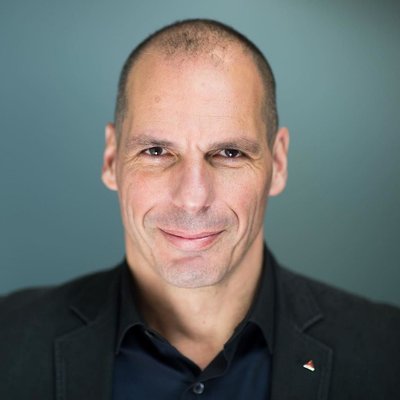
Economics professor, quietly writing obscure economic texts for years, until thrust onto the public scene by Europe's inane handling of an inevitable crisis
Athens, Greece
Joined March 2010
- Tweets31.6K
- Following540
- Followers1.2M
- Likes83
Pinned Tweet
RAISE YOUR SOUL! My new book telling the story of the last 100 years through the voices of 5 remarkable women. Unlike anything I have written before, it focuses on 5 women who taught me how to resist fascism, authoritarianism, chauvinism &... hopelessness yanisvaroufakis.eu/2025/10/1…

Yanis Varoufakis retweeted

Εδώ και 4 δεκαετίες τα δισεκατομμύρια που κερδίζουν στα χρηματιστήρια δεν είναι από την «ανάπτυξη», είναι οι μέτοχοι που παίρνουν όλο και περισσότερο τον κόπο των εργαζόμενων, είναι η εξουσία που τους δίνει φθηνό χρήμα και περιορίζει το ρίσκο τους. Δεν είναι δημιουργία πλούτου, είναι εξαγωγή πλούτου. Ο Γουόρεν Μπάφετ το έχει πει ευθέως, οι πλούσιοι διεξάγουν ταξικό πόλεμο κατά των υπόλοιπων και κερδίζουν.
Ο Γιάνης Βαρουφάκης συζητά με τον Wolfgang Munchau στο Econoclasts και το UnHerd.
Yanis Varoufakis retweeted

Journalists should be able to question politicians without being smeared and libelled like this.
Defenders of the Israeli government have run out of rational arguments to support it.
Please help protect independent journalism and support us here:
👉 declassifieduk.org/join pic.x.com/DNMYxk9CGG


Andreas Malm Denied Entry to the UK to Speak at Tribune Event tribunemag.co.uk/2026/10/and…

Πολύ πριν αποχαιρετίσουμε τον Πάτρικ Στιούαρτ, στο ΜέΡΑ25 επισημάναμε την σημασία του Star Trek ως εισαγωγή στον ελευθεριακό κομουνισμό - στο πως το AI και η ρομποτική μπορούν, στο πλαίσιο της κοινωνικοποίησης των μηχανών, να στηρίξουν μια κοινωνία χωρίς εκμετάλλευση, ιδιωτική ιδιοκτησία των μέσων παραγωγής, χρήματος. Καλό ταξίδι Πάτρικ. unherd.com/2025/01/why-the-l… youtube.com/watch?v=6jjqRhVx…

The impact of AI on jobs available to young people is already greater than we had feared. Wolfgang explains (jump to 24') youtube.com/watch?v=4a5RSWh1…

The trend that Brazil bucked by re-electing Lula:
"The string of bail outs in the West (2001, 2009, 2020, 2022, 2023) reveals the rule: When financial wealth is threatened, governments discover that money can be found.
Today, in the United States, the top 10% own almost 90% of all shares. It’s a similar picture in the UK and the EU. The US federal government and the Fed, the UK governments and the Bank of England, Brussels and the European Central Bank have repeatedly intervened to insure the wealth of the wealthy, doing “whatever it takes” to prop up their asset prices.
The rest of the population pays the premium, in the form of the austerity that follows every bailout."
youtube.com/watch?v=4a5RSWh1…
Yanis Varoufakis retweeted

Watch the full interview with Yanis Varoufakis, the former Finance Minister of Greece: Corruption of the EU youtu.be/Fyae_Ohvjf4
Thanks for helping so many of us ENGAGE! theguardian.com/culture/2026…

Yanis Varoufakis retweeted

In a show-trial riddled with procedural irregularities, Germany is seeking to make an example of five activists who organized against the genocide in Gaza. progressive.international/wi…

Yanis Varoufakis retweeted
Έτσι χτίζονται τα δήθεν «success story», καλπάζει ο πληθωρισμός, αυξάνει το ΑΕΠ και μειώνεται η αναλογία του χρέους χωρίς να πηγαίνουν καλά τα νούμερα, δεν μπορεί κανένας να επαίρεται.
Ο συντονιστής της Κ.Ε. του ΜέΡΑ25 Νίκος Θεοχαράκης στο NET24.
Δείτε ολόκληρη την συνέντευξη 🖇️ youtube.com/watch?v=FnNnpzQO…
Yanis Varoufakis retweeted

📌 Please share 📌
The People’s Emergency Briefing On Climate And Nature is a super-accessible documentary presented by the brilliant @ChrisGPackham.
This 45-min film shows UK climate scientists and experts explaining unprecedented threats to our:
- Food and water supply
- National security
- Economy
- Survival (from climate breakdown –
heatwaves, crop failures, wildfires, storms, floods,
wildlife destruction).
At the same time, it provides clear solutions to all these issues. See trailer here:
nebriefing.org/the-film
👉👉 What can you do?
1. So far, over 150 MPs have signed a Parliamentary Call for the government to present a Televised Emergency Briefing to the nation. You can sign the petition here:
petition.parliament.uk/petit…
2. Host a screening in your community or workplace. See how to here:
nebriefing.org/host-the-film
3. Urge your MP to join the @nebriefing Parliamentary Call:
nebriefing.org/take-action

Yanis Varoufakis retweeted
Yanis Varoufakis: US-Russia Reconciliation & European Vassalage
greatereurasia.substack.com/…

I am going to write something below that should be seen as the musings of one who celebrated – and still celebrates – Lula’s victory over Bolsonaro Jr. Here it goes:
I cannot for the life of me justify why o why Brazil’s courts had to demand of Bolsonaro that he hands over his passport the moment he lost the election. That he disputed the veracity of the election result is a sign of a faulty character, evidence that he is a bad loser. BUT, he had every right to being a bad loser; to dispute, rightly or wrongly, any result.
As for the argument that he was being investigated for other misdemeanours or crimes, that doesn’t wash either: What would have happened if Bolsonaro had won the election? Would the judges also prevent him from travelling abroad, as President-elect? I very much doubt that – which means that the judges were conflating executive and judicial powers.
To those who tell me that the Bolsonaro clan is a fascistic, criminal family, my reply is: You and I may very well think that. Alas, the judiciary has no right to use its powers to indict and to pursue someone because – or immediately after – they lost an election. It is shameful, to be precise. And it is also dangerous for those of us on the left who know what it means to be banned and hounded by rogue judges and police commissioners.
But I also have a message to Bolsonaro supporters, or those sitting on the fence, who assume that Lula is somehow behind the judges. He is not! This is the same court that imprisoned, falsely, Lula himself. What we have in Brazil is a judiciary that overreaches and habitually crosses the line that ought to separate judicial from political power.
It is such a shame that a judge took it upon himself to go after Bolsonaro on the eve of his defeat and, in doing so, to sully Lula’s stupendous victory.
One last point that my comrades in Brazil should note: If Bolsonaro and Rubio wanted to mount a campaign against Lula and Brazilian democracy they could never have been aided better than by that judge’s reckless writ.

WHAT LULA’S RE-ELECTION TELLS US: The Class War Need Not End in Fascism
On Sunday, Brazilians did something that the commentariat had told us was a lost cause. On the eve of his eighty-first birthday, Luiz Inácio Lula da Silva, a former metalworker, turned the Trumpist, evangelical, neofascist, Zionist tide in Latin America to get re-elected President of Brazil.
Three weeks earlier, he had come second in the first round, behind Flávio Bolsonaro, son and political heir of the man who trumpeted the merits of fascism, who had embraced Trump as his lord and master, who plotted a cynical coup against Brazilian democracy – moreover, the main candidates that were eliminated were rightists whose voters were meant to move to Bolsonaro. Yesterday, Lula overturned this deficit and won with a margin of nearly four and a half million votes.
I want to use Lula’s victory to tell a broader story. A story about a war, the class war that the few are waging against the many across the Western world. And a story about how that war need not end, as so many now fear, in a neofascist revival.
THE HIDDEN CLASS WAR
“There’s class warfare, all right,” Warren Buffett once said, “but it’s my class, the rich class, that’s making war, and we’re winning.” Mr Buffett was not exaggerating. For almost four decades, Western governments and central banks have pulled every policy lever in the same direction: to make the assets of the few burgeon at the expense of the incomes of the many.
Consider the numbers. Between 1952 and 1988, economic growth explained nearly all the gains of the West’s stock market. From 1989 onwards, growth explains only about a quarter. The largest share, around 40 per cent, came from income diverted from workers to shareholders. Another third came from cheaper money and lower perceived risk. That is not wealth creation. It is wealth extraction: a transfer from those who work to those who own, inflated by cheap money and paraded on the evening news as “a strong economy”.
Then look at the rescues. 2001, 2008, 2020, the British gilt crisis of 2022, Silicon Valley Bank in 2023: each time, the state rushed in to save the asset holders. Together they reveal the rule: to save the economy, you must save the wealth of those who own it – not those who produce stuff, not even productive companies. In the United States, the top tenth own almost 90 per cent of all shares. The Fed and the US federal government insure it for them, doing ‘whatever it takes’ to prop them up whenever their prices tank. The rest of us in the West pay the premium, in the form of the austerity that always follows the bailout.
And the owners need never sell. Why do billionaires pay so little tax? Because they do not earn incomes - they accumulate capital gains, taxed only when sold. So they borrow against their soaring assets at 1 or 2 per cent and live on the loan. Then they die and pay no tax on their capital gains, passing on the loot to their kids at ridiculously low inheritance taxes. Meanwhile, to pay bills and put food on the table, the worker borrows on a credit card at 20 per cent, her debts the mirror image of their fortunes.
Then, a large chunk of these accumulating assets seek even higher rents in places like Brazil where the US government intervenes to ensure that the local governments will also place the defence of these assets’ values above all else.
CAPITAL IS NOT A THING, NOT MERELY AN ASSET
Why does austerity keep returning, even though it is economically self-defeating? Marx tells the story of Thomas Peel, who in 1829 sailed to Western Australia’s Swan River with £50,000 of provisions and three hundred working-class men, women and children. On arrival, his workers walked off into the bush and worked for themselves. Peel had brought money, tools and labour, but he could not bring capitalism along, because his workers had an alternative.
Capital, Marx concluded, is not a thing but a social relation: the power of those who own to get those who don’t own to do things they’d rather did not do. Austerity is not an economic policy. It is a disciplinary device, keeping the many sufficiently insecure and indebted to accept whatever is on offer. The ruling class’s deepest fear is not inflation or debt. It is to end up like Peel: rich, but without the power to compel.
IS FASCISM INEVITABLE?
Here is the part of the story that keeps so many of us awake at night. When centre-left politicians, from Bill Clinton, Barack Obama and Tony Blair to Gerhard Schröder, Francois Hollande and Andy Burnham abandoned the language of class, a void opened up in the working-class heartlands of the West. Into that void stepped a venomous storyteller with a century of experience in filling such voids: the recalcitrant far right, the rebranded fascists. They offer left-behind workers a story of dignity, then redirect their fury away from the owner who shipped their factory abroad or sold their council house to some fund and towards the migrant next door. It does not end the class war. It merely divides one side – the workers – to rule over them. It camouflages it.
From the red suburbs of Paris to south Piraeus, from England’s red wall to Italy’s rust belt in Taranto, from the American rust belt to eastern Germany, the pattern seems relentless. And so, a fatalism has set in: the class war waged from above, we are told, must inevitably end in a neofascist, racist, misogynist revival.
Brazil has just refuted this fatalism. Brazil knows the monster intimately. It lived through four years of Jair Bolsonaro, with his nostalgia for the military dictatorship. On 8 January 2023, his followers stormed the Congress, the Supreme Court and the presidential palace. Brazil’s far right is not a fringe. Unlike Trump’s rag tag storm troopers, they had years of running a dictatorship. It won the first round of this election. They had the White House fully behind them, while the US Democrats, once again demonstrating their irrelevance, stayed mute. And yet, yesterday, they were defeated.
How? Not by hand-wringing about “populism”, nor by a centrist promise to manage the status quo more efficiently. Lula won because he did what the Western centre-left forgot how to do: he spoke the language of class, and backed it with policies that shifted power, however modestly, from the few to the many. His government exempted those earning up to five thousand reals a month from income tax and paid for it with a minimum tax on the very richest. During Brazil’s G20 presidency, it proposed a global minimum tax on billionaires. When Lula tells Brazilian workers that the elites have rigged the game, he points his finger upwards, at the rentier and the speculator, not sideways, at the migrant or the poor.
PIX – AN EXAMPLE OF AN ANTI-OLIGARCHY DIGITAL TOOL
But the most innovative weapon in Brazil’s arsenal is one that few outside Latin America have heard of. It is called Pix.
Every time you tap a card to pay for a coffee, a toll is levied. Visa, Mastercard and the banks take a cut, often 2 or 3 per cent, from every transaction. Multiply this by billions of purchases a day and you grasp one of the most lucrative rent-extraction machines ever devised. These are not profits made in competitive markets but rent extracted by those who own the digital rails on which our economic lives now run. It is part of what I call technofeudalism.
Unlike Britain, Europe or, of course, America, Brazil’s central bank moved to limit this rabid exploitation. It launched an alternative: a public, instant payment system, free for individuals and with capped fees for merchants. A Brazilian pays a street vendor in Salvador or sends money to her mother in Recife, instantly, using Pix from her phone, with no card company or bank taking its slice. Brazilians took to it with astonishing enthusiasm. Last year, Pix processed almost 80 billion transactions and overtook credit cards as the most popular way to pay online.
Pix is, in effect, the Swan River of the digital age. It gave tens of millions of Brazilians, including the poorest, who had never had a bank card, an alternative to the toll booths of Big Finance. And, like Peel, the toll collectors did not take it lying down. This summer, Washington imposed 25 per cent tariffs on most Brazilian exports, and its trade representative explicitly named Pix as a grievance, complaining that it “unfairly disadvantaged” American payment companies! The most powerful government on Earth deployed its trade arsenal against a free public service for being too successful at denying rents to Visa and Mastercard.
Lula did not blink. He defended Pix as a Brazilian public good, and Brazilians rewarded him for it. Here, at last, is a concrete example of limiting the power of Big Business, Big Finance and Big Tech: not with slogans, but by building public digital infrastructure that removes the opportunity to extract rent in the first place.
NOT A REVOLUTION, BUT AN AUSPICIOUS PORTENT
Let me not romanticise. Lula is no revolutionary. His margin was narrow. Brazil’s Congress remains in the grip of agribusiness and evangelical blocs. Its central bank still keeps interest rates punishingly high, a weapon of the class war if ever there was one. Lula himself has compromised much too much with these vested interests, and lost support as a result.
But Brazil has shown three things the rest of us must learn. First, the class war waged against the many does not have to end in fascism. Fascism wins only when the left vacates the battlefield of class. Second, a progressive government can win by pointing upwards, at those who extract rent, rather than downwards, at those who suffer. And third, Big Business can be defeated, at least forced to lose some battles, by building public alternatives to its rent-extracting machines.
So, here is the challenge to Britain, to Europe, to the people of the United States.
-Build your own Pix: public payment rails that end the tolls of Visa and Mastercard.
-Tax capital gains, ill-gotten wealth that is, not just income.
-Make every rescue conditional, with the public receiving real, permanent equity in return.
-Create a public investment bank as an alternative to the bond markets. Restore the bargaining power of the workforce. And give working people what Peel’s workers found at Swan River: an alternative, and the freedom to say no.
Buffett was right. There is a class war, and his class has been winning hands down. But yesterday, in Brazil, it lost a battle though not the war. It lost because a working-class president dared to name the war and fight it using weapons fashioned to defend the many.
unherd.com/2026/10/why-lula-…

In this episode of The Econoclasts, we dissect the elections in Brazil and Serbia to debunk the prevailing narrative that the rise of the Right is an inevitable force that can only be mitigated by centrist technocracy. We also reveal the looming threat of a silent AI-driven hiring freeze that risks permanently locking young workers out of the economy. youtube.com/watch?v=4a5RSWh1…
US-Russia Reconciliation & European Vassalage youtube.com/watch?v=Fyae_Ohv…

A message to those who still believe that it all started on October 7. No, it didn't. A 'managed genocide', to keep 1.5 million Palestinians "on the edge of life" was in force years before. Read the latest report by Eyal Weizman:
"A military document called ‘Red Lines’ set the minimum number of calories required to sustain Gaza’s population at a level just above the UN definition of hunger (2100 calories a day for men, 1700 for women and a varying amount for children depending on gender and age). The total number of calories was translated into the tonnage required to feed Gaza’s then population of 1.5 million and thus the number of aid trucks allowed into the territory. The same went for megawatts of electricity and litres of fuel and water. What was seen as good behaviour was rewarded by an increase in the amounts coming in, any acts of resistance by the tightening of the siege, like a population-scale version of a Milgram experiment."
lrb.co.uk/the-paper/v48/n20/…

NEW REPORT! “Truth under the Rubble: Media in the Time of Genocide”
In Palestine, the destruction of the truth has become integral to the destruction of the Palestinian people.
The new report examines:
1) Israel’s systematic elimination of Palestinian journalists and media infrastructure.
2) Censorship, propaganda, dehumanisation and genocidal incitement against Palestinians, in Israel.
3) The role of influential media and digital platforms in marginalising Palestinian voices and reproducing Israeli narratives.
💬 “Perpetrators and enablers of genocide often seek to shape how genocidal destruction is perceived and remembered. [...] The current genocidal phase has intensified the war both on and through the media.”
READ THE REPORT🔗 docs.un.org/A/81/249. Available in all official UN Languages.

WHAT LULA’S RE-ELECTION TELLS US: The Class War Need Not End in Fascism
On Sunday, Brazilians did something that the commentariat had told us was a lost cause. On the eve of his eighty-first birthday, Luiz Inácio Lula da Silva, a former metalworker, turned the Trumpist, evangelical, neofascist, Zionist tide in Latin America to get re-elected President of Brazil.
Three weeks earlier, he had come second in the first round, behind Flávio Bolsonaro, son and political heir of the man who trumpeted the merits of fascism, who had embraced Trump as his lord and master, who plotted a cynical coup against Brazilian democracy – moreover, the main candidates that were eliminated were rightists whose voters were meant to move to Bolsonaro. Yesterday, Lula overturned this deficit and won with a margin of nearly four and a half million votes.
I want to use Lula’s victory to tell a broader story. A story about a war, the class war that the few are waging against the many across the Western world. And a story about how that war need not end, as so many now fear, in a neofascist revival.
THE HIDDEN CLASS WAR
“There’s class warfare, all right,” Warren Buffett once said, “but it’s my class, the rich class, that’s making war, and we’re winning.” Mr Buffett was not exaggerating. For almost four decades, Western governments and central banks have pulled every policy lever in the same direction: to make the assets of the few burgeon at the expense of the incomes of the many.
Consider the numbers. Between 1952 and 1988, economic growth explained nearly all the gains of the West’s stock market. From 1989 onwards, growth explains only about a quarter. The largest share, around 40 per cent, came from income diverted from workers to shareholders. Another third came from cheaper money and lower perceived risk. That is not wealth creation. It is wealth extraction: a transfer from those who work to those who own, inflated by cheap money and paraded on the evening news as “a strong economy”.
Then look at the rescues. 2001, 2008, 2020, the British gilt crisis of 2022, Silicon Valley Bank in 2023: each time, the state rushed in to save the asset holders. Together they reveal the rule: to save the economy, you must save the wealth of those who own it – not those who produce stuff, not even productive companies. In the United States, the top tenth own almost 90 per cent of all shares. The Fed and the US federal government insure it for them, doing ‘whatever it takes’ to prop them up whenever their prices tank. The rest of us in the West pay the premium, in the form of the austerity that always follows the bailout.
And the owners need never sell. Why do billionaires pay so little tax? Because they do not earn incomes - they accumulate capital gains, taxed only when sold. So they borrow against their soaring assets at 1 or 2 per cent and live on the loan. Then they die and pay no tax on their capital gains, passing on the loot to their kids at ridiculously low inheritance taxes. Meanwhile, to pay bills and put food on the table, the worker borrows on a credit card at 20 per cent, her debts the mirror image of their fortunes.
Then, a large chunk of these accumulating assets seek even higher rents in places like Brazil where the US government intervenes to ensure that the local governments will also place the defence of these assets’ values above all else.
CAPITAL IS NOT A THING, NOT MERELY AN ASSET
Why does austerity keep returning, even though it is economically self-defeating? Marx tells the story of Thomas Peel, who in 1829 sailed to Western Australia’s Swan River with £50,000 of provisions and three hundred working-class men, women and children. On arrival, his workers walked off into the bush and worked for themselves. Peel had brought money, tools and labour, but he could not bring capitalism along, because his workers had an alternative.
Capital, Marx concluded, is not a thing but a social relation: the power of those who own to get those who don’t own to do things they’d rather did not do. Austerity is not an economic policy. It is a disciplinary device, keeping the many sufficiently insecure and indebted to accept whatever is on offer. The ruling class’s deepest fear is not inflation or debt. It is to end up like Peel: rich, but without the power to compel.
IS FASCISM INEVITABLE?
Here is the part of the story that keeps so many of us awake at night. When centre-left politicians, from Bill Clinton, Barack Obama and Tony Blair to Gerhard Schröder, Francois Hollande and Andy Burnham abandoned the language of class, a void opened up in the working-class heartlands of the West. Into that void stepped a venomous storyteller with a century of experience in filling such voids: the recalcitrant far right, the rebranded fascists. They offer left-behind workers a story of dignity, then redirect their fury away from the owner who shipped their factory abroad or sold their council house to some fund and towards the migrant next door. It does not end the class war. It merely divides one side – the workers – to rule over them. It camouflages it.
From the red suburbs of Paris to south Piraeus, from England’s red wall to Italy’s rust belt in Taranto, from the American rust belt to eastern Germany, the pattern seems relentless. And so, a fatalism has set in: the class war waged from above, we are told, must inevitably end in a neofascist, racist, misogynist revival.
Brazil has just refuted this fatalism. Brazil knows the monster intimately. It lived through four years of Jair Bolsonaro, with his nostalgia for the military dictatorship. On 8 January 2023, his followers stormed the Congress, the Supreme Court and the presidential palace. Brazil’s far right is not a fringe. Unlike Trump’s rag tag storm troopers, they had years of running a dictatorship. It won the first round of this election. They had the White House fully behind them, while the US Democrats, once again demonstrating their irrelevance, stayed mute. And yet, yesterday, they were defeated.
How? Not by hand-wringing about “populism”, nor by a centrist promise to manage the status quo more efficiently. Lula won because he did what the Western centre-left forgot how to do: he spoke the language of class, and backed it with policies that shifted power, however modestly, from the few to the many. His government exempted those earning up to five thousand reals a month from income tax and paid for it with a minimum tax on the very richest. During Brazil’s G20 presidency, it proposed a global minimum tax on billionaires. When Lula tells Brazilian workers that the elites have rigged the game, he points his finger upwards, at the rentier and the speculator, not sideways, at the migrant or the poor.
PIX – AN EXAMPLE OF AN ANTI-OLIGARCHY DIGITAL TOOL
But the most innovative weapon in Brazil’s arsenal is one that few outside Latin America have heard of. It is called Pix.
Every time you tap a card to pay for a coffee, a toll is levied. Visa, Mastercard and the banks take a cut, often 2 or 3 per cent, from every transaction. Multiply this by billions of purchases a day and you grasp one of the most lucrative rent-extraction machines ever devised. These are not profits made in competitive markets but rent extracted by those who own the digital rails on which our economic lives now run. It is part of what I call technofeudalism.
Unlike Britain, Europe or, of course, America, Brazil’s central bank moved to limit this rabid exploitation. It launched an alternative: a public, instant payment system, free for individuals and with capped fees for merchants. A Brazilian pays a street vendor in Salvador or sends money to her mother in Recife, instantly, using Pix from her phone, with no card company or bank taking its slice. Brazilians took to it with astonishing enthusiasm. Last year, Pix processed almost 80 billion transactions and overtook credit cards as the most popular way to pay online.
Pix is, in effect, the Swan River of the digital age. It gave tens of millions of Brazilians, including the poorest, who had never had a bank card, an alternative to the toll booths of Big Finance. And, like Peel, the toll collectors did not take it lying down. This summer, Washington imposed 25 per cent tariffs on most Brazilian exports, and its trade representative explicitly named Pix as a grievance, complaining that it “unfairly disadvantaged” American payment companies! The most powerful government on Earth deployed its trade arsenal against a free public service for being too successful at denying rents to Visa and Mastercard.
Lula did not blink. He defended Pix as a Brazilian public good, and Brazilians rewarded him for it. Here, at last, is a concrete example of limiting the power of Big Business, Big Finance and Big Tech: not with slogans, but by building public digital infrastructure that removes the opportunity to extract rent in the first place.
NOT A REVOLUTION, BUT AN AUSPICIOUS PORTENT
Let me not romanticise. Lula is no revolutionary. His margin was narrow. Brazil’s Congress remains in the grip of agribusiness and evangelical blocs. Its central bank still keeps interest rates punishingly high, a weapon of the class war if ever there was one. Lula himself has compromised much too much with these vested interests, and lost support as a result.
But Brazil has shown three things the rest of us must learn. First, the class war waged against the many does not have to end in fascism. Fascism wins only when the left vacates the battlefield of class. Second, a progressive government can win by pointing upwards, at those who extract rent, rather than downwards, at those who suffer. And third, Big Business can be defeated, at least forced to lose some battles, by building public alternatives to its rent-extracting machines.
So, here is the challenge to Britain, to Europe, to the people of the United States.
-Build your own Pix: public payment rails that end the tolls of Visa and Mastercard.
-Tax capital gains, ill-gotten wealth that is, not just income.
-Make every rescue conditional, with the public receiving real, permanent equity in return.
-Create a public investment bank as an alternative to the bond markets. Restore the bargaining power of the workforce. And give working people what Peel’s workers found at Swan River: an alternative, and the freedom to say no.
Buffett was right. There is a class war, and his class has been winning hands down. But yesterday, in Brazil, it lost a battle though not the war. It lost because a working-class president dared to name the war and fight it using weapons fashioned to defend the many.
unherd.com/2026/10/why-lula-…
Yanis Varoufakis retweeted

"when it comes to inter-temporal, long-term transactions, e.g. mortgages, the difference between ideal money and typical European currencies would be somewhat intense, if not dramatic."
John F Nash Jr., 2000 (with Yanis Varoufakis, on Ideal Money)
buff.ly/3dRZ4IL
