

Zenith is the EVM and SVM execution layer for Canton Network, advancing real-world capital markets initiatives on-chain.
Joined August 2023
- Tweets1.4K
- Following43
- Followers46.9K
- Likes5.6K






Pinned Tweet
JUST IN: The Zenith EVM Testnet is live and open to the public.
For the first time, 31800+ Ethereum developers can deploy standard Solidity applications that compose atomically with @CantonNetwork - the institutional blockchain where DTCC, JPMorgan, Goldman Sachs, and Visa process $9T+ in monthly settlement volume.
Point your existing tools at the Zenith RPC endpoint and deploy. Your contracts don't change, your tooling doesn't change, and every transaction is finalized through Canton's consensus with deterministic finality in seconds. The external_call() primitive enables atomic composability with Canton-native Daml workflows directly, and the Linked Transactions explorer shows you the full lifecycle of every transaction across both environments in one place.
Zenith is already contributing to two of the most significant tokenization initiatives running on Canton: @The_DTCC 's DTC Digital Assets Solutions Industry Working Group bringing $114 trillion in U.S. securities on-chain, and @progmat_en's Tokenized JGB working group targeting Japan's $1.6 trillion JGB repo market alongside MUFG, Mizuho, and BlackRock Japan.
This is the first public venue where Ethereum's programmability and Canton's institutional rails meet.
Get started: docs.zenith.network
Explore: explorer.testnet.zenith.netw…
Full announcement: zenith.network/resources/blo…
To test atomic cross-environment workflows with the Zenith Gateway, reach out to us directly: [email protected]
Zth.
A nine-to-five market leaves bond collateral difficult to access for 16 hours a day, plus weekends and public holidays.
What changes when those assets become available 24/7/365?
@HeslinKim walks through what changes when tokenized bonds are accessible around the clock. The bond can be posted as collateral in established DeFi lending infrastructure, a stablecoin can be borrowed against it, and that stablecoin can be put into a tokenized money market fund, one of the most broadly accessible RWAs today. The bond keeps its place as collateral while the borrowed cash earns in a separate position.
Ethereum already has an established ecosystem of programmable financial applications. Canton brings institutional assets and the controls governing their use. Zenith EVM connects these capabilities, enabling Canton-native financial workflows and EVM smart contracts to participate in the same atomic transactions.
Zth.

Weekends. Public holidays. Overnight closures.
What if your bond collateral could keep working?
Heslin Kim (@HeslinKim), co-founder and CBO of Zenith (@ZenithFdn), walks through the possibilities: use tokenized bonds as collateral, borrow stablecoins, and put those funds to work in tokenized money market funds.
Thanks to everyone who has been building on and testing Zenith EVM Testnet.
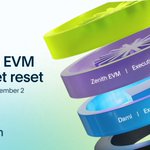
The Zenith EVM Testnet will be reset on Monday, 2 Nov 2026, between approximately 2pm and 5pm CET (13:00 to 16:00 UTC), to ship a protocol upgrade, performance improvements and network hardening.
What the reset means for you:
• All testnet state will be wiped: balances, deployed contracts and transaction history.
• Re-fund your wallet from the faucet once the network is back.
• Redeploy your contracts after the reset.
What’s changing:
• Faucet bot protection: The faucet is now protected by a captcha, so bots and spammers can’t block real users from getting tokens.
• Stricter faucet rate limits: Claims are now more tightly rate-limited, so funds are spread fairly among builders and testers.
• Per-block transaction cap removed: The previous limit on transactions per block is increasing too.
• Fixes and hardening: This upgrade includes fixes for issues discovered on the current testnet, plus general stability improvements.
A note on testnet ZTH:
All existing testnet ZTH balances, including any previously farmed ZTH, will be gone after the reset. Testnet ZTH has no value, and farming it provides no benefit. The faucet exists so developers can test, and the new protective measures are there to keep it that way.
Network details:
We expect RPC endpoints and other network settings to stay the same. If anything changes, we’ll update our docs accordingly.
Expect some downtime during the upgrade. We’ll post here as soon as the network is live again.
For more info about our testnet, please visit our docs: docs.zenith.network
Zth.

Japan’s JGB repo market is estimated at approximately $1.6 trillion, a market where faster settlement and programmable collateral could improve efficiency, liquidity and access.
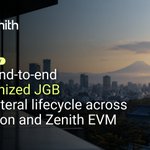
As part of our contribution to the @progmat_en-led consortium’s Tokenized JGB working group, we validated an end-to-end pilot workflow for a tokenized JGB: issuance on Canton, purchase through an atomic DvP against stablecoins, collateralization and borrowing on Zenith EVM, monitoring, and resolution by repayment or liquidation.
At every stage, either the full operation commits or nothing does.
Zth.

A bond’s on chain journey goes beyond issuance.
@ZenithFdn details a local pilot connecting Canton assets with EVM payments and lending from purchase to borrowing, repayment or liquidation.
The workflow was tested on a fully local stack.
cantonnews.org/zenith-detail…

Faster settlement is only part of the cross-border finance equation.
T+0 can reduce settlement delays. Stablecoins can improve payment accessibility. Tokenization can make financial assets programmable. But none of these automatically creates unified global liquidity.
At RWA Summit Singapore, our Co-Founder & CBO @HeslinKim joined Galaxy, Optimism, STBL/Ajna Capital, and Base to discuss what comes next.
The challenge is connecting institutional financial networks with programmable applications while preserving the controls and legal requirements those markets depend on.
More than moving money faster, it's about making capital more useful across markets.
Thanks to @rwasummitglobal for the conversation.
Zth.

✨RWA SUMMIT SINGAPORE RECAP: Cross-Border Infrastructure Development: Competitive Landscape, Winners and Losers
Cross-border money movement is slow and fee-heavy. Industry leaders at @rwasummitglobal Singapore discussed how #tokenization and stablecoin rails unlock continuous global liquidity.
Key takeaways:
- Zero idle capital: T+0 settlement cuts transfer windows from days to milliseconds, keeping assets productive 24/7.
- Bank integration: Traditional institutions are adopting tokenized deposits, digital wallets, and stablecoin pilots rather than being replaced.
- Unified liquidity: Global scale requires connecting private institutional networks with public #DeFi ecosystems.
Featured Speakers:
• John Cahill - Head of Galaxy, APAC at @galaxyhq
• Christopher Andreola - Senior Director Commercial Strategy at @Optimism
• Pranav Agarwal - Founding Investor at @stbl_official
& Director, Investments & Strategy at @Ajna_VC
• Heslin Kim - Co-Founder & CBO at @ZenithFdn
• Moderator: Nick See Tong - APAC Regional Lead for @base at @coinbase
👉 Catch the full conversation here: youtu.be/nYvicACFtL0?si=3wNA…


DTCC's Tokenization Service is Live.
Years of regulatory engagement. Input from 150+ firms with 20 DTC participants signed on.
@CantonNetwork and DTCC's private Besu network are integrated from day one, supporting tokenized representations of DTC-custodied securities, including eligible Russell 1000 stocks, major index ETFs, and U.S. Treasuries. More networks are planned for 2027.
EVM infrastructure is already part of the institutional tokenization stack at launch. DTCC's multi-network approach reflects a broader reality: institutional finance won't run on a single chain. Different requirements call for different execution environments.
As a member of the DTC Digital Assets Solutions Industry Working Group, Zenith sends warm congratulations to @The_DTCC, @CantonNetwork, @digitalasset, and the participating institutions who helped bring this milestone to life.
Zth.


The DTCC Tokenization Service is now live, and this is only the beginning.
Explore the service: brnw.ch/21x6JeP
Zenith retweeted

On our panel at @blockworksDAS Asia, Monad Co-Founder @keoneHD raised an important question to @wesearn_real about composability on @CantonNetwork: where does DeFi fit into the picture?
It's worth asking, and I respect his grit to dive into these types of questions on stage.
My answer: Ethereum has spent years building an ecosystem of lending markets, decentralized exchanges, liquidity pools, and applications that compose through shared EVM execution. Canton, meanwhile, brings together major financial institutions, tokenized assets, and workflows that can transact atomically across different participants without making sensitive financial information public.
As @wesarn_real, Co-Founder of Digital Asset, explained on the panel, Canton was built to preserve atomic composability even when participants have different privacy requirements and validator sets. Where many privacy-focused blockchain approaches have struggled to preserve composability, Canton made it a fundamental part of its architecture.
So the challenge isn't to make Canton composable for the first time. It's to add natively Ethereum-compatible execution without creating another settlement boundary.
And to understand why that matters, we need to distinguish a few things the industry often groups together.
"Cross-chain composability" usually describes one of three very different things.
1. Bridging: An asset is locked in one place and a representation of it is created somewhere else. The asset has moved, but what you now hold is a claim on a lockbox. If the lockbox fails, the claim is worthless.
2. Messaging: One chain sends a message, and another chain acts on it later. The two halves of the operation settle separately, on different schedules, under different finality rules. Most of the time this works but when it does not, one side of the trade has happened and the other has not.
3. Atomic composability: Every step of an operation, across every application and asset involved, happens in a single transaction. Either all of it succeeds, or none of it does. Traditional finance knows this as delivery versus payment (DvP), Ethereum developers know it as atomic smart contract execution.
Only the third one is composability in the sense that matters for finance at scale: the ability to execute a single financial transaction across different environments without splitting its settlement.
I get it. It's easy to get caught in marketing semantics, and who has time to granularly review the legitimacy of public claims, but the underlying implications of the actual technology are dramatic.
Over the past decade, public blockchains and institutional blockchains both wanted to make financial assets programmable and easier to transact with, but each ran into a different limitation.
Public chains kept composability, then fragmented it.
Ethereum showed how lending protocols, exchanges, and liquidity pools became building blocks that other applications could use and combine. But its public transaction history and broadly visible contract state present challenges for institutions handling confidential positions, client data, and regulated assets. And, as activity expanded across L2s and independent networks, accessing liquidity and applications across different environments increasingly required bridges and messaging, introducing additional dependencies and security risks. The costs were real: Chainalysis estimated that around $2 billion was stolen from cross-chain bridges in 2022 alone, the majority of all crypto stolen that year.
Private enterprise chains kept privacy giving up broader composability, and what we call DeFi. Financial institutions couldn't simply put sensitive customer positions and transaction details on a fully transparent ledger. Those networks could support their own internal workflows, but connecting assets and applications across different institutional systems remained difficult.
There's a definitive reason we built Zenith and dialed into a GTM/PMF with @cantonnetwork.
On Canton, parties with different privacy requirements and different validators can still transact atomically. A tokenized bond held privately by one institution can settle against a payment from another in the same transaction, without either side exposing its data to the other's validators.
That is the point @digitalasset made on the panel, and it is a genuinely new capability.
But it does not fully answer Monad's question. DeFi is not only assets but also applications: lending logic, liquidity pools, risk engines, liquidation mechanics. Almost all of that logic is written in Solidity, battle-tested over years, and maintained by the largest developer community in the industry.
The obvious shortcut would be to bridge Canton assets out to wherever DeFi already lives. But that would bring back exactly the problems described above. The asset would leave the environment that gives it its legal and operational guarantees, and the transaction would lose its atomicity at the moment it matters most.
So here's the PMF. Zenith has brought universal application composability to @cantonnetwork. It's not merely about asset composability... the stress-tested, DeFiLlama ranked protocols are critical to mobilizing the trillions in assets that are on @cantonnetwork's doorstep.
This is what we saw needed to be built in early 2025. Zenith brings native EVM execution to Canton, so Solidity applications run inside Canton's transaction model rather than next to it. As I said on the panel, the idea is to "bring a little bit of Ethereum to the Canton side, and a bit of Canton to the Ethereum side as well." Thanks to @hosseeb for inspiring that line, and also unintentionally validating our thesis.
Here is what that looks like in a single transaction:
➜ An institution holds tokenized Treasury fund shares on Canton.
➜ It moves those shares into Zenith EVM and deposits them as collateral in a lending protocol written in Solidity. The original shares are locked on Canton, and a fully backed representation is created on Zenith EVM.
➜ Canton applies the asset’s compliance rules: eligibility, transfer restrictions, and any other conditions the issuer has defined.
➜ The lending contract checks the collateral value and issues a stablecoin loan.
➜ Canton validators finalize the full operation. Either everything commits or nothing does.
➜ If any step fails, whether that's an eligibility check, a price check, or a contract error, nothing settles.
That's what makes Zenith's approach different: rather than simply moving assets between environments, it allows Canton-native assets and EVM smart contracts to interact and settle atomically as part of the same transaction.
Now imagine eligible tokenized Japanese Government Bonds (JGBs) on Canton being used to borrow stablecoins through an EVM lending application. This is actually in motion already.
However, @keoneHD's question is the right one to keep asking, and the answer will be measured in deployments and volume, not in architecture diagrams.
Native EVM execution on Canton does not create DeFi liquidity overnight. Protocols still need to deploy, liquidity needs to develop, and institutions must determine which assets can participate in which applications.
What has changed is the starting point, and a door where there used not to be one.
Before we built the Zenith Stack, connecting DeFi to institutional assets meant asking one side to give up what made it valuable: either the institution gave up its security guarantees for distribution on other chains, or the DeFi protocols gave up before rewriting their code to Daml.
That trade-off no longer has to exist. The entire reason to be on-chain is composability, and the next step is making sure it does not stop at the edge of a chain.
Watch the full DAS Asia discussion: nitter.cf/ZenithFdn/status/21081…
Explore Zenith EVM Testnet: docs.zenith.network/
Zth.


Zenith retweeted
On Canton, atomic composability means every leg of a transaction commits together, or none of it does.
Bridging and messaging settle separately, under different timelines and finality.
Zenith runs Solidity in that model, committing atomically alongside Canton-native assets.

At @blockworksDAS Asia 2026, @keoneHD from Monad asked the right question: where does DeFi fit into Canton?
@HeslinKim, Zenith Co-Founder and CBO, came with a specific answer: Zenith is the middle ground. Not by moving assets between environments and calling it composability, but by bringing Ethereum-compatible execution natively into @CantonNetwork's transaction model, so Solidity applications and Canton-native assets settle atomically in the same transaction.
Most of what the industry calls cross-chain composability is either bridging or messaging, two operations that settle independently, on different schedules, under different finality rules. The gap between them is where the risk lives. Atomic composability means there is no gap. Either every leg of the transaction commits together or the entire operation aborts.
That distinction is at the heart of a piece we published recently. If the DAS Asia conversation sparked the same questions for you, it’s worth the read.
Zth.

Six years of @redstone_defi. We got a head start on the celebration.
The invite-only dinner we co-hosted during @kbwofficial in Seoul was one of the highlights of the autumn for us.Institutions and infrastructure teams in one room, talking through where tokenization on @CantonNetwork is actually heading.
Happy birthday to a team that has spent six years building oracle infrastructure the industry actually relies on. Glad to have had you in the room.
Zth.
As part of our contribution to @progmat_en's Tokenized JGB working group - alongside MUFG, Mizuho, BlackRock Japan, and State Street - Zenith validated an end-to-end JGB collateral lifecycle spanning @CantonNetwork and Zenith EVM.
Japan’s JGB repo market processes approximately $1.6 trillion annually. It is one of the largest fixed income markets in the world, and much of its inefficiency comes from the same place: collateral that moves slowly, settlement that takes days, and liquidity that sits idle because the infrastructure to mobilize it in real time doesn’t exist yet.
What we validated is a workflow that addresses exactly that. A tokenized JGB is issued on Canton, purchased against stablecoins in an atomic DvP settlement, deposited as collateral in a Solidity lending protocol on Zenith EVM, monitored in real time from Canton, and ultimately released or liquidated, all within a single coordinated system where Canton remains the compliance and settlement layer throughout.
This is what programmable collateral looks like in practice, institutional assets that can participate in lending markets and liquidity workflows without leaving the environment that governs them.
Read the full breakdown: zenith.network/resources/blo…
Zth.

10,000+ monthly active developers across the EVM ecosystem. Over $9T in monthly tokenized asset activity on @CantonNetwork.
Two ecosystems with different strengths, both building important pieces of on-chain finance.
> Ethereum has spent more than a decade developing the infrastructure and applications behind DeFi: lending markets, DEXs, and liquidity protocols. It has demonstrated what's possible when financial applications can build on one another and share liquidity.
> Canton has brought major financial institutions and regulated assets on-chain, supporting real financial activity while addressing the privacy, compliance, and settlement requirements these markets operate under.
The debate around tokenized deposits raises an important question: how do we make institutional assets useful beyond issuance and transfers, while respecting the requirements that govern them?
That's what we're building toward at Zenith: Ethereum-compatible execution integrated into Canton's settlement model, allowing Solidity applications and Canton-native assets to participate in the same atomic transactions. Atomic composability doesn't remove issuer restrictions or automatically create liquidity. But it expands what financial applications can do with institutional assets within those constraints.
The next step isn't just bringing more assets on-chain. It's expanding what they can actually do once they're there.
Zth.

Once again Yuval resorts to personal attacks on me without fully engaging on a complicated topic. (He also has some weird fetish about mine being a teacher, but that's his business).
So let me elaborate my critique of the utility of tokenized bank deposits like JPMD in simple language that hopefully he can understand.
The biggest difference between the liability of a fractionally-reserved bank and that of a narrow bank (aka stablecoin issuer) is run risk. Levered banks live under constant threat of runs, narrow banks don't.
Due to run risk, a tokenized deposit can never be a bearer instrument. The bank must know who every token holder is at all times to manage the FDIC (or foreign equivalent) insurance limit. Otherwise a single customer could put $1m into 4 wallets and quadruple their insurance, thus Sybil Attacking the FDIC.
Also due to run risk, tokenized deposits cannot be allowed to trade freely in the secondary market. Stablecoins like USDT and USDC have micro-depegs all the time due to liquidity, but nobody cares because they are fully reserved. A tokenized deposit having even the slightest depeg could cause a run on the entire bank.
Run risk is why bank deposits have opt-in ownership (everyone must be KYC'ed) but stablecoins have opt-out (almost nobody does, unless there is a law enforcement action).
And BTW, every single senior bank exec (including at JPM) and bank regulator I've ever discussed this issue with agrees with my logic. The concept of a tokenized deposit moving as freely as a stablecoin is terrifying.
This is also why stablecoin issuers have gone out of their way to promote their liability for agentic use while banks have outright banned it.
Yuval's point about "stablecoin issuers also holding deposits" is irrelevant since they are fully reserved.
He also seems to imply the law will change to force stablecoins issuers to also have to KYC every holder. Genius doesn't touch this, nor does any regulator I know. This change would destroy stablecoin utility.
Now, knowing all of this, why do I think products like JPMD are mostly innovation theater? Because you literally can't do anything with them you couldn't also do with an API and 30 year old database tech inside JPM.
You can't use JPMD in DeFi unless you are only trading with other JPM customers and only against other assets directly on JPM's balance sheet. Why you'd want to pay Ethereum gas fees and deal with 12 second slot times to do the same thing the bank can handle instantly for free is beyond me.
Also, any swap of JPMD against a different asset (say ETH) runs the risk of JPM refusing to honor the deposit swap leg of the transaction. This swap isn't atomic and has high settlement risk.
Can stablecoin issuers also do this and interfere in DeFi? Yes, but they go out of their way not to, because having their coins featured in DeFi is great for business - unlike for banks.
Also, stable issuers don't know who 99% of token holders are, so have no basis to interfering. Banks know who every depositor is and have a long history of censoring, including against the crypto industry.
I'm guessing the reason Yuval is upset about my post is because JPMD is soon coming to Canton. That deployment actually makes sense. They should definitely do it.
Canton is just a database with a button. JPMD is an asset with a button. Both feature a single entity, possibly a single person, who can endogenously void holder rights at any time. Thus both have infinite settlement risk.
Infinity multiplied by infinity is still infinity.
Simple math that even a non-academic could understand.
Tokenizing an asset doesn't automatically make it liquid. Just as moving assets between networks doesn't make them atomically composable.
The next challenge is making those assets useful across financial markets. Atomic composability is an important piece of that: allowing collateral, lending, and other financial operations to execute and settle together, rather than as disconnected transactions.
But infrastructure alone doesn't create liquidity. Protocols, participants, and real market demand still need to follow.
Zenith Co-Founder & CBO @HeslinKim joins @totofinance, @MIDAODS, @redstone_defi and @prypcocom at @AIBC_World in Rome on November 3 to discuss what it takes to turn tokenized assets into active financial markets.
Zth.

Tokenized RWAs keep growing on paper. But how much of it actually trades?
Our CEO @stevengae_06 is taking on that question at @AIBC_World, Rome next week.
Panel - Tokenized Everything, Traded by Nobody: The Liquidity Problem RWA Keeps Avoiding
Date: Tuesday, 3rd November
Time: 14:10 to 14:45 CET (UTC+1)
Location: AIBC Stage, Hall 7
He’ll be on stage alongside leaders from @MIDAODS, @ZenithFdn, @redstone_defi and @prypcocom, discussing what’s really trading, what’s simply parked, and whether tokenization has solved anything for assets that were illiquid to begin with.
At @totofinance, we started with copper because a tokenized asset only matters when it’s real, verifiable and connected to an actual market.
Catch the panel, then come find us at Booth H7-7184 to keep the conversation going.

At @blockworksDAS Asia 2026, @keoneHD from Monad asked the right question: where does DeFi fit into Canton?
@HeslinKim, Zenith Co-Founder and CBO, came with a specific answer: Zenith is the middle ground. Not by moving assets between environments and calling it composability, but by bringing Ethereum-compatible execution natively into @CantonNetwork's transaction model, so Solidity applications and Canton-native assets settle atomically in the same transaction.
Most of what the industry calls cross-chain composability is either bridging or messaging, two operations that settle independently, on different schedules, under different finality rules. The gap between them is where the risk lives. Atomic composability means there is no gap. Either every leg of the transaction commits together or the entire operation aborts.
That distinction is at the heart of a piece we published recently. If the DAS Asia conversation sparked the same questions for you, it’s worth the read.
Zth.

Ethereum built the most composable financial ecosystem in the world. @CantonNetwork built what institutions needed first: privacy, compliance, and atomic settlement at real scale. For years those two things existed in parallel, with no native path between them.
Zenith’s role is to be the middle ground where they converge. Not by picking which asset class comes first or by betting on a specific tokenization thesis, but by building the execution environment that lets the full scope of traditional capital markets - U.S. Treasuries, sovereign debt, JGBs, tokenized funds - compose natively with the lending protocols, liquidity pools, and DeFi primitives that Ethereum developers have spent a decade building and hardening.
@HeslinKim explains the philosophy behind this in the clip below. Zenith doesn’t define the product roadmap in advance. The institutions coming to Zenith as customers define it, because when a specific institutional need drives what gets built, you already know the application has a home before a single line of code is written.
The Zenith EVM Testnet is where that convergence starts, open today for developers to build on: docs.zenith.network
Zth.

Institutions ask. Zenith builds.
@ZenithFdn co-founder Heslin Kim explains why customer demand shapes what they’re bringing to Canton.
The word“composability” gets used to describe three very different things in blockchain, and conflating them is the source of most of the confusion around cross-chain finance.
> Bridging: An asset is locked in one place and a representation of it is created somewhere else. The asset has moved, but what you now hold is a claim on a lockbox. If the lockbox fails, the claim is worthless.
> Messaging: One chain sends a message, and another chain acts on it later. The two halves of the operation settle separately, on different schedules, under different finality rules.
> Atomic composability: Every step of an operation, across every application and asset involved, happens in a single transaction. Either all of it succeeds, or none of it does.
TradFi knows the third one as delivery versus payment (DvP), Ethereum developers know it as atomic smart contract execution. It’s the only one that matters for finance at scale, and it’s the one Zenith was built around.
The full argument is in the article.
Zth.
Most cross-environment blockchain architectures break composability at the seam between environments. Zenith was built to eliminate that seam entirely.
At @blockworksDAS Asia 2026, @HeslinKim described what Zenith co-architected with @digitalasset’s CPO Bernard Elsner: the first non-EVM L1 with atomic EVM settlement, where block production and state finality are embedded directly into Canton’s consensus.
The result: Daml-native Canton assets, with their full selective disclosure and privacy model intact, composable with the top DeFi protocols in the same atomic transaction. An EVM application doesn’t just connect to Canton, it settles inside it. The institutional asset layer and Ethereum’s developer ecosystem, finally on the same rails.
The 3.6 upgrade brings external_call() to @CantonNetwork Mainnet. What Heslin describes here is what that actually means in practice.
Zth.
Zenith has joined the Digital Assets Association (DAA), a Singapore-based non-profit advancing the integration of blockchain technology into traditional finance.
Singapore is an important meeting point for financial institutions, digital asset infrastructure, and cross-border capital markets. DAA brings these worlds together, with a focus on institutional blockchain adoption, asset tokenization, and connecting traditional finance with on-chain markets.
Zenith is joining a network of industry players including @coinbase, @BitGo, @GSR_io, @trmlabs, Murex, and many others.
At Zenith, we're building Ethereum-compatible execution infrastructure for Canton Network. Zenith EVM lets developers build Solidity applications that interact atomically with Canton-native assets and workflows, and Zenith Stack enables institutions to deploy their own customizable EVM environments with greater control over how they operate.
Looking forward to being part of the DAA community and contributing to what's being built across the region.
Learn more: digitalassetsassociation.org
Zth.

Getting a regulated asset on-chain is a solved problem for a growing number of teams. Getting it to move atomically through settlement workflows, serve as collateral, and interact with DeFi applications while keeping its compliance rules intact is the problem that’s still being worked out. That’s the infrastructure Zenith is building on @CantonNetwork, and the conversation we’re most excited to be part of here.
Looking forward to the work ahead with the @ERC3643Org.
Zth.
