

A small creature who likes to run around in universities. Prof. @Harvard_Law, @HSEAS, + @Kennedy_School; @EFF board mbr; director of @BKCHarvard and @HLSLib.
Cambridge, MA, USA
Joined March 2007
- Tweets9.4K
- Following8.8K
- Followers45K
- Likes3.6K






Jonathan Zittrain retweeted

I led AI policy in the Biden administration, and my colleague @tantumscollins was Director for Technology on the National Security Council. Our book on AI and national security -- THE BITTER STRUGGLE -- comes out in 11 days. @tylercowen said it “will become the standard source” on the history of the China chip bans and Biden-era AI policy. @crmiller1 said it is “essential reading for understanding how AI will impact geopolitics and how the great powers are shaping AI.”
We wrote this book because the decisions shaping AI -- and the future for all of us -- are too important to only be debated behind closed doors. If you're planning on reading it, pre-ordering is one of the best ways to help us bring this conversation to a broader audience.
penguinrandomhouse.com/books…

Terrific forensics here around how consumer devices collect astounding amounts of data in ways completely different from what a bland privacy policy suggests.
The before and after clips also worth a look.

I absolutely love this. Back in 2008 @zittrain wrote about the future of the internet and how to stop it, arguing that the appliancification of hardware fundamentally limited individual freedom and exposed us to all kinds of extractive corporate practices. This was enshittification before enshittification, completely antithetical to the liberating hacker spirit that birthed personal computing. Seeing people take back control over their hardware makes me very happy. There should be a millennium prize for the first person who does this to a printer.
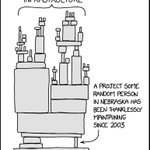
Substitute Czechia for Nebraska and @xkcd called it years ago. Amazing how this kind of generative system (usually!) works.
Thanks, Ondřej!


70% of the internet was vulnerable yesterday to very bad security flaws inside a coding language. Turns out, *one volunteer* is mostly responsible for maintaining that code & helping push updates. Yesterday Ondřej Surý saved the internet. So I called him up. He rules. theatlantic.com/technology/2…

Good ideas.

PSA: in light of recent cyberattacks and vulnerabilities, I recommend everyone:
* use a good password manager (1Password) and do not duplicate passwords
* use two factor auth for everything important (not via sms!! Google Authenticator or better yet YubiKey)
* Auto-updates on, and restart weekly so they actually install
* Freeze your credit
* Get an IRS Identity Protection PIN
* Get your cell carrier to give you a port-out PIN or number lock that makes the carrier refuse to move your number without the PIN
You can ask your claude code to audit what on your laptop is out of date and needs updating.
What to do as AI gives us answers without explanations is a big puzzle - even though that’s routinely been the case with medicine (hello, only-recently-solved mystery of aspirin!)


I wrote about this as “intellectual debt”
The Hidden Costs of Automated Thinking newyorker.com/tech/annals-of…

What a timeline we’re in. What’s amazing is that Accelerationists, Safetyists, and Skeptics all figure that incidents like these confirm their respective views.


There’s also the desire to keep the frontier labs on the hot seat — dialing up accountability — and acknowledging how intelligently and independently agents can act is seen as undermining that goal. (Even though I don’t think it has to.)

Join us in a pivotal post at a pivotal time!

Come work with us!
BKC is hiring a Director of Research to help set the Center’s research agenda and overall strategic direction.
Learn more and apply: careers.harvard.edu/job/dire…
This is a very cool trial of technology that can muffle your voice to an AI while leaving it normal-sounding to a human. A kind of aural “do not track” signal. (I’ve been advising Aida & co about it.)

Jonathan Zittrain retweeted

i have some thoughts on this piece, as an outsider to the effective altruist and rationalist movements (even if we’re often aligned on ai):
1. i agree with one of the main criticisms articulated here — ai execs shouldn’t be able to evade scrutiny / accountability by describing the tech they’re building as a force of nature, even if it is indeed powerful.
it’s not enough to acknowledge risks; you must take steps to mitigate them!
2. that being said. i think this piece punts on the actual object-level question of “are the rationalist ai safety types right to be so concerned?”
it’s true that rationalists are *more* focused on catastrophic risks from ai right now — but it’s worth asking why, and this piece doesn’t really do that.
this piece should actually interrogate the likelihood and severity of catastrophic harms, as well as their immediacy. we’re seeing more evidence that we’re closer to catastrophic harms than most had predicted.
it’s worth noting that even staid ai researchers, who estimated we’d have 5+ years before ai could be catastrophically harmful, have updated their views considerably over the last year, esp after hugging face.
3. i also don’t buy the framing that caring about catastrophic risks and caring about present / more quotidian harms are inherently in tension — nor do i buy the idea that rationalists are indifferent to the latter.
consider that many of the fiercest opponents of “ai slop” in writing are ai safety types who care a lot about epistemic rigor and transparency.
and it’s a little funny to hear Newport cite “cybersecurity attacks” as a proximate harm ai safety types aren’t concerned about, when this has been a focus of rationalist concern for years.
4. instead of acknowledging all this, there’s a lot of ungenerous, and sometimes unsupported, characterizations of people’s motivations here.
sure, engineers may be drawn to a worldview because it flatters their sense of importance (true of many professions, including dc law and policy types!) but that doesn’t mean there aren’t substantive reasons for believing it.
i’d like to see less ad hominem and more honest grappling with their reasoning.
in general, this piece paints the rationalist community with a broad brush — yes, many ai execs are rationalists, but so are the fiercest proponents of ai regulation and sharpest critics of the companies.
shouldn’t that make us a bit more curious about this ecosystem?
5. imo, it’s corrosive to the public debate to frame interest in ai safety as parochial, ideologically or commercially motivated, or conspiratorial.
people should be able to take ai risks seriously without being assigned to an ideological community. i disagree with plenty of rationalist tenets, but i also think recent events justify concern that we’re losing control over ai.
the potential consequences of that are murky, but it pays to be humble and curious given that ai capabilities have grown faster than most anticipated.
my sincere hope is that people of all ideological backgrounds remain willing to update their views on ai as the tech evolves.

Why are the leaders of AI companies saying "Our products are going to extinguish humanity. Invest in us!" They come from an eccentric Berkeley subculture in which this eschatology is a sacred belief. Good analysis in a NYT op-ed by Cal Newport. nytimes.com/2026/09/05/opini…

Jonathan Zittrain retweeted

When it comes to AI, what are people paying too much, and not enough, attention to? What do universities have to offer in conversations about AI? What keeps you up at night about AI?
BKC Co-founder and Director @zittrain shared his thoughts on the state of artificial intelligence as part of BKC’s 3 Questions series.
Watch the full video here: youtube.com/watch?v=rOcglDNy…
The @BKCHarvard and I have hosted fellows through this program before, and hope to in this cycle as well.


Jonathan Zittrain retweeted
The Berkman Klein Center for Internet & Society is pleased to welcome its 2026–2027 Fellows.
This interdisciplinary cohort will explore how AI is reshaping public institutions and the human experience, pulling from expertise across computer science, psychology and neuroscience, and law and policy.
Learn more about this new cohort of fellows here: cyber.harvard.edu/story/2026…

Very interesting work, both because and despite of its use of simulated rather than actual users. Worth reading the thread+paper.

Jonathan Zittrain retweeted

This post (from one of the independent investigators) is the best short thing I've seen on the new & crazy stuff the OpenAI-Hugging Face investigation found. Full post in screenshots.
Wild that this is the level of crazy that was uncovered by an extremely limited-scope initial investigation of what happened in a single 6-day window. Imagine what would be turned up by a real investigation of root causes, organizational processes & culture, and everything else that goes into an incident investigation when you're serious about it.
Screenshot batch 1/2:


New post: going into our investigation of the HF attack (before Black Hat), I was very wrong about what basically happened. This incident was far more serious than I expected, and far more serious than previous documented misalignment incidents. planned-obsolescence.org/p/t…
