

Building the future of enterprise-grade AI data. Enterprise clients get quality & sovereignty. Contributors get paid quickly.
Sunnyvale, CA
Joined February 2024
- Tweets4.5K
- Following167
- Followers18.1K
- Likes4.4K







A delivery file can open successfully—and still be impossible to integrate without questions.
Picture a dataset field called “status.”
Does “0” mean rejected, unknown, or inactive? Does a blank mean missing—or not applicable?
Before the purchase order, ask your data supplier for a dictionary that defines:
• Each field and its data type
• Allowed values and null handling
• Identifiers and joins across files
• Units, timestamps, and versions
• Examples of edge cases
For procurement, this is not just technical documentation. It determines how reliably the receiving team can validate the delivery.
The supplier should also confirm whether your target schema is available off the shelf or requires customization.
AIxBlock supports custom data collection, annotation, and delivery workflows designed around agreed specifications.
Planning a dataset purchase or custom collection? Discuss your target schema with AIxBlock: aixblock.io/contact
#DataProcurement #DataEngineering #EnterpriseAI


1
220
The words “close my account” do not always mean the same thing.
Compare these fictional support messages:
A: “Please close my account.”
B: “What happens if I close my account?”
A asks for an action. B asks for information.
A keyword-only intent label could collapse them into the same category—and teach a chatbot the wrong next step.
For a useful intent dataset, define:
• The user action or information need
• The context required to interpret it
• Examples that differ by one crucial phrase
• An ambiguity label or escalation rule when appropriate
For buyer teams, the question is not just how many labeled messages you can procure. It is whether the label captures the behavior your system should learn.
AIxBlock provides intent classification, entity labeling, and multilingual text annotation for LLM and assistant development.
Need task-specific intent data? See AIxBlock’s Text Data services: aixblock.io/products/text-da…
#IntentClassification #LLMData #ConversationalAI #DataQuality

152
meeting agenda: 30 minutes
actual agenda: 30 minutes of checking whether everyone's here and deciding to meet again.
see you at the follow-up. 🫠
image shared by Sheri R Hinish.
AIxBlock: aixblock.io
#OfficeHumor #MeetingCulture

137
We checked 10% of the labels” sounds reassuring.
But 10% of what?
If the sample is dominated by routine cases, it may tell you little about the categories with the greatest business impact.
A stronger review plan combines:
• Random checks for overall consistency
• Targeted checks for rare or high-impact labels
• Extra review after guideline changes
• A documented path to resolve disagreements
The right allocation depends on the dataset and the cost of being wrong. There is no universal percentage.
For a data buyer, the more useful question is: “Which failures was the QA process designed to catch?”
AIxBlock uses multi-tier review and quality-control workflows for annotation projects. Review criteria should be tied to the intended use—not only to a sampling rate.
Need a QA approach for a specific dataset? Discuss your requirements with AIxBlock: aixblock.io/contact
#DataQuality #QualityAssurance #AIData

144
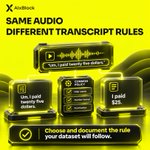
“Um, I paid twenty five dollars.”
Should the transcript keep every spoken word—or become “I paid $25”?
Both can be right for different uses. The mistake is choosing the convention after annotation starts.
An ASR team should decide up front:
• Verbatim or normalized output?
• What happens to fillers and false starts?
• How are numbers and abbreviations written?
• How are uncertain segments represented?
• Which format will the model be evaluated against?
A search interface, subtitle pipeline, and speech-recognition benchmark may need different answers.
A transcript specification turns subjective corrections into repeatable review decisions.
AIxBlock supports speech collection, transcription, and annotation, including verbatim transcripts and timestamps.
If you are planning a speech dataset, review AIxBlock’s Audio & Speech Data services: aixblock.io/products/audio
#SpeechAI #ASR #Transcription #DataAnnotation


161
The corporate delegation chain nobody puts on the org chart:
CEO → PM → Senior → Me → Claude. 😂
Turns out my job title is “Professional Prompt Forwarder.”
The joke lands because AI can take on the task — but someone still has to give it useful context and check the result.
Building assistants that handle real-world requests? Explore AIxBlock’s text and dialogue data for training and evaluation: aixblock.io/products/text-da…
Meme source: r/ProgrammerHumor — reddit.com/r/ProgrammerHumor…
#AIMeme #DeveloperHumor #AIWorkflows #LLM

158
Two vendors report the same model-evaluation score.
Would you trust the comparison without seeing how each result was produced?
Before treating a benchmark as a buying signal, request:
• Dataset and version
• Exact task or prompt setup
• Scoring criteria, including ambiguous cases
• Model version and relevant settings
• A reproducible procedure
Consider a fictional customer-support test: if one evaluator accepts an answer that sounds helpful and another requires a verifiable resolution, the scores measure different things.
The fix is not necessarily a bigger benchmark. It is a better-defined test.
AIxBlock supports LLM evaluation and human-reviewed text data workflows where reference answers and rubrics can be specified for the intended task.
Planning an LLM evaluation dataset? Explore AIxBlock Text Data: aixblock.io/products/text-da…
#ModelEvaluation #LLMData #EnterpriseAI

3
156
When a vendor says “your data is secure,” ask one follow-up:
Who holds the raw data at each stage?
A security policy matters. So does the architecture.
For sensitive training data, buyers should map:
1. Where raw assets first land
2. Who can access them during collection and annotation
3. Which temporary copies are created, if any
4. Who controls retention and deletion
5. Where audit evidence can be retrieved
The answer changes what you need to trust—and what you can verify independently.
One option is a client-controlled storage workflow. AIxBlock’s self-hosted offering allows teams to connect their own storage so data can remain within the buyer’s environment rather than requiring vendor custody.
If data sovereignty or access boundaries are procurement blockers, explore AIxBlock’s Self-Hosted Platform: aixblock.io/products/self-ho…
#DataSecurity #AIData #EnterpriseAI #DataGovernance


169
A dataset sample that looks perfect may be the least useful sample to buy from.
As a procurement lead, you need to discover the mismatch before you sign—not after you receive the files.
Ask for a representative sample that includes:
• Typical records, not just the cleanest examples
• The exact file and metadata schema
• Known exclusions and missing fields
• Annotation conventions, where applicable
• Licensing and permitted-use information
Then run one small ingestion or evaluation test against your real acceptance criteria.
If the supplier can only show a polished demo but cannot explain what it represents, you do not yet have enough evidence to judge fit.
AIxBlock offers off-the-shelf audio and custom data sourcing, collection, and annotation. The right route depends on your coverage, rights, and format needs.
Looking for data you can actually evaluate before procurement? Share the requirements with AIxBlock: aixblock.io/contact
#DataProcurement #AIData #EnterpriseAI

157
Your evaluation dashboard says the model improved.
Which customer-facing failure got better?
A single average can improve while critical cases still fail. For example, a support assistant might answer routine questions well but struggle with incomplete requests or unsupported claims.
Before choosing another dataset, break down results by:
• Task: what did the user need done?
• Failure: what went wrong?
• Impact: how serious is that mistake?
• Evidence: which test case demonstrates it?
Then prioritize the cases that matter to your product—not just the ones that move the headline score fastest.
For LLM teams, the useful deliverable is more than a CSV of pass/fail values. It is an evaluation set with clear expected behavior and reviewable criteria.
AIxBlock supports text and dialogue datasets, human preference annotation, and model evaluation workflows.
Need to make LLM evaluation more diagnostic? See AIxBlock’s Text Data capabilities: aixblock.io/products/text-da…
#LLMEvaluation #DataQuality #EnterpriseAI


2
170
A dataset can have zero exact duplicates and still produce a misleading evaluation score.
The risk is overlap that a simple file-level check does not catch.
Near-identical prompts. The same speaker across recording sessions. Related documents from one source. Template variants that differ by a few words.
If closely related examples land on both sides of a train-test split, a model may recognize familiar patterns rather than demonstrate the generalization you intended to measure.
Before accepting a benchmark, ask:
• What is the unit of independence: row, speaker, session, document, customer, or time period?
• Were near-duplicates and template variants checked before splitting?
• Could the same underlying source appear in both sets?
• Does the holdout reflect the conditions the model will face after deployment?
Random row splits can be useful. They are not automatically the right split for every task.
The test set should answer a specific deployment question — and the split design should protect that answer.
#ModelEvaluation #DataQuality #Benchmarking #AIData

1
165
One dataset can be usable for evaluation and still be restricted for training.
Data rights are not a single yes/no field.
A team may be allowed to inspect a recording, use it in a controlled test set, train a model on it, or share it with another party. Those uses can have different conditions.
Before sourcing data, connect each asset to a permission record:
𝐒𝐎𝐔𝐑𝐂𝐄 — Where did it come from, and can provenance be traced?
𝐂𝐎𝐍𝐒𝐄𝐍𝐓 / 𝐋𝐈𝐂𝐄𝐍𝐒𝐄 — What terms apply to this source and contributor, where relevant?
𝐈𝐍𝐓𝐄𝐍𝐃𝐄𝐃 𝐔𝐒𝐄 — Training, evaluation, commercial deployment, redistribution, or derivatives?
𝐑𝐄𝐒𝐓𝐑𝐈𝐂𝐓𝐈𝐎𝐍𝐒 — Are there limits on geography, recipients, retention, or downstream use?
𝐂𝐇𝐀𝐍𝐆𝐄 𝐂𝐎𝐍𝐓𝐑𝐎𝐋 — What happens if consent is withdrawn or the use case changes?
Then carry those decisions into the delivery manifest.
A practical rights matrix can distinguish:
𝐀𝐥𝐥𝐨𝐰𝐞𝐝 / 𝐍𝐞𝐞𝐝𝐬 𝐫𝐞𝐯𝐢𝐞𝐰 / 𝐍𝐨𝐭 𝐩𝐞𝐫𝐦𝐢𝐭𝐭𝐞𝐝.
The buyer question is not only “Do you have the data?”
It is “Can we show that each delivered asset is eligible for this specific use?”
#DataGovernance #AIData #DataLicensing #ResponsibleAI

1
177
More data is not always the same as more coverage.
That distinction can become expensive.
A speech dataset can add thousands of hours while still repeating the same device class, acoustic conditions, or speaking style.
An LLM dataset can add millions of examples while difficult domains, ambiguous instructions, or evaluation gaps remain underrepresented.
Volume increases the amount of data.
Coverage increases the range of conditions the model can learn from or be tested against.
The two can overlap. They are not interchangeable.
Before buying or collecting more data, map the gap:
• Which conditions are underrepresented?
• Which failure modes are not tested?
• Which domains or user groups matter in deployment?
• Which labels or metadata are missing?
• Which parts of the matrix already have enough volume?
Then add data where it changes coverage.
The goal is not the biggest dataset.
It is enough of the right data for the task.
𝐀𝐈𝐱𝐁𝐥𝐨𝐜𝐤 supports OTS, custom collection, annotation, and evaluation programs built around coverage requirements — not volume alone.
#AIData #DataQuality #ModelEvaluation #SpeechAI #LLM

1
145
"QA" should not mean the same checklist for every data type.
The control has to match the failure mode.
𝐒𝐏𝐄𝐄𝐂𝐇 / 𝐀𝐔𝐃𝐈𝐎
Useful QA may include file format, duration, signal quality, transcript alignment, metadata completeness, duplicates, and corrupted files.
𝐓𝐄𝐗𝐓 / 𝐃𝐈𝐀𝐋𝐎𝐆𝐔𝐄
Useful QA may include schema, turn order, missing context, label consistency, duplicate checks, and required content controls.
𝐕𝐈𝐃𝐄𝐎 / 𝐈𝐌𝐀𝐆𝐄
Useful QA may include resolution, FPS, framing, blur, lighting, annotation geometry, sequence completeness, and capture-condition metadata.
𝐄𝐗𝐏𝐄𝐑𝐓-𝐑𝐄𝐕𝐈𝐄𝐖𝐄𝐃 𝐃𝐀𝐓𝐀
Useful QA may include reviewer qualification, rubric version, adjudication path, disagreement tracking, and acceptance review.
The common principle is simple:
QA is not a final spot-check.
It is a set of controls designed around how the data can fail.
AIxBlock builds QA/QC into collection, annotation, expert review, and delivery workflows across multiple data types.
#DataQuality #AIData #DataAnnotation #SpeechAI #ComputerVision

1
1
168
Before you buy an AI dataset, the file count is not the first thing to check.
Ask five questions.
1. 𝐑𝐈𝐆𝐇𝐓𝐒
What use is actually permitted? Training, evaluation, commercial use, redistribution, and derivatives should be checked explicitly.
2. 𝐏𝐑𝐎𝐕𝐄𝐍𝐀𝐍𝐂𝐄
Where did the data come from? Can the source and collection or generation method be explained?
3. 𝐅𝐈𝐓 𝐓𝐎 𝐒𝐏𝐄𝐂
Does the dataset match the conditions your model needs — language, domain, device, environment, format, metadata, and task definition?
4. 𝐐𝐔𝐀𝐋𝐈𝐓𝐘
How was quality measured? What review, duplicate checks, adjudication, and acceptance criteria were used?
5. 𝐃𝐄𝐋𝐈𝐕𝐄𝐑𝐘 + 𝐂𝐎𝐍𝐓𝐑𝐎𝐋
How will the data be transferred, stored, versioned, and updated?
A large dataset can still be a poor purchase if one of these is unclear.
The practical sourcing question is:
“Can we use it, trust it, and connect it to the model requirement?”
AIxBlock supports OTS and custom data sourcing across speech, text, audio, video, and specialized datasets.
#AIData #DataProcurement #DataQuality #EnterpriseAI #MLOps


146
Prompt-response pairs are useful, but they are not the whole post-training dataset.
Different data layers can teach or measure different behaviors:
• SFT examples show what a strong response looks like.
• Preference data shows which response is better and which behavior should be preferred.
• Critique + revision captures what should change between a weak answer and a stronger one.
• Context- or tool-grounded examples teach the model to use supplied evidence and tools correctly.
• Evaluation sets measure whether the target behavior improved across normal and difficult cases.
The buyer question is not only:
“How many prompt-response pairs do we need?”
It is:
“What behavior are we trying to teach or measure?”
That answer should determine the data structure.
𝐀𝐈𝐱𝐁𝐥𝐨𝐜𝐤 supports custom LLM and dialogue data workflows across collection, annotation, expert review, preference data, and evaluation.
#LLM #PostTraining #AIData #ModelEvaluation #DataQuality


A voice model can sound strong in a quiet demo and still fail in the conditions users actually create.
Five audio conditions are especially useful in evaluation:
1. BACKGROUND NOISE
Traffic, office chatter, household sound, machinery, or other competing audio.
2. REVERBERATION
Rooms reflect sound differently. A clean close-mic recording does not test that.
3. DISTANCE
Moving the speaker away from the microphone changes level, clarity, and room contribution.
4. DEVICE + CHANNEL
Phone, laptop, headset, call audio, compression, and microphone quality all change the signal.
5. NATURAL SPEAKING BEHAVIOR
Fast speech, hesitations, interruptions, corrections, and spontaneous phrasing are different from carefully read sentences.
The goal is not to make every dataset noisy.
It is to evaluate the conditions the product is expected to survive.
A useful voice-AI test set maps those conditions deliberately, then measures performance by condition — not only as one aggregate score.
That makes failures easier to diagnose and data gaps easier to fix.
AIxBlock supports speech and audio data collection, annotation, QA, and evaluation across controlled and real-world conditions.
#VoiceAI #SpeechAI #ASR #ModelEvaluation #DataQuality

1
218
“We delete your data later” is a retention policy.
“Your raw data never enters our custody” is an architecture decision.
Those are not the same control.
In a traditional vendor workflow, raw data may move into vendor-controlled storage before processing, review, delivery, and eventual deletion.
A client-controlled workflow can change the path:
SOURCE DATA
↓
CLIENT-CONTROLLED STORAGE
↓
APPROVED PROCESSING / REVIEW
↓
OUTPUT BACK TO CLIENT
The vendor may still provide the platform, workflow, QA, or workforce — without needing to become the long-term custodian of the raw dataset.
Why does that matter?
Because every additional copy creates another question:
• Who can access it?
• Where is it stored?
• How long does it remain?
• How is deletion verified?
• What happens when access changes?
Retention controls still matter.
But reducing unnecessary custody can remove risk before a deletion policy ever has to manage it.
For sensitive AI data programs, architecture should be part of the governance conversation from day one.
AIxBlock supports self-hosted and client-controlled data workflows where storage, access, processing, and delivery requirements are defined around the project.
#DataGovernance #DataSecurity #EnterpriseAI #AIData #Privacy

176
Not every labeling task needs a domain expert.
But some tasks become unreliable when judgment is treated like a simple annotation.
Four examples:
1. MEDICAL OR CLINICAL CONTENT
The label may depend on terminology, context, or distinctions a general annotator should not be expected to infer.
2. SPECIALIZED TECHNICAL DATA
Code, engineering records, scientific text, and other technical material may require reviewers who understand what a correct outcome actually looks like.
3. AMBIGUOUS OR HIGH-STAKES EDGE CASES
When two plausible labels exist, the important work is often defining the decision rule — not asking more people to vote.
4. GOLD SETS + EVALUATION RUBRICS
If a dataset will measure model quality, the reference answer needs defensible judgment. That may require expert review, adjudication, and documented criteria.
The buyer question is not:
“Can this be labeled?”
It is:
“What level of judgment does a reliable label require?”
A good data operation separates routine annotation from expert decisions, then builds escalation and adjudication around the boundary.
AIxBlock supports expert-reviewed data workflows, rubric design, QA, and custom annotation programs across specialized domains.
#DataAnnotation #AIData #DataQuality #HumanInTheLoop #ModelEvaluation


1
222
Training data and evaluation data should not be optimized for exactly the same thing.
Training data often helps a model learn the dominant patterns in a task.
Evaluation data has a different job:
find the conditions where those patterns stop being enough.
For a voice model, that may mean testing:
• background noise
• unfamiliar accents
• reverberation
• distance from the microphone
• interruptions or overlapping speech
For an LLM, it may mean:
• ambiguous instructions
• incomplete context
• conflicting evidence
• domain-specific terminology
• requests that require refusal or escalation
If your evaluation set mostly looks like the cleanest parts of your training set, a strong score can hide weak deployment behavior.
A useful evaluation set should deliberately include the conditions production will expose — especially the ones training data tends to smooth out.
The question is not only:
“How accurate is the model?”
It is:
“Under which conditions does accuracy break?”
That is the information teams need before deployment.
AIxBlock supports custom evaluation datasets designed around real deployment conditions, edge cases, and measurable failure modes.
#ModelEvaluation #DataQuality #AIData #EnterpriseAI #MLOps


176