

AI+Science, Co-Founder @accelerated_u, Bren Professor @caltech, Time100, Fmr Sr Director of #AI research @nvidia Fmr Principal Scientist @awscloud
Joined May 2021
- Tweets2.8K
- Following2.5K
- Followers46.9K
- Likes7.1K







Pinned Tweet
Excited to see @Reuters cover the launch of our startup Accelerated Understanding.
We are training large scale AI models that can simulate and understand physics to invent and discover. Our models understand the world directly in 4D (3D + time) and across physical phenomena. Going full 4D requires massive context length, we have pushed it to a Trillion in training and exceeding 5 Trillion at inference.
AI giving you a bigger haystack of ideas doesn’t help. The bottleneck for new inventions and discoveries is shifting from ideas to the ability to test them. With AI that can simulate and understand physics we are directly attacking this bottleneck.
People have been trying to do this for a while now, but usually by taking shortcuts. Narrow surrogates are great if you happen to have enough of precisely the right data and your design loop stays in distribution. Video models look fantastic but sweep physical accuracy under the rug, and some static world models cut out physics altogether. A lot of interesting physics isn’t visual.
What does not cutting corners look like? Space stays 3D and you also have time: so 4D in total. You also need multiple physical modalities in the same model, not just things you can see. That’s what we’ve built.
Scaling is the primary ingredient to make this work. To represent the world you need sufficient context, which in our case grows in 4 dimensions. Individual samples get so big they don’t fit into single accelerators or even full nodes anymore.
We’ve developed architectural tricks to make it work. We’ve pushed our models to 1T parameters during large scale pre-training and are able to train at up to a Trillion context when needed and do inference exceeding 5 Trillion context without any sub-sampling or patching.
Building on prior successes of AI weather forecasting, fusion simulation, design of medical devices, drugs and chips, we wanted to see if scale and universality can benefit AI for physical understanding. With our teams’ experience in large-scale infrastructure and model training we’ve been able to pull it off.
reuters.com/business/ai-foun…
acceleratedunderstanding.com…
@accelerated_u @bjenik


It was such a fantastic experience giving the keynote earlier today at #sc26 For anyone who wanted to meet to talk about my research at @Caltech and what we are building at @accelerated_u Accelerated Understanding we are hosting a meet and greet at the conference this afternoon at 3pm at W196a

📣 📣 #SC26 Special Announcement!
We are delighted to announce that our keynote speaker, Dr Anima Anandkumar, will participate in a meet-and-greet tomorrow, Tuesday, Nov. 17th, from 3:00 PM CST onwards in W196a. Join us for this incredible in-person opportunity.

See you soon at my keynote @Supercomputing #SC26
Animashree "Anima" Anandkumar takes the stage as our #SC26 Keynote at 8:30 AM CST in W375de and live on our Digital Experience.
Join in as she presents: The Next Scaling Law after LLMs: AI that Understands the Physical World. sc26.supercomputing.org/prog…

Prof. Anima Anandkumar retweeted

really fun doing this with @srush_nlp!! softmax was just the start. we did a full numerical audit of ML ops across PyTorch, JAX, TF, NumPy, CuPy, ONNX Runtime and MLX, checked against TorchLean, and found a lot more!!!

Lean Verified Precision (w/ @Robertljg)
Recently, "A Fix for Softmax" demonstrated a surprising bug in the textbook softmax implementation. How do we avoid having subtle bugs in the world's most expensive software? 🧵

Prof. Anima Anandkumar retweeted

From language models to AI that understands the physical world, @AnimaAnandkumar outlines what she sees as the next wave of artificial intelligence at #HTLS2026!
In conversation with @vishalmathur85, Technology Editor, Hindustan Times.
📺 Watch the session on YouTube: youtube.com/watch?v=apA9XLQn…
#NewRulesNewRealities #HTLeadershipSummit #HindustanTimes | @VFSGlobal @AdityaBirlaGrp
Prof. Anima Anandkumar retweeted
How can AI improve the way we predict extreme weather events?
At #HTLS2026, @AnimaAnandkumar highlights how AI-powered forecasting uses historical data and learned patterns to make faster, more reliable predictions, including hurricane tracking.
#NewRulesNewRealities #HTLeadershipSummit #HindustanTimes | @AdityaBirlaGrp | @VFSGlobal | @vishalmathur85
Prof. Anima Anandkumar retweeted


HTLS 2026 Day 1: VFS Global's Zubin Karkaria and Caltech's Anima Anandkumar Join In nitter.cf/i/broadcasts/2POrpQOam…

Prof. Anima Anandkumar retweeted
🔴 #LIVE: 𝐙𝐮𝐛𝐢𝐧 𝐊𝐚𝐫𝐤𝐚𝐫𝐢𝐚, Founder and CEO, VFS Global, and 𝐀𝐧𝐢𝐦𝐚 𝐀𝐧𝐚𝐧𝐝𝐤𝐮𝐦𝐚𝐫, Co-Founder of Accelerated Understanding and Bren Professor at Caltech, take the stage for conversations on Day 1 of #HTLS2026 ✨
#NewRulesNewRealities #HTLeadershipSummit #HindustanTimes | @AnimaAnandkumar | @Nisheeth_U @vishalmathur85
nitter.cf/i/broadcasts/2yboWMbno…

Prof. Anima Anandkumar retweeted
At #HTLS2026, @AnimaAnandkumar highlights how AI-powered scientific modelling can make complex physical simulations faster and more efficient, in conversation with @vishalmathur85!
📺 Watch the session on YouTube: youtube.com/watch?v=apA9XLQn…
More details: hindustantimes.com/s/1lwRVM8
#NewRulesNewRealities #HTLeadershipSummit #HindustanTimes | @VFSGlobal @AdityaBirlaGrp
Not many are aware that Arthashastra was discovered in my hometown of Mysuru by my great great grandfather R.Shamasastry. en.wikipedia.org/wiki/R._Sha… The manuscript can be seen in the Oriental Research Institute, where he was the director, along with many other priceless palm leaf manuscripts.

From Mahabharata to Arthashastra, 3 Indian classics earn UNESCO recognition
tribuneindia.com/news/india/…
via NaMo App

Prof. Anima Anandkumar retweeted

Two weeks from today: #SC26 Keynote Speaker Anima Anandkumar takes the stage in Chicago!
Learn more about her work in AI and her special relationship with the SC Conference series: sc26.supercomputing.org/2026…

Inspired by the spinor nature of spin–orbit-coupled electronic states, we introduce eSpinor, an SU(2)-equivariant graph neural network that propagates spinor features to predict spin-orbit coupling (SOC)-dependent magnetic properties.
Magnetic properties such as magnetic anisotropy, excitation energies, and spin dynamics guide the design of single-molecule magnets, MRI probes, and other spin-based technologies. Predicting them often requires CASSCF-SO calculations to capture multireference electronic structure, which can take hours for a single molecular geometry.
SO(3)-equivariance has improved the accuracy of rotation-invariant energy predictions in machine-learning interatomic potentials. Can we take this idea further by imposing SU(2)-equivariance on spinor features as an inductive bias for predicting magnetic properties?
Our main contributions are:
(1) SU(2)-equivariant spinor message passing: Hamiltonian-derived spinors and classified interaction types enable gauge-covariant updates and gauge-invariant predictions
(2) Unseen-ligand generalization: Improved magnetic anisotropy and excitation-energy predictions for cobalt and dysprosium single-molecule magnet candidates
(3) Spin dynamics and solvent transfer: More accurate predictions for a dysprosium MRI probe, with benefits extending from water to methanol without retraining
Our results support SU(2)-equivariant spinor message passing as a useful inductive bias for molecular magnetism, even when the targets are integer-rank tensors or invariant scalars.
With this framework, we’re excited to help accelerate the discovery of new magnetic molecules and deepen our understanding of their spin dynamics!
arxiv.org/abs/2610.29111

Prof. Anima Anandkumar retweeted

Very excited to share GeoWind2Plan 🚀, our NeurIPS 2026 Spotlight paper, and a new interactive demo ✨!
We make high-resolution 3D wind predictions in seconds to guide energy-efficient drone planning.
Wind-aware planners often assume the wind field is already known. But simulating airflow around buildings takes hours of CFD, making it impractical for short drone missions when wind conditions change.
Our approach couples wind prediction with trajectory optimization. By rotating the city layout to align with a fixed reference wind, we turn wind-direction generalization into building-geometry generalization. A localized neural operator uses multi-directional distance features to predict 3D wind within a flight corridor. The planner then optimizes the drone’s path and speed in continuous 3D space to reduce energy use. In our simulations, the drone generally flies higher and faster in tailwinds, lower and slower in headwinds, and shifts sideways to exploit favorable local winds.
Corridor prediction takes about 3 seconds versus roughly 8 hours for full-domain CFD. Compared with wind-agnostic planning, our method reduces average energy use per kilometer by 12.7% in headwinds, 6.9% in tailwinds, and 4.5% in crosswinds in CFD-evaluated simulations. It captures 75–88% of the energy savings achieved with CFD-reference wind fields.
Moving forward, we will focus on turning AI predictions of the physical world into actionable decisions for autonomous systems. Follow our lab for updates: dual.xiongyexiao.com
Explore the demo: move the start 🚩 and goal ⛳, change the wind, and watch the airflow and routes respond.
Demo: geowind2plan.com
Desktop Chrome or Edge recommended.
Paper: arxiv.org/abs/2609.36056
Congratulations to my students Shaoxiang Qin and Yucheng Zhao, and thank you both for your hard work on this project! Many thanks as well to Fuyuan Lyu, Di Zhou, Jiachen Yao, Steve Liu, Anima Anandkumar, and Liangzhu Leon Wang for their valuable contributions and collaboration. We’re also very grateful to the NSF-funded COMPASS: Center for Complex Particle Systems and AI Tennessee for supporting this work!
Proud to be selected for the H2O.ai AI100 list and featured on Nasdaq tower in Times Square!


Prof. Anima Anandkumar retweeted

SkAI and NNCI welcomed @Caltech’s Dr. @AnimaAnandkumar on neural operators & AI for science. From a weather model that beat supercomputers to simulating black holes and fusion reactors, she still emphasizes the human role: "AI isn’t replacing scientists anytime soon."


Prof. Anima Anandkumar retweeted

Introducing our first #MWC27 Barcelona keynote speakers 👏
🔹 @mati, @ElevenLabs
🔹 @amywebb, @FTSG_Consulting
🔹 Yoon Young Park, KT
🔹 @AnimaAnandkumar, @accelerated_u & @Caltech
🔹 Dr Hany Farid, GetReal Security
Pre-register now 👉 gsma.at/47yn7Kq

Prof. Anima Anandkumar retweeted

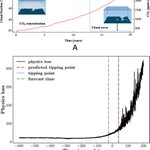
A new Caltech-led paper demonstrates that an AI program can be used to predict when tipping points occur in simple models, including models of a climate-change system and simulations of turbulent airflow over a plane's wing.
caltech.edu/about/news/forec…

Can we predict electronic bands beyond DFT across different systems?
A material’s electronic band structure provides the basis for band gaps, densities of states, and carrier effective masses, while connecting theory with spectroscopy. For quantum materials, getting these bands right can change our understanding of physics. Yet the calculations needed to go beyond standard DFT remain expensive.
We introduce O-krystal, a periodic E(3)-equivariant graph neural network that learns corrections to individual electronic states. It uses orbital information from lower cost PBE calculations in both real and reciprocal space, bringing local electronic interactions and the momentum dependence of the crystal into the same model.
O-kRystal is the first machine learning framework to combine:
1. Scale across chemistry: HSE06 band predictions across nearly 6,000 chemically diverse three dimensional materials
2. Breadth across electronic behavior: metals and insulators, magnetic and nonmagnetic systems, with spin resolution and different numbers of bands
3. Flexibility across theory and dimensionality: the same framework, trained separately, predicts G0W0 quasiparticle energies in two dimensional materials.
Although trained only at high symmetry points, it maintains comparable accuracy at unseen points along band paths and reconstructs densities of states from dense Brillouin zone predictions.
On a separate benchmark of strongly correlated materials, O-kRystal reduces the PBE band energy MAE by 68.7%. As demonstrated for AFM-II MnO, a canonical Mott insulator, it captures distinct corrections to Mn 3d and O 2p states, recovering their relative placement by accounting for the effects of exact exchange.
As electronic structure methods advance, this framework offers a path toward experimental accuracy and large-scale discovery of quantum materials with emergent phases, including superconductivity. @Caltech

Link to the paper: arxiv.org/abs/2610.19919
