
@APAi
iAccount based inUnited States
About this account
- Account based in
- United States
- Connected via
- Web
Account-level information from X, not a live location or the device used for a specific post.
Official voice of American Psychological Association | Promoting advancement, communication & application of #PsychScience to benefit society & improve lives
Washington, DC
Joined February 2012
- Tweets20K
- Following1.6K
- Followers291K
- Likes14.9K
If used appropriately, AI can be a helpful tool for finding the right type of mental health provider or organizing your thoughts between therapy sessions, says Dr. Stephen Schueller. Read more guidance from APA on how to navigate AI-generated advice. at.apa.org/ai-guide
A long-term study of older adults found cognitive enrichment throughout life was linked to slower cognitive decline, lower likelihood of Alzheimer’s-related dementia, and an estimated 5-year delay in dementia onset. More highlights from recent studies: at.apa.org/f6dc69
Nearly half of workers are concerned about their job duties becoming obsolete as a result of AI, according to APA’s 2026 Work in America survey. Approximately 64% believe technology benefits employers more than workers. Read the report’s full findings: at.apa.org/zlm
A course with Stanford University neuroscientist Dr. Robert Sapolsky set Dr. Rebecca Thurston on a path to studying the mind-body connection.
Now, Dr. Thurston credits a 20-year daily meditation practice with this key insight: you are not your thoughts.
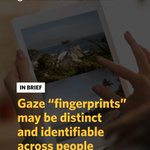
Fingerprints aren’t the only thing that make you unique. Research found the way people look at images is surprisingly consistent over time and unique enough to act like a personal “gaze fingerprint.” Read more highlights from recent peer-reviewed studies: at.apa.org/f6dc69
Why are so many of us drawn to scary movies, true crime, and all things creepy?
Dr. Coltan Scrivner explains how frightening entertainment might actually boost resilience for some people and help us cope with real-life challenges: at.apa.org/vku
This month’s Psychology for a Better You newsletter explores why we’re drawn to the things that scare us, and what that can teach us about handling real-life fears.
Read the full issue and subscribe: at.apa.org/986057
It’s Banned Books Week (October 4–10).
Join us in celebrating the freedom to read with Magination Press books that have faced challenges over the years.
Which banned or challenged book are you reading this month?
at.apa.org/n8h
Mental and behavioral health care is essential care, and expanding access to evidence-based services can help people get support before they reach a crisis.
As Election Day approaches, learn where candidates stand on the issues and make a plan to vote: at.apa.org/vote2026

ALT A graphic by American Psychological Association Services, Inc. with a blue background. It includes the headline "Psychology and the Issues" and the message "Mental and behavioral health care saves lives." Below, it states, "Expanding access to evidence-based care can help people get support when and where they need it.
AI can help students finish the work. But is it helping them learn? Dr. Nicole Barnes explains why better performance on a task doesn’t always mean understanding has developed. Explore APA’s report on children’s learning with educational technology. at.apa.org/yp6
Listen as Dr. Malissa Clark explains how workaholism differs from just working hard, and how it can affect people’s physical and mental health, as well as their relationships.
Hear the full conversation: at.apa.org/lbs
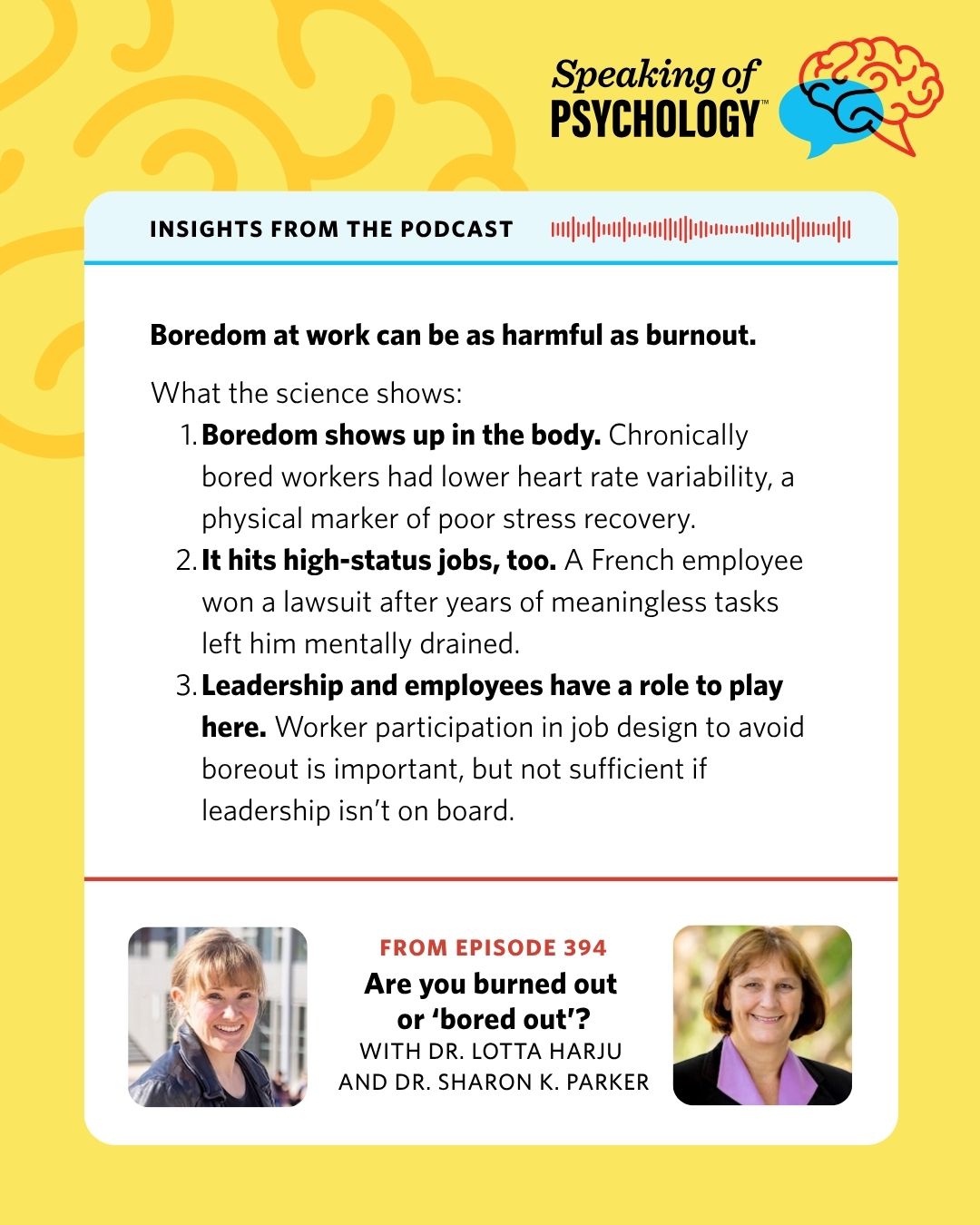
Burnout gets most of the attention. But for nearly half of workers, the problem isn’t too much, it’s too little. Psychologists call it “rustout,” and its effects on health and well-being are just as serious. Learn more: at.apa.org/sdp
Psychologists recommend people lean on loved ones, prioritize self-care, and be patient with themselves to help manage the stressful effects of trauma.
Learn more about how to cope with traumatic stress: at.apa.org/f20efb
Chatbots tend to validate. Psychologists know when to push back. Dr. Mitch Prinstein, APA’s senior science advisor, explains why that difference matters. Read more guidance from APA on how to navigate AI-generated advice thoughtfully and safely. at.apa.org/ai-guide
Not having enough to do can wear on your health and performance just as much as having too much. Listen to the full episode of APA’s Speaking of Psychology podcast with Dr. Lotta Harju and Dr. Sharon K. Parker.
at.apa.org/4h1
Workers with high psychological capital are significantly less likely to report work-related mental health concerns, according to APA’s 2026 Work in America survey. Read the full findings: at.apa.org/zlm
Congratulations to Dr. Candice Hargons, a tenured associate professor of behavioral, social, and health education sciences at Emory University, for being elected as APA’s 2028 president. She will serve as 2027 president-elect as of January 1. Learn more: at.apa.org/eb9450
When a student says, “Don’t tell anyone,” that’s exactly when adults need to act.
Dr. Matthew Nock explains why breaking secrecy can save lives and how teachers can be a bridge to professional mental health care.
Learn more: at.apa.org/zfh
Congratulations to Dr. Michael Yartsev!
Read more about the recent accomplishments of esteemed psychologists from across the country: at.apa.org/3e10fa
Let’s revisit our conversation with Dr. Ruth Ogden as she breaks down the psychology behind our perception of time and explains how our memories, routines, and emotions can make life feel like it’s speeding by. Hear the full discussion: at.apa.org/qnl