

Official Twitter account for the Ark Encounter, located in Williamstown, Kentucky.
Greater Cincinnati
Joined November 2010
- Tweets9.3K
- Following3
- Followers42.1K
- Likes281


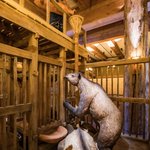
Most flying creatures can escape regional flooding, yet Genesis says they were preserved on the Ark during the Flood. This indicates the global extent of the catastrophe.

See how many animals could fit in the Ark and how Noah may have housed them when you visit the Ark Encounter.
A question is only sincere if you’re willing to consider the answer. We’ve been answering these questions for longer than you’ve been alive. We even built a full-sized replica of the ark to make it easy to understand.
The Ark was designed to carry all of the animals, food, storage, and supplies necessary to survive the Flood.
The Ark’s enormous size is consistent with the interpretation that Noah’s Flood was not just a regional or local flood.
What did Junior's Zoo keepers do with their extra hour this week? Sleep!
“He will not allow your foot to stumble; He who keeps you will not slumber. Behold, He who keeps Israel will not slumber and will not sleep” (Psalm 121:3-4 LSB).


According to the Bible, the Ark measured 300 x 50 x 30 cubits. Using a 20.4-inch cubit length, that corresponds to a volume of about 1.88 million cubic feet after we subtract 15% to account for the curved hull.
Some rock layers in and near the Grand Canyon are smoothly curved, consistent with the idea that they were bent while still wet from the Flood.
The extremely popular Animal Care exhibit explores questions that most people have never considered. How could the small cages be designed to minimize precious time for feeding and cleaning up after the animals? How were small reptiles and amphibians housed and fed? How did Noah’s family provide for animals with picky diets, such as koalas and anteaters?
The second bay of this exhibit focuses on some large-scale issues concerning the Ark. How could Noah’s family collect enough water for drinking and cleaning? How was the Ark ventilated and lit? How could they efficiently remove waste?
Dioramas and interactive videos demonstrate possible techniques used on the Ark to automate some of the daily chores involved in caring for a large number of animals.


Ark Encounter estimates that Noah may have cared for around 1,400 kinds of land animals and flying creatures.
A common question voiced by believers and skeptics alike is, “How could Noah fit all the animals on the Ark?” The key to understanding this issue is that Noah and his family brought only land-dependent animals with them on the Ark, and of those, they brought representatives from every kind.
Since kinds are typically made up of numerous different species, this means that God only brought select land-dependent representatives of each kind to the Ark.
The Animal Kinds teaching bays discuss topics like how many species there are in the world today, what a “created kind” is, the potential mechanisms for the generation of new species within kinds, the differences between biblical creationism and forms of evolution, and the significant shortcomings of the latter.
Displayed animal figures include representatives of the dog, cat, Archaeopteryx, and great ape kinds.


In many cases, the biblical “kind” may be approximated by the family level of biological classification.
Noah didn’t preserve two of every species on the Ark but representatives from flying and land animal kinds.
A fossilized marine reptile preserved in the process of giving birth demonstrate instant burial, which is what would occur during the global Flood.
