

Dermatopathologist (Derm trained Dermpath) It was love at first slide. Data analysis, Debates, Philosophy. https://nitter.cf/t.co/jJQcOXJykn
Joined December 2019
- Tweets50K
- Following1.1K
- Followers28.8K
- Likes12.4K







Speaking of access to care, no country with a single-payer healthcare system currently pays for modern GLP-1 medications (Wegovy/Zepbound) for weight loss with obesity alone (without diabetes or other weight related conditions).
The only countries that cover modern GLP-1 drugs for obesity alone (without diabetes or other weight related conditions) have multi-payer healthcare systems.
Let's compare the single-payer and multi-payer countries by modern GLP-1 coverage for obesity alone.
Single-payer healthcare systems:
UK: Requires at least 1 weight-related comorbidity (no public coverage for Obesity alone) and at a BMI of 35+. Ruthless NICE restrictions on top of that, but that's another matter.
Canada: No public coverage for obesity alone.
Taiwan: No public coverage for obesity alone.
Australia: No public coverage for obesity alone.
Sweden: No public coverage for obesity alone.
Finland: No public coverage for obesity alone.
Iceland: No public coverage for obesity alone.
New Zealand: No public coverage for obesity alone.
Denmark: No public coverage for obesity alone.
South Korea: No public coverage for obesity alone.
Spain: No public coverage for obesity alone.
Portugal: No public coverage for obesity alone.
Italy: No public coverage for obesity alone.
New Zealand: No public coverage for obesity alone.
Ireland: Only covers older, less effective GLP-1 liraglutide, and even then requires multiple weight-related comorbidities.
Multi-payer healthcare systems:
USA:
Medicare (65+) bridge program currently covers modern GLP-1 drugs at a BMI of 35+ even with no weight related conditions at a $50 co-pay.
For Medicaid, 8 states (North Carolina, Tennessee, Missouri, Minnesota, Kansas, Mississippi, Wisconsin, Delaware) cover modern GLP-1 drugs at BMI 30+ even with no weight related conditions. Incidentally, they generally cover it at a BMI of 27+ with a weight related condition.
2 states (Michigan, Virginia) cover modern GLP-1 drugs at BMI 40+ with no weight related condition.
For private employer sponsored plans: 18% of firms with 200+ workers, 33% of firms with 2000+ workers (KFF Employer Health Benefits Survey). Other employer surveys have found higher rates (WTW at ~53% and Business Group on Health at 60-67%), but they may be less representative than KFF.
Switzerland: Covers 90% of cost (after deductible) for modern GLP-1 drugs for obesity at BMI 35+ even without weight related conditions.
France: Covers 65% of cost for modern GLP-1 drugs for obesity at BMI 40+ without weight related conditions. Rest of cost is typically topped off via a private supplementary insurance plan. In practice, most patients end up with little or no out-of-pocket cost.
Japan: Requires weight related conditions.
Germany: No public coverage for obesity alone.
Belgium: No public coverage for obesity alone.
Austria: No public coverage for obesity alone.
Re: "But but but the US has more obese people!"
That's true! Which means it costs the US way more to cover, and yet they still cover it more than single-payer countries. And either way, adjusting for obesity rates the US rate of coverage won't yield equality (trivially true when single-payer coverage is zero).
Not to mention Switzerland (another multi-payer country) only has an obesity rate of only 12.1% and covers it.
So no matter how you slice the data or the objections, multi-payer countries have better access (on average) to GLP-1s for obesity than single-payer countries, which essentially don't cover it at all.
5
327
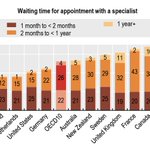
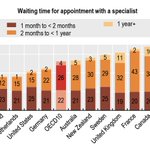
Median waiting time to be treated by a specialist in Canada has reached 30.7 weeks (~7 months).
By location shortest wait time was Ontario at 22.1 weeks (~5 months) and the longest was New Brunswick at 64.4 weeks (~1.2 years).
A reminder that affordability is not the only meaningful barrier to accessing care.


Patient who wore a watch (but no sun protection) for decades.
On the rest of the sun-exposed arm and dorsal hand, there are numerous actinic keratoses (pre-cancers), photo-aged skin, as well as a propensity for bruising as a consequence of solar elastosis replacing collagen.

Good. Hopefully she pays dearly.
On a broader note: We should normalize defamation cases against shameless liars in slop media, and perhaps create channels / support pathways to lessen the friction to those injured to bring truth and justice to this massively polluted space.

We've gone from "you're a complete moron if you think Mamdani will actually release criminals back on the streets with program reforms" to "why is releasing criminals back on the streets with program reforms bad, fascist?"
Holy shit


The New Yorker story that seems to have led to this incredible retraction. newyorker.com/magazine/2026/…


Honestly, I would have rather just paid the taxes to build 6 more prisons instead 4 if it meant no criminals released from Rikers.
Would have been one of the few Mamdani taxes I could actually get behind.
Hey so remember when I was getting shit for opposing Mamdani on this because they didn't believe my prediction that he would actually release criminals back on the streets couched in "alternative-to-incarceration" programs?
Welp, his new Rikers plan is out. And not only does it not meet the promised 2027 deadline (pushed out to 2032), it STILL calls for releasing hundreds charged with class B felonies with alternative-to-incarceration programs.
Also of note, no where in the plan does it mention that those released will only those with non-violent class B charges, or that whether the crime was violent or not would even serve as the basis of risk assessment.
Furthermore when the plan parenthetically lists examples of such class B felonies that it suggests may be for targeted reduction (as opposed to diversion at the point of arraignment), they are explicitly listed as "attempted murder and first-degree: robbery, rape, burglary, and assault". 🙃
The closure of Rikers Island by 2027 is probably the most important issue of the entire debate yet it was only covered for a few minutes. So let me be clear:
We currently have NO alternative to Rikers ready to handle its prisoner/detainee population.
If it does close, in practice approximately 3,700–4,300 individuals would need to be diverted from incarceration (up to 7,669 if replacements delayed) through mechanisms like bail reform, expedited court processing, "alternative-to-incarceration" programs, or releases, effectively reducing the detained population by more than half. About half of this population are being held for violent crimes including murder, rape, and assault.
Do not let anyone (including Zohran) tell you that it's not their position to blanket release these prisoners. This is technically true in theory but misleading because these alternative-to-incarceration programs are not considered blanket releases, but in practice, they basically are in the sense that these people will ultimately be back on the streets as we have no other practical way to handle such a population in the current timeframe that Zohran is insisting on.

The full story behind this retraction is wild.
Just an incomprehensible degree of consistent fraud that harmed so many people.
We need to have laws on the books for things like this.
newyorker.com/magazine/2026/…

The Lancet is retracting a 2006 Case Report by Koren et al, following the outcome of a formal investigation. The investigation found that important results from the infant’s toxicology reports were omitted from the paper, including the infant’s blood codeine and acetaminophen levels, and the finding that codeine was present in the baby's stomach contents. The report concluded that these omissions amounted to falsification. Read more: spkl.io/60177jReH

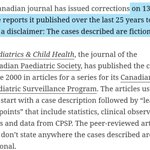
This was the "Baby Boy Blue" case (Rieder & Koren, Paediatrics & Child Health, 2010)
This was a different publication but by the same author, as the now retracted Lancet case the 2006 paper ("Pharmacogenetics of morphine poisoning in a breastfed neonate of a codeine-prescribed mother"), which reported the 2005 death of a real infant, but omitted key details that changed the interpretation of the cause of death.
If we lived in a world where humans were bred by the billions into factory farms and slaughtered for their flesh, with no plausible future ban in sight, then making lab grown human meat would be at the top of my priorities.
Hopefully it would be at the top of yours too.
