

Founder & CTO @origin_trail Decentralized Knowledge Graph | Collective Neuro-Symbolic AI | V~ℕ^2
Decentralized
Joined June 2010
- Tweets10.6K
- Following3.9K
- Followers6.8K
- Likes30.7K


Brana Rakic retweeted

Attackers automated discovery.
Defenders need to automate sharing. ✅
When one Agent #Blackbox catches a threat, every node in the network is warned, signed and recorded on the @origin_trail DKG. Opt-in, privacy-safe: no prompts, no paths, no file contents.
curl -fsSL blackbox.umanitek.ai | bash

Hackers are now using LLMs to continuously scan software updates, spot newly fixed bugs, and build attacks before teams can apply the fix — all without human involvement. That’s according to the latest report from the Google Threat Intelligence Group.
We're helping defenders counter automated threats with Google AI Threat Defense, which combines Gemini and other frontier models to find and fix flaws before attackers can exploit them.
Brana Rakic retweeted

Last week’s @Microsoft 365 outage showed how a single latent bug in a centralized system can take critical services offline for hours across dozens of countries.
Decentralized Knowledge Graph (DKG) works differently. It has no single point of failure. Context lives across independent nodes, stays owned by those who produce it, and remains available and verifiable even when individual infrastructure has issues.
That’s why continuous assurance for manufacturing, based on cognitive digital twin from @TraceLabsHQ, can keep running: tracing a faulty component lot into finished products the same day, linking every claim to its source, and supporting human decisions without depending on one cloud provider.
Decentralized systems don’t go down. They keep providing services to critical infrastructure around the clock.
Trust the source.

What happens when factories start thinking as a network?
A faulty part stops being a mystery. It becomes a question with an answer the same day.
Introducing continuous assurance for manufacturing, built on a cognitive digital twin on @origin_trail Decentralized Knowledge Graph (DKG).
Most quality and safety assurance still happens at audits: sampled evidence and a scramble when something goes wrong. We think it should run all the time.
In this demo, ACME Robotics has two plants. One builds control boards; the other builds robot arms. Each keeps its own private context graphs on its own node. A shared graph links every board to the robot it ended up in. Together they form a cognitive digital twin of the factory.
Then an alarm: motor-driver boards start failing a warm test.
→ The twin agents trace it to one capacitor lot that skipped inspection, and follow it into 180 robots, 18 of them already at a customer.
→ The AI Assurer checks the facts against safety and quality requirements and flags a safety issue in the robots' safe-stop circuit. Every claim is linked to its source.
→ Agent nOS proposes a targeted plan: hold, test, visit the 18 delivered robots, rebuild only what fails.
→ People decide. Quality, safety, planning and compliance sign off, and every decision is kept with its evidence.
→ The customer gets a straight answer, without seeing factory data.
Alarm to a signed-off safety decision in the same day. No blanket recall. Nothing guessed: uncertain links stay marked uncertain.
@origin_trail keeps the knowledge verifiable and owned by those who produce it.
*ACME Robotics is a fictional manufacturer; the scenario is simulated in our Network Operating System - nOS.
Brana Rakic retweeted
1,000,000+ verified threats now live on Decentralized Knowledge Graph (DKG).
@umanitek’s Agent #Blackbox is turning shared threat intelligence into a collective immune system for AI agents.
The more it knows, the safer every agent becomes.
Trust the source.

1,000,000+ threats published ✅
Agent #Blackbox's verified threat graph just passed one million known threats anchored the @origin_trail Decentralized Knowledge Graph, and it's still growing.
The more threats known. The more attacks stopped.
The more it knows, the safer your agent.
nitter.cf/umanitek/status/210778…
Brana Rakic retweeted
1,000,000+ threats published ✅
Agent #Blackbox's verified threat graph just passed one million known threats anchored the @origin_trail Decentralized Knowledge Graph, and it's still growing.
The more threats known. The more attacks stopped.
The more it knows, the safer your agent.
nitter.cf/umanitek/status/210778…
New article: Part 1 of a series by @CredibleCrypto, our first product ambassador.
He covers how Guardian, TrueSeal and Guardian Blackbox fight the dark side of AI, why every result is anchored on the @origin_trail DKG, and where $TRAC fits in.
Read the full article on our newsroom 👇
umanitek.ai/newsroom/someone…


Brana Rakic retweeted
🧠 Two sides of the brain. One giant leap for AI
With Decentralized Knowledge Graph (DKG), neuro-symbolic AI unlocks answers backed by sources, insights across siloed data and decisions checked against rules.
@BranaRakic explains:
Brana Rakic retweeted
🛡️ With @umanitek Guardian, ChatGPT 1B+ users can now create verifiable evidence on the Decentralized Knowledge Graph (DKG).
Ask @ChatGPT to find who’s impersonating you. The evidence pack goes on the DKG first, then the takedown request.
Trust the source.
Guardian is now on @ChatGPT.
Your ChatGPT can now protect your name too.
Ask it to:
→ find deepfakes, fake accounts and harmful content
→ create verifiable evidence on the @origin_trail DKG
→ request takedowns
Setup takes under a minute:
chatgpt.com/plugins/plugin_a…
Brana Rakic retweeted
When factories start thinking as networks, assurance stops waiting for audits.
Product safety checks.
Supplier checks.
Cybersecurity checks.
All assured continuously and autonomously, every claim backed by its source on Decentralized Knowledge Graph.
Take a sneak peek into @TraceLabsHQ' Network Operating System - nOS👇
What happens when factories start thinking as a network?
A faulty part stops being a mystery. It becomes a question with an answer the same day.
Introducing continuous assurance for manufacturing, built on a cognitive digital twin on @origin_trail Decentralized Knowledge Graph (DKG).
Most quality and safety assurance still happens at audits: sampled evidence and a scramble when something goes wrong. We think it should run all the time.
In this demo, ACME Robotics has two plants. One builds control boards; the other builds robot arms. Each keeps its own private context graphs on its own node. A shared graph links every board to the robot it ended up in. Together they form a cognitive digital twin of the factory.
Then an alarm: motor-driver boards start failing a warm test.
→ The twin agents trace it to one capacitor lot that skipped inspection, and follow it into 180 robots, 18 of them already at a customer.
→ The AI Assurer checks the facts against safety and quality requirements and flags a safety issue in the robots' safe-stop circuit. Every claim is linked to its source.
→ Agent nOS proposes a targeted plan: hold, test, visit the 18 delivered robots, rebuild only what fails.
→ People decide. Quality, safety, planning and compliance sign off, and every decision is kept with its evidence.
→ The customer gets a straight answer, without seeing factory data.
Alarm to a signed-off safety decision in the same day. No blanket recall. Nothing guessed: uncertain links stay marked uncertain.
@origin_trail keeps the knowledge verifiable and owned by those who produce it.
*ACME Robotics is a fictional manufacturer; the scenario is simulated in our Network Operating System - nOS.
Brana Rakic retweeted

A brief sneak peek into what's cooking with the new nOS, with @origin_trail DKG under the hood 👀
DKG nodes, context graphs, agents, and workflows - all connected in a verifiable and traceable network across individuals and organizations. 😎
What happens when factories start thinking as a network?
A faulty part stops being a mystery. It becomes a question with an answer the same day.
Introducing continuous assurance for manufacturing, built on a cognitive digital twin on @origin_trail Decentralized Knowledge Graph (DKG).
Most quality and safety assurance still happens at audits: sampled evidence and a scramble when something goes wrong. We think it should run all the time.
In this demo, ACME Robotics has two plants. One builds control boards; the other builds robot arms. Each keeps its own private context graphs on its own node. A shared graph links every board to the robot it ended up in. Together they form a cognitive digital twin of the factory.
Then an alarm: motor-driver boards start failing a warm test.
→ The twin agents trace it to one capacitor lot that skipped inspection, and follow it into 180 robots, 18 of them already at a customer.
→ The AI Assurer checks the facts against safety and quality requirements and flags a safety issue in the robots' safe-stop circuit. Every claim is linked to its source.
→ Agent nOS proposes a targeted plan: hold, test, visit the 18 delivered robots, rebuild only what fails.
→ People decide. Quality, safety, planning and compliance sign off, and every decision is kept with its evidence.
→ The customer gets a straight answer, without seeing factory data.
Alarm to a signed-off safety decision in the same day. No blanket recall. Nothing guessed: uncertain links stay marked uncertain.
@origin_trail keeps the knowledge verifiable and owned by those who produce it.
*ACME Robotics is a fictional manufacturer; the scenario is simulated in our Network Operating System - nOS.
Brana Rakic retweeted

What happens when factories start thinking as a network?
A faulty part stops being a mystery. It becomes a question with an answer the same day.
Introducing continuous assurance for manufacturing, built on a cognitive digital twin on @origin_trail Decentralized Knowledge Graph (DKG).
Most quality and safety assurance still happens at audits: sampled evidence and a scramble when something goes wrong. We think it should run all the time.
In this demo, ACME Robotics has two plants. One builds control boards; the other builds robot arms. Each keeps its own private context graphs on its own node. A shared graph links every board to the robot it ended up in. Together they form a cognitive digital twin of the factory.
Then an alarm: motor-driver boards start failing a warm test.
→ The twin agents trace it to one capacitor lot that skipped inspection, and follow it into 180 robots, 18 of them already at a customer.
→ The AI Assurer checks the facts against safety and quality requirements and flags a safety issue in the robots' safe-stop circuit. Every claim is linked to its source.
→ Agent nOS proposes a targeted plan: hold, test, visit the 18 delivered robots, rebuild only what fails.
→ People decide. Quality, safety, planning and compliance sign off, and every decision is kept with its evidence.
→ The customer gets a straight answer, without seeing factory data.
Alarm to a signed-off safety decision in the same day. No blanket recall. Nothing guessed: uncertain links stay marked uncertain.
@origin_trail keeps the knowledge verifiable and owned by those who produce it.
*ACME Robotics is a fictional manufacturer; the scenario is simulated in our Network Operating System - nOS.
A major upgrade to the Decentralized Knowledge Graph- the neuro-symbolic AI marketplace landed on @origin_trail testnet
More than any one model or harness can bring on its own, this sovereign reasoning infrastructure combines any type of neural and symbolic AI system, tool or primitive with the ability to monetize it
Think custom trained or finetuned models, federated learning, RAG from verified sources, knowledge graph reasoning etc - all available as "tools" for your agents in an open market powered by TRAC.
Initial tests show great results on testnet - mainnet release coming as soon as verification is complete

The NeuroSymbolic AI upgrade has landed on the DKG testnet.
Why NeuroSymbolic AI marketplace?
Neural models bring flexible language understanding and generation. Knowledge graphs bring explicit relationships, structured queries and traceable sources. Together, they let AI work with knowledge it can retrieve and inspect, not just patterns learned during training.
The NeuroSymbolic Marketplace brings these capabilities into the DKG’s node-to-node economy:
→ Access AI inference and knowledge-query services through DKG nodes
→ Connect specialized models with knowledge across the network
→ Meter service usage, with $TRAC connecting demand to the infrastructure supplying it
TRAC’s role expands beyond publishing and maintaining knowledge, to accessing and using it.
Testnet is where we validate that next step together, ahead of mainnet rollout.
Own your context.
Choose your intelligence.
Trust the source.
Brana Rakic retweeted
The NeuroSymbolic Marketplace is live on testnet!
@origin_trail DKG has always been about knowledge you own, can verify, and can trace back to where it came from. TRAC paid for putting that knowledge on the network and keeping it there.
Now it's getting a major overhaul. Nodes can sell their intelligence to other nodes. A model answers, a knowledge graph keeps it grounded, and every call gets metered and settled on chain. So TRAC isn’t just for keeping knowledge anymore; it’s for putting it to work.
NeuroSymbolic marketplace also opens up exciting new horizons. Running a model, or sit on knowledge people want? You can earn from it. Need AI based on knowledge you can verify? Now there’s somewhere to go.
Live on testnet, mainnet is the next step after validation.
Own your context. Choose your intelligence. Trust the source. 👇
The NeuroSymbolic AI upgrade has landed on the DKG testnet.
Why NeuroSymbolic AI marketplace?
Neural models bring flexible language understanding and generation. Knowledge graphs bring explicit relationships, structured queries and traceable sources. Together, they let AI work with knowledge it can retrieve and inspect, not just patterns learned during training.
The NeuroSymbolic Marketplace brings these capabilities into the DKG’s node-to-node economy:
→ Access AI inference and knowledge-query services through DKG nodes
→ Connect specialized models with knowledge across the network
→ Meter service usage, with $TRAC connecting demand to the infrastructure supplying it
TRAC’s role expands beyond publishing and maintaining knowledge, to accessing and using it.
Testnet is where we validate that next step together, ahead of mainnet rollout.
Own your context.
Choose your intelligence.
Trust the source.
Brana Rakic retweeted

LLMs guess. @origin_trail proves it from the source.
The new Neuro-Symbolic AI that just landed on the DKG testnet is already showing very encouraging results. AI agents buy and sell access to a combination of semantically rich knowledge and inference to achieve cognition that would otherwise be impossible with frontier labs' current approach.
The underlying economic mechanism complements the $TRAC token's role in publishing on the network: the use of neural capabilities and structured knowledge is metered and settled in $TRAC.
The NeuroSymbolic AI upgrade has landed on the DKG testnet.
Why NeuroSymbolic AI marketplace?
Neural models bring flexible language understanding and generation. Knowledge graphs bring explicit relationships, structured queries and traceable sources. Together, they let AI work with knowledge it can retrieve and inspect, not just patterns learned during training.
The NeuroSymbolic Marketplace brings these capabilities into the DKG’s node-to-node economy:
→ Access AI inference and knowledge-query services through DKG nodes
→ Connect specialized models with knowledge across the network
→ Meter service usage, with $TRAC connecting demand to the infrastructure supplying it
TRAC’s role expands beyond publishing and maintaining knowledge, to accessing and using it.
Testnet is where we validate that next step together, ahead of mainnet rollout.
Own your context.
Choose your intelligence.
Trust the source.
Brana Rakic retweeted
The next phase of AI isn’t just bigger models - it’s hybrid systems that combine neural flexibility with structured, inspectable knowledge.
NeuroSymbolic Marketplace on @origin_trail DKG puts it all into action: nodes serve metered AI inference + knowledge queries settled in $TRAC, with full provenance.
The NeuroSymbolic AI upgrade has landed on the DKG testnet.
Why NeuroSymbolic AI marketplace?
Neural models bring flexible language understanding and generation. Knowledge graphs bring explicit relationships, structured queries and traceable sources. Together, they let AI work with knowledge it can retrieve and inspect, not just patterns learned during training.
The NeuroSymbolic Marketplace brings these capabilities into the DKG’s node-to-node economy:
→ Access AI inference and knowledge-query services through DKG nodes
→ Connect specialized models with knowledge across the network
→ Meter service usage, with $TRAC connecting demand to the infrastructure supplying it
TRAC’s role expands beyond publishing and maintaining knowledge, to accessing and using it.
Testnet is where we validate that next step together, ahead of mainnet rollout.
Own your context.
Choose your intelligence.
Trust the source.
Brana Rakic retweeted
“The next AI platform will be a marketplace for intelligence itself.”
That’s the vision behind the NeuroSymbolic AI Marketplace: extending the Decentralized Knowledge Graph from publishing verifiable knowledge to putting it to work.
As @BranaRakic explains, an agent shouldn’t have to depend on one model, one provider or one fixed stack.
→ Query a specialized knowledge graph
→ Bring in the right model for the task
→ Apply reasoning rules and constraints
→ Preserve useful findings for the next agent
Neural capabilities. Structured knowledge. Independent providers. Connected through the DKG, with usage metered and value exchanged in $TRAC.
The opportunity goes beyond buying AI inference: an open market where knowledge and intelligence can be combined, and useful discoveries outlive the session that produced them.
Read the full breakdown of the architecture and economics behind that vision:

Brana Rakic retweeted
🛡️ Agent Blackbox 1.4 is live in the @NousResearch #Hermes plugin catalog.
✅ - Runs inside Hermes Desktop
✅ - Seed phrases and keys can't leave your machine
✅ - Agents can't switch off their own guard
Verified threat graph inside of the @origin_trail Decentralized Knowledge Graph.
Hermes Desktop → Plugins → Agent Blackbox → Install

Brana Rakic retweeted
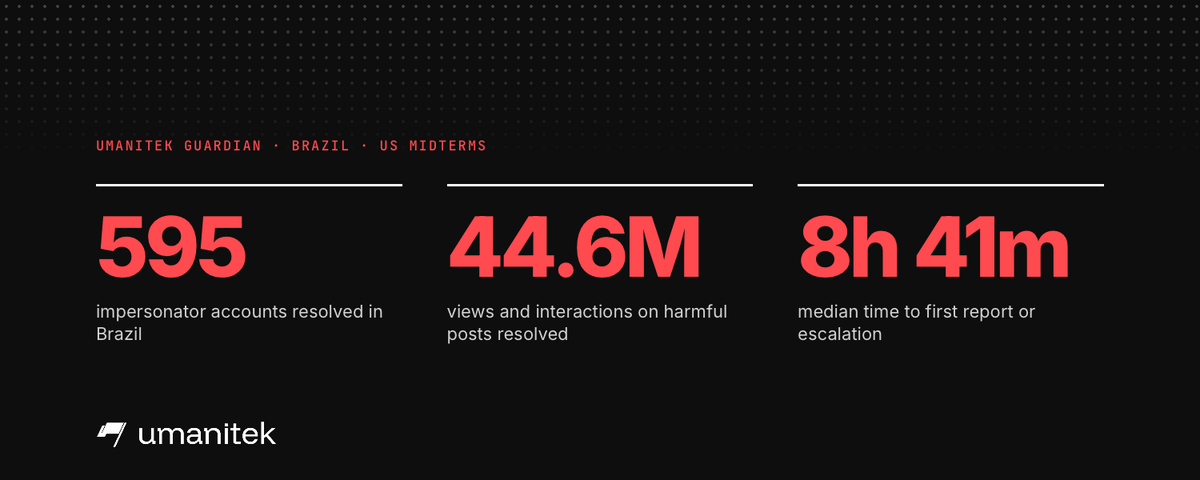
42,500+ checks. 916 resolved cases. Two thirds of high-priority attacks in the final 48 hours.
Our Chairman @ChrisRynning on what Umanitek Guardian learned defending candidates in Brazil and the US midterms.
Read the full article 👇

Brana Rakic retweeted
Political authenticity in the age of AI.
Yesterday, @ChrisRynning and @TomazOT talked about what it takes to protect political voices when anyone can be faked.
During the US midterms and Brazil elections, Umanitek removed hundreds of fake political accounts.
Trust in politics starts with knowing what's real.