

"Self-trust is the first secret of success." -Ralph Waldo Emerson · Chat With Traders Interview: https://nitter.cf/t.co/dNADBHAdEg · Pinned post for YT, Blogs, Interviews.
San Francisco, California
Joined April 2017
- Tweets13K
- Following339
- Followers57.3K
- Likes20.4K




Pinned Tweet
I am the "R Guy", focused on risk management, systematic thinking, mindset and practical trading tools you can understand.
For all of my links including my Discord, Youtube, blogs, interviews or simply to support more content like this please click here: brand.page/BrianLeeTrades


No the locate situation is very bad, definitely unique.
A lot of accelerations happening with trader knowledge, AI + Algorithmic adoption and a lack of real consequences for fat-tailed behavior is one aspect of it and then the other driver is definitely outside of retail control.

See this is where I think I should've clarified. The difference is that anyone in the world can do what you're describing, but not many can do what I'm describing. There is a skill component but objectively it doesn't prove better or worse results if you have a better expectancy sure.
The best way I can describe it is likely this: a very wide stop takes an extreme to a comically easy execution level whereas optimizing RR taken to the extreme is very difficult, not only to construct but also to endure. Both are not equal in their execution or strategy at the poles.
The last bit is that it can be argued that optimizing a RR strategy towards win rate will have a less dramatic impact towards profitability than optimizing RR on a high win rate strategy.
A lot of reasons for this including unoptimized gains leaving potential profits on the table plus the multiplicative effect of RR. Optimizing $ risk increases fat tails for risk of ruin even if simulated gains are much higher a la Kelly criterion.
There's more to this, a lot more.
In any case optimizing has a lot of diminishing returns. My main point is that there is skill in depth, both poles are not equally deep.

I think the point is actually very simple, and we've probably overcomplicated it.
R/R alone tells you nothing about the quality of a trading strategy. You need to consider it alongside win rate, or, in one word, expectancy.
There's nothing inherently better, more skillful, or more impressive about a 5R strategy compared to a 0.5R strategy. Either could have a higher expectancy, and even expectancy alone isn't enough to evaluate a strategy. What ultimately matters is the expectancy of your bets, their frequency, their correlation, and, also important, how efficiently you can deploy capital across them (for instance, when shorting illiquid small caps, I might deliberately choose a wider stop and a smaller position, sacrificing theoretical R/R to reduce market impact and improve execution efficiency. A tighter stop might look better on paper, but the larger position it allows can make the actual risk significantly harder to control).
A strategy generating 0.2R over 1,000 opportunities could be vastly more valuable than one generating 2R over 10 opportunities.
So when you say that a 3R trade is more impressive than a 1R trade, or that moving your entry closer to your stop improves the quality of a setup without changing other variables, I disagree. In fact, I think the conclusion is mathematically unjustified: you're optimizing one variable without considering its effect on the entire distribution of outcomes.
All the other stuff, collecting statistics, managing risk, improving execution, of course I completely agree with.
Big translated response 2 threads, I used AI to format but all words are entirely written by me.
1/8 — Risk Measurement
HIS CRITICISM:
There are many ways to measure risk, the SL is just one of them, especially in SC, for both Long and Short, though mostly in SS.
MY RESPONSE:
I don’t understand the point being made, one should be aware of their intended $ loss ahead of the trade no?
Your logic is confusing because you talk of outliers but traders who engage with risk without knowing their actually intended $ risk are the outliers, it’s more pragmatic for the vast majority of traders to know what I’m saying.
Width isn’t a factor here, just pure position sizing.
⸻
2/8 — Win Rate vs. Risk/Reward
HIS CRITICISM:
Pretty indifferent…We all know WR or RR strategies, I don’t see why it should be an issue, both have their pros and cons.
MY RESPONSE:
I’ll admit this is more egotistical and profitability in the long-term is more based on your expectancy but I will say that thinking in these terms develops the “skill” of trading.
I know you don’t think trading is skillful but I believe strategy and the construction of an execution methodology is actually what separates many intermediate traders from advanced traders.
If 1,000 traders short GME at the same location, some will have massive multiples, some will have massive PNLs and others will fall within the spectrum of bankrupt to mid.
This indicates, at least to me, that there is a skill in the implementation of strategy but I’ll leave that to the public to decide.
⸻
3/8 — Is Trading a Skill?
HIS CRITICISM:
Again, calling trading a “SKILL” when in reality it isn’t, but rather a distribution of outcomes where you need a positive mathematical expectation. There’s nothing Skillful about it.
Some people trade discretionarily? Great, everyone does it their own way, but Trading isn’t a “SKILL” you learn and that’s it, otherwise EVERY FOOTBALL PLAYER WOULD BE MESSI.
MY RESPONSE:
I touched on this a bit earlier but my entire thread is based on the mathematical expectation so we’re not aligning on that essential agreement. Skill is a separate topic.
Athleticism, drive, determination, luck and environment are important factors for players like Messi and so forth. In fact they are outliers, which I argue is not the mentality to adopt.
If one wants to be an outlier they’d do precisely what I don’t suggest because my intention is always to address what the majority can do to bridge the gap to become the top 1% of traders.
Being the top 1% in any field is not difficult, it seems daunting but it’s actually just putting in more effort, intention and commitment than the rest.
The actual outliers are the top 1% of 1%. A top 1% trader could simply be a profitable trader making six figures consistently per year.
Anyone who’s competed in any sport seriously knows that there are extremely talented players who are capable of winning championships that simply didn’t have the right mix of factors I listed above to get the opportunity to compete for it btw… only a few people get the chance to have everything line up to become the highlighted outlier.
⸻
4/8 — 1R vs. 3R Execution
HIS CRITICISM:
Again, what does RR have to do with how “impressive” a trader you are? I just don’t get it…
MY RESPONSE:
Without a doubt this is my ego speaking but I think is generically true.
We always think of the win first but what if we just consider the loss aspect?
If I lost 3k and you lost 10k what is more impressive? Probably that I lost less, given I could make the same.
1/2 🧵See Part 2 Below
This quoted post is unavailable.
2/2 🧵
5/8 — The 12.5R Example
HIS CRITICISM:
Great, and your hit rate will also be around 15%, so if you count 800$ x 14 losing trades = 11,200$ at risk and one winning trade at 12.5R gives you 10,000$. In other words, it leaves you in the red.
But hey, maybe you can consistently have a 20% WR with a 12.5:1 RR, who knows.
MY RESPONSE:
This is literally cherry picking though, that isn’t a normal return at all.
Extrapolating the metrics to support that stat line is missing the point… that’s an outcome that occurs infrequently but does occur, not a baseline statistic.
If anyone showed me stats indicating that I would absolutely agree it’s not optimal.
Most of the time an average of 2-4/5 RR is able to support various lines with WR’s from 30-60%, 15% at 12.5RR is a ridiculous assumption.
⸻
6/8 — Maximizing R/R vs. Predicting Tops and Bottoms
HIS CRITICISM:
But again, what does the ratio have to do with it? We’d all like to sell at the TOP TICK or buy at the BOTTOM, but who the fuck knows which is the TOP or the BOTTOM? Nobody, not even the best trader in the world knows.
Could looking for high-RR trades in specific scenarios be a good idea? Yes, why not? Great, backtest it and that’s it.
MY RESPONSE:
Just because you’re not able to determine it doesn’t mean it’s not possible to place high probability bets consistently.
This is a blind spot, speaking from your mention that one “outliers” experience doesn’t ring true for the masses. Do you spot any hypocrisy here?
I know it’s not a singular experience because I have taught and passed on the knowledge to hundreds of traders who use it everyday to succeed.
And btw, I know traders who have literally made 8-9 figures who cannot teach their strategy, is that a skill issue or there is no skill so their mentees should quickly achieve the same result?
⸻
7/8 — Profitability, Expectancy & Edge
HIS CRITICISM:
Sounds nice, but that’s not how it works. Profitable trading requires a risk premium or alpha, something that gives you a real edge. Managing risk and position sizing well without an “edge” will only make you lose money with discipline.
MY RESPONSE:
You’re speaking in circles because we have the same claim that mathematical expectation is the key. That’s my entire point.
It actually doesn’t matter what your RR + WR combination is as long as it creates a positive equity curve which you can derive through simulations and accurate bookkeeping of your data so it’s realistic and not projected.
This is probably the most baffling criticism.
⸻
8/8 — Survivorship Bias & Outliers
HIS CRITICISM:
There are other things in this post that I agree with, but the conclusion I reach is always the same:
Certain outliers use their own experience as “truth” when in reality it is full of survivorship bias and bias that, mathematically, ARE NOT CORRECT.
PS: This isn’t HATE, as I always say, it’s just my personal opinion. My respect to all the traders who have achieved incredible results.
MY RESPONSE:
I touched on this already so it’s above.
I think I hold a pretty clear view that I maintain, being the top 1% of any field isn’t actually special.
It’s a lot easier than people think, I know this because I’ve experienced it in numerous competitive fields.
I know that being a top 250 player is not a pro level player by any means, in fact a lot of the time they’d get massacred in competition by an elite player however they are still one of the best in the world.
Luckily trading is so abundant that being a top 1% trader is actually lucrative and worthwhile versus a sport where it’s top-heavy and dominated by the actual need to win championships.
Can you name the 11th richest person in the world or even the 5th off the top of your head?
This isn’t actually to your point but all I’m saying is that it’s not outlier behavior that pushing but quite the opposite.
I appreciate your opinion and actually found this very fun and interesting to dissect so thank you for engaging.
1
24
2,522
Brian Lee retweeted
Let me put this bluntly.
If you don't collect, store and know your trading statistics + execution data then you absolutely cannot complain if you are not where you want to be.
It's not an afterthought, it's not a luxury, it's a MUST.
Charts alone rarely say anything, it's literally just finance porn.
What says everything is when you can tell me these things:
-How much risk did you put on? (Per trade, I know some of you demons have 20 different flat positions and can't be bothered to even make sense of it)
-Where did you place your stop and would you lose the aforementioned risk you intended?
-When you won how much did you win relative to your risk? I don't care about your PNL, I care about how well-constructed the trade was.
These are the factors that highlight your skill, not how pretty it looks.
Winning is so overrated, winning comes at the cost of maximizing trades.
Losing is winning, let's go beyond the obvious risk management aspect and go a step further... Being able and willing to lose allows you to renegotiate entries and risk and, in many cases, improve your reward exponentially without even increasing the $ risk you apply to the trade whatsoever -> Closer to risk level = bigger position size = bigger risk/reward ratio = higher quality aka grade setup WITHOUT changing any other variables.
If you want to impress me don't turn $10,000 risk into a $10,000 PNL trade...
Turn a $3,333 risk into a $10,000 PNL trade.
That's literally just the tip of the iceberg.
Top level traders can hit ratios much higher than 3:1 when they come by the right setups.
Using an actual RR trade that I put up this week (12.5R)... in terms of ratio that means I could make $10,000 PNL with a $800 risk.
In my mind, and I could be wrong, there is nothing more impressive or important than actually sharing the RR execution data when posting charts.
Without that information, you have NO idea. I have seen thousands of charts from traders that I help and can't tell you how many times a 'nice chart' actually ends up being a .5R, .7R, 1R or very tiny win that was NOT maximized or EVEN A LOSS!
This is why the first thing I EVER do when I talk with people is ask if they can produce statistics for me to analyze and then sync it with their charts to make a determination of how we can take steps to optimize OR if we simply have to start over.
This is the equalizing factor that determines skill regardless of PNL outcome. If someone comes in with a $2m account and makes $10k (.5% gain) how is that remotely impressive?
If you want to acquire more truth then ask of yourself and of others to produce trading data based on execution performance.
The truth is that 99.9% of people don't want to do that because it exposes many ugly truths and, again, are just clueless as to why they can't make progress in their trading.
Nothing is more important than getting real with cold hard facts and the unequivocal truth that trading profitability is as simple as your average win/loss ratio and win rate.
The simplicity is right in front of you, the conviction and belief in one's process is right there to be seized.
Observe and master the fundamentals, these are the keys: Risk Management, Position Sizing and Statistics + Data.
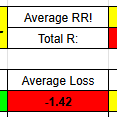
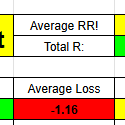
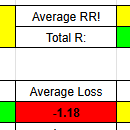
What's impressive is that my RR is still immaculate thanks to the blood offering the other day... without that just pain.
Few things:
1. Is it annoying as hell? - YES and that did lead to some boredom trades which are unusual mistakes, that inflates my loss count a little
2. Is it normal? - NO and I don't take it personally just objectively lame
3. The execution still remains really high and so the moment things turn it will keep printing, I am not lowering my standards just to compensate
4. Lowest win rate in my career, small samples but I think it's funny to be sub 10%, typical variance is from 15-40% on a good or bad month
As a trader I do believe in keeping form no matter the outcomes, I will not scalp or make half-hearted trades just because I want some green. That may or may not be the mentality for everyone but I personally think it's one of the best to adopt.

Brian Lee retweeted

Bet size matters because the first rule of trading is you have to survive. In the law of large numbers, there are some things working against us - namely probabilities of losing streaks.
Let’s take a simple 100 time coin flip game where for heads you add plus 2 and tails you minus 1. I want you to take a few minutes and actually do this exercise. Write 1-100 on a paper, take a coin and flip it 100 times, writing +2 for heads and -1 for tails or vice versa.
What were my numbers? I had a 53% win rate and a total of 59R when adding up pluses and minus. Not bad, right? But here’s the catch - I had a 9 flip losing streak and several 3-5 streaks.
What does this have to do with trading? A lot. If you oversize your positions, when you hit one of these inevitable losing streaks, the damage can be massive. I had a 9 loss streak in a game that is theoretically 50/50. In poor markets your win rate will be much lower.
Look at the image posted. If your win rate drops to 40%, there’s a near statistical guarantee that over 50 or 100 trades that you’ll get many 3-6 trade loss streaks. That same 9 trade loss streak that was 8% probable at 50% win rate becomes more than 35% probable with a 40% win rate. The bad news is your win rate will probably be worse than 40% in a poor market.
Qullamaggies win rate is in the 20-30% range much of the time, which is why he says he’s in a drawdown 80% of the time. He hits these streaks of losses quite often, but he is wildly profitable.
He survives and thrives against these odds because he keeps his bet size reasonable on every trade and he catches enough large winners to offset the losses. He lets the law of large averages tilt the end result in his favor. It’s not about 5 trades making you rich, but understanding that you’ll take hundreds and thousands of trades as a swing trader.
Oversizing can work for a short time, but the probabilities of a loss streak catching up to you is extremely high. This is why market corrections are so dangerous and deadly.

Intentional trading is being mindful of the fundamentals:
-Keep Losses Small
-Maximize Winners
-Understand the law of large numbers (be the house, not the gambler)
Meta Objectives:
-Control Drawdowns with systematic downsizing
-Control Risk with Max Losses and % Risk tuned to worst-case scenarios -> Currently using .5%
-Wire out consistently, treat trading as a business
-Compound
-Understand Cycles and apply Game Theory
-Judgement is purely focused on performance relative to opportunity set and not subjective experience
-Consistently review and reverse engineer total opportunity set daily, weekly
-Reverse engineer what DOESN'T WORK, cut those trades

Brian Lee retweeted
Understanding comes first - anticipation, reaction are both able to address emotions that flare up without overcompensating for strategy or behavioral change
2nd comes systems - are my systems actually able to handle the risks? do I have the ability to sustain damage and stay within geometric drawdown parameters like keeping drawdowns in a manageable range before they balloon into exponential difficulty?
such systems would be a drawdown control that I've mentioned in interviews, I think the riz one was the most recent that I did talk about it - very briefly but cannot be overlooked due to how important it is
and in terms of objectivity the main post I made about performance is very important, do you maintain a standard of excellence so that u know ur results are born of the market and not ones own erroneous trades -- if you know it's not you and it's the market, you know the market was going to be this way AND you have the systems to deal with it then it becomes a matter of personal discipline and patience
Brian Lee retweeted
I can say it was absolutely worse without a doubt based on duration and uncertainty.
The annoying elements were part 2022 in the first two quarters and now it’s just simply costs.
Ironically scalping is way worse and it favors RR much more because of efficiency. That’s always been the case but negligible cuz you could still profit over fees without an issue.
As for anything related to squeezes or manipulation or whatever.. that is simply a strategic and risk issue that is being exposed.
There used to be way more multi day movers that would not instantaneously die within one day. There used to be more sectors that would ruin the market for weeks, this has hardly been any worse
Brian Lee retweeted
This isn’t the first time it’s happened and it won’t be the last.
I’m not trying to say this to be arrogant I’m just saying that the very feelings you have about it is what you need to be able to transcend.
I have the entire year on record calling each cycle in advance, it’s not impossible but it takes a lot of experience.
I do agree a lot of the year was bad, that happened in 2022 but actually 50% worse than it was now. It wasn’t out of the blue, it was a result of the players not realizing what was going on under the surface in terms of game theory
I cannot stress this enough… I find myself repeatedly guiding people through this month after month.
My suggestion is to read this tweet and the thread quoted within… really internalize this concept because your smallcap career can be a total nightmare or you can ground your experience in understanding.

One of the MOST important ideas is to reverse engineer your worst-case outcomes aka MAX LOSS(ES) and to size appropriately to that exact condition.
When you measure your exposure you should be able to configure your risk % per trade.
When all you do is focus on uncontrollable outcomes (wins), you’re being blinded by greed instead of steadiness.
Risk is one of the few trading variables that you’re able to manipulate effectively.
When I see traders focus on theoretical winning outcomes, even self-generated datapoints, I can immediately spot the tail risks if they exist.
You need to fight the impulse and be proactive about defense. That’s what I notice affects most traders when they lack the necessary scrutiny to SIZE down or adapt defensive tactics WHILE WINNING.
Brian Lee retweeted

I attribute my profitability to this tweet.
I came across it this time last year and after an intensive review, I discovered my average MAE and was able to take my system from a 1:1.5 to a 0.7: 1.5R making it a 1:2R system.
Thank you for the wisdom @BrianLeeTrades
The most underrated aspect of trade management and risk/reward is the effect of small losers.
Small losers dramatically affect your averages due to the fact that most strategies have the potential to win far more than they lose, even at the scalp level.
Instead of wondering how you can squeeze more water out of a rock, you can invert the process into, “how small can I lose when I’m wrong?” in order to achieve a similar result.
Example: 2:1 can become 2/.75 which is 2.67:1 adjusted RR, a massive leap.
It gets crazier at higher R like 3:.75 is 4:1 and so forth.
Even if your average win decreases trying to lose smaller, you may very well experience a big boon in your trade expectation -> equity curve projection.
This part of the trade is ephemeral, when you’re not quite winning or losing yet.
Traders can flub trades by overemphasizing small losses and hamstring good trades needlessly, it needs to be adjusted to one’s overall strategy and serve a real purpose.
For this I would systematize it and make it so you’re prompted to lose less versus trying to wrestle with your emotions.
The majority of traders focus on winning bigger and sometimes go backwards by taking even larger losses.
Consider a 4:2 RR will be the same as 2:1. Yeah you won bigger but at what cost?
It comes down to the root, bigger =/= better.
When you can understand this and implement it with intention, you’ll be able to improve your trading in unexpected ways.
This is almost never discussed because it’s not sexy.
Without understanding this concept it will be imperceptible, you will be missing out on a golden nugget.
The effect is dramatic, but back to your regular programmed clickbait feed.