

Building habit tracking app https://nitter.cf/t.co/JcuKNT0Ypf on IOS | Founder @ Minty Digital
London & Barcelona
Joined December 2009
- Tweets2.5K
- Following1.4K
- Followers2.7K
- Likes3.1K





Pinned Tweet
Running a company makes it easy to drop the habits that keep you sharp.
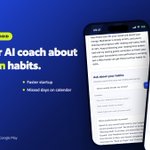
So I built a habit tracker I can ask questions.
"What breaks my streak?" > busy weeks with no gym.
"What's working?" > 30+ days alcohol-free.
Tracka just shipped this on iOS + Android 👇

7
5
207
And the smaller stuff:
✅ Choose the currency you see prices in
✅ Day picker for weekly habits
✅ Streaks start collapsed so Today stays clean
✅ Ticking off habits is more reliable
1
24
Free to start:
iOS: apps.apple.com/app/id6746562…
Android: play.google.com/store/apps/d…
11
And the smaller stuff:
• Choose the currency you see prices in
• Day picker for weekly habits
• Streaks start collapsed so Today stays clean
• Ticking off habits is more reliable
• Sign in with Apple fixed
1
1
17
Free to start. Update or download:
iOS: apps.apple.com/gb/app/tracka…
Android: play.google.com/store/apps/d…
1
18
Is agentic e-commerce the future, or will it be stopped before it even starts?
Amazon and other ecom giants are blocking tools like Meta's AI shopping assistant from accessing its platform.
Officially, it's about security and customer data BUT there's a much bigger commercial question here.
If AI agents start researching, comparing and buying products on our behalf, what happens to the billions Amazon makes from sponsored listings?
And what happens when consumers stop browsing marketplaces altogether?
Amazon wants to own the shopping experience, not become the fulfilment provider for someone else's AI agent.
For brands, this could completely change how they approach SEO, paid search and e-commerce as instead of competing for rankings and clicks, they'll increasingly be competing to get recommended and selected by AI agents.
The technology is moving fast, but the platforms controlling the transactions have plenty of reasons to resist.
Is agentic e-commerce inevitable, or will the big platforms stop it before it takes off?

5
93
Louis Therouxs next documentary: Inside the SEOsphere.
Exploring the dark underworld of black-hat SEO, fake gurus and fully grown adults arguing about how to manipulate Domain Authority.
Pretty cool to be speaking at the same event as him at @wearelegalgeek today 😂


48
Rumours are there’s a pretty big Google/AI Search algorithm update on the horizon.
I’ve been banging on quite a bit recently about self-promotional listicles and other questionable tactics being used to manipulate AI Search results but it looks like search engines are starting to catch on.
In some testing I shared the other day, we found that over 40% of sources cited by LLMs for searches like “best SEO agency” were self-promotional listicles, with agencies conveniently ranking themselves at #1.
While LLMs are still citing these articles, in some cases they’re actively questioning their credibility, flagging conflicts of interest and leaving the agencies promoting themselves out of the recommendations.
In the example attached, Claude explicitly warns that many “best SEO agencies in London” lists are written by agencies ranking themselves at the top.
It then explains that it’s prioritising independently judged awards and agencies appearing across multiple independent sources instead.
On top of this Anthropic has just updated Claude’s usage policy and from 12 November, explicitly prohibits using Claude to manipulate the sources that search engines and AI systems draw answers from.
This includes tactics such as:
✅ Fake authors and personas
✅ Networks of supposedly independent websites that are actually connected
✅ Fake reviews and accounts
✅ Hiding sponsorship or the true source of content
✅ Seeding multiple websites with the same claims to influence AI-generated answers
Google has already been targeting scaled content abuse and site reputation abuse through its spam policies and now Anthropic is explicitly addressing manipulation of AI answers.
To be clear, this isn’t confirmation of an upcoming algorithm update, and Anthropic’s policy isn’t the same as a search ranking change but the direction of travel seems pretty clear.
Predictions are over the next 6–12 months, are we’ll see a much bigger correction around self-promotional listicles, fake authors, manufactured citations and scaled GEO content designed purely to game AI Search.
A lot of these tactics remind me of the early days of SEO, when exploiting loopholes worked brilliantly until the algorithms caught up.
Let's see where the next few months takes us!

3
227
Apparently the best way to become the UK's #1 SEO agency is to just write an article saying you are.
Earlier this year, there were reports of Google cracking down on self-promotional listicles.
Yet it's October and when I was looking at AI search results for queries like "best SEO agency" and found that 42% of cited sources were listicles.
And scrolling through the results, plenty of them are written by agencies ranking themselves as one of the best (often #1).
Essentially, agencies recommending themselves, which AI search engines then use as sources when recommending agencies to users.
The funny thing is, Google has reportedly been targeting this exact tactic, yet it still seems to be working.
I'm not saying listicles don't have their place, but there's a pretty big difference between an independent recommendation and a company recommending itself.
Not sure whether this says more about the state of SEO or AI search in 2026.
Interested to see how long this continues.

5
5
408
Fake AI doctors are getting millions of views giving health advice online.
Which feels like a pretty good example of why visibility and trust in AI search are becoming such a big deal for health brands.
Last week I spoke at Health Foundry in London about how health brands can get found in AI search.
While prepping for the talk these numbers came as a bit of a surprise:
👉 Over 15% of UK adults have used an AI chatbot instead of contacting their GP or the NHS.
👉 Over 21% have decided against seeing a healthcare professional because of something a chatbot told them.
👉 And more than half of health-related Google searches now trigger an AI Overview.
So people aren't just using AI to research products, write emails or plan holidays.
They're using it to make decisions about their health.
At the same time, we're now seeing completely AI-generated "doctors" appearing on social media and attracting millions of views with questionable health advice.
That makes the question for legitimate health brands much bigger than "Do we rank on Google?"
It's also:
"When someone asks AI about their health, who is influencing the answer?"
A few things I covered in the session:
✅ Put real experts behind your content. Proper authors, bios and credentials matter.
✅ Pay attention to where AI gets its information. Reddit, YouTube, publishers and third-party websites can be just as important as your own site.
✅ Make sure you're not blocking AI crawlers. Sounds obvious, but plenty of sites still are.
✅ Get your experts quoted. Journalist requests and Digital PR aren't just about links anymore. They help build the authority and third-party signals AI systems pull from.
✅ Track visibility properly. One ChatGPT search tells you very little. Track the same prompts across different engines over time.
Health has always had a higher trust bar than most industries.
AI isn't lowering that bar.
If anything, it's making genuine expertise even more valuable.
And with so much questionable AI-generated health content appearing online, there's a huge opportunity for credible health brands to become the sources these systems actually trust.
Happy to share the slides if anyone wants a copy just send me a DM.

1
5
164
300+ backlinks recovered in 5 minutes.
Here's how 👇
One of the quickest SEO wins I've seen in a while.
In this case, a client had deleted a load of pages across their website without putting 301 redirects in place.
The result? Hundreds of valuable backlinks pointing to pages that no longer existed.
On one URL alone, we found:
✅ 300+ unique referring domains
✅ 40+ links from DR70+ websites
✅ Links from some seriously authoritative publications
All of these pointing to a dead page with years of link equity going to waste.
And potentially years of link equity going to waste.
The fix?
Audit your broken pages, identify those with valuable backlinks and implement relevant 301 redirects to the most appropriate live pages.
Not particularly exciting SEO work, but sometimes it's the stuff that makes the biggest difference.

3
8
153
I need to make an apology.
On behalf of the SEO community.
I’m sorry that:
We ruined half the internet by publishing AI-generated content at scale.
We made Reddit borderline unusable by spamming every vaguely relevant thread.
We started ranking our own clients #1 in “independent” guides… published on their own websites.
We filled Google with 2,000-word articles answering questions that needed two sentences.
We added “People Also Ask” sections nobody asked for.
And now we’re trying to do exactly the same thing to AI Search 😭
Obviously, not everyone in SEO has been doing this, but as an industry, we definitely have some previous.
The good news is that while we’re still seeing plenty of dodgy tactics slip through in AI Search, this new wave is forcing us to grow up a bit.
Less focus on manipulating results.
More focus on actually building a brand.
The brands already winning aren’t the ones relying on quick wins or loopholes they’re the ones doing genuinely good marketing.
Hopefully, this is a bit of a fresh start for online marketing.
Sorry about the last 15 years x

2
3
253
Can everyone stop listing themselves as #1 in their own listicles to try and manipulate AI Search 😭
I get it, it works and we know because we’ve experimented with it ourselves.
But imagine you’re a potential client searching for something like “Best Physiotherapy Clinics in London” and you land on a supposedly impartial, medically reviewed guide only to find the company publishing it has conveniently ranked themselves #1.
Yes, you might influence what gets surfaced in AI Search but as soon as the content is read by a human they're going to lose trust immediately and likely never choose to move forward with your brand.
As we keep shouting good GEO = good marketing.
That means not just relying on what SEOs have always done (i.e manipulate search results short term) but focusing on building a brand people actually trust for the long term.
Would you be comfortable doing this if the customer knew exactly why you were doing it?

1
1
106
Here’s one of the simplest ways to turn AI visibility into a measurable content strategy.
It starts with the traditional SEO playbook:
👉 Plug your site and competitors into Ahrefs.
👉 See which content is ranking.
👉 Create something better and take the position.
The same principle now applies to GEO but instead of looking only at rankings, we’re looking at what AI platforms are using as sources.
Using tools like Peec AI, we can:
👉 Track the prompts that matter to a business
👉 See which competitors and pages are being cited
👉 Identify why that content is being selected
👉Feed those insights into the content plan
👉 Create something more useful and take that visibility
In the example screenshot, we used this strategy to create content that outperformed our competitors and is now:
✅ Being retrieved as a source across eight tracked seed prompts
✅ Achieving a 70% citation rate
✅ Being retrieved by ChatGPT, Google AI Overviews, AI Mode and Gemini
To measure the impact, we can combine AI visibility metrics with GA4 data and CTA tracking to see whether that visibility is translating into traffic and conversions.
If you want more tips on how we’re rolling out measurable GEO strategies for our clients, sign up to my newsletter.

1
1
144

The 10 Agency Commandments.
Biggie had rules for the street.
After 10+ years running an agency, I’ve got a few for this game too.
Commandment 1:
Never get high on revenue.
Turnover looks good but profit pays the bills.
Commandment 2:
Never let one client control more than 20% of your MRR.
If they leave and the lights go off, you were too exposed.
Commandment 3:
Don’t hire for the agency you hope you’ll have.
Hire for the one you’ve actually got.
Commandment 4:
Keep your numbers locked in and measured.
Margin. Churn. Pipeline. Cash.
If you don’t know them, you’re guessing.
Commandment 5:
Never promise what your team can’t deliver.
It's to easy to make concessions and promises you'll struggle to keep just to close a deal.
Delivery and retention keeps the business alive.
Commandment 6:
Not every client deserves a seat at the table.
Bad money is still bad money.
Commandment 7:
Protect the people who make you look good.
Clients come and go. Great team members are harder to find.
Commandment 8:
Don’t confuse chaos with growth.
If everything needs you, you haven’t built a company yet.
Commandment 9:
Keep your pipeline moving, even when times are good.
The worst time to start selling is when you suddenly need sales. You'll be desperate and take on bad clients.
Commandment 10:
Don’t build a business you secretly hate running.
More staff. More clients. More revenue.
None of it matters if you’ve built yourself a prison.
I’ve broken most of these at least once but that’s how I learned them.
🤖 Made with AI

If you want more first-hand tips on what’s actually working in SEO + AI Search, I share them in my newsletter here:
charlieclark.co.uk/
69
If you're tracking AI visibility in the same way you're tracking traditional SEO, you're setting yourself up to lose.
IMO AI Search reporting should be treated a lot more like Digital PR reporting than traditional SEO.
The current metrics we're tracking at Minty Digital are:
✅ Share of voice
✅ Sentiment
✅ Visibility
✅ Citations
These sit alongside SEO metrics, not as part of them.
There are some great tools out there at the moment, such as Peec AI(yes, I'm biased, but I think it's the best one), that make it much easier to visually showcase this to clients.
A recent example from one of our campaigns 👇
We analysed the content competitors were being surfaced for across AI Search, identified where we could create something better, and published a new piece targeting those topics.
A couple of weeks later, that article had already been retrieved 15 times across tracked prompts in Gemini, ChatGPT and Claude, with 9 inline citations.
Within a month, visibility continued to increase across different tracked questions around the client's core service including:
📈 Informational questions about the service
📈 Questions around costs and when to take action
📈 High-intent prompts asking which company or provider to use
This is the type of data we're now building into our client reporting alongside traditional SEO metrics.
And I think how we communicate these numbers is important.
Clients don't necessarily care that they have a “10% AI visibility score.”
They care that their brand “appears in 1 in 7 AI answers on Google AI Overview.”
And, ultimately, how that visibility is affecting the bottom line.
That's where the SEO reporting comes back in.
AI Search reporting is still evolving, but increasingly I think the best framework already exists:
Treat it like PR: measure how visible the brand is, where it appears, and how often it gets cited.


1
2
125