

Compound manages $5B+ for entrepreneurs, professionals, and retirees who want the personal touch of a trusted advisor and a beautiful digital experience.
Joined February 2010
- Tweets3K
- Following1
- Followers11.7K
- Likes152





Pinned Tweet
It's here... Meet the Compound iOS app. 🙌
Our dashboard gives you a complete picture of your financial life — net worth, equity, cash flow, tax modeling, and documents, all in one place.
The kind of visibility that used to require a family office is now accessible to anyone managing real financial complexity. And now it's on your iPhone.
Everything you need, now in your pocket:
→ Net worth tracking with automatic updates as markets move and valuations change
→ Equity grant monitoring
→Your full document vault — financial, tax, and estate files, always accessible
→Instantly switch between dashboards without signing back in
Everything stays secure and automatically synced, so what you see on your phone always matches what's on your desktop.
Already have a dashboard? Download and sign in. If you haven't set one up yet, you can do it entirely from your phone.
📲 Download on the App Store: apps.apple.com/us/app/compou…
compound retweeted

If your clients have significant capital gains on the horizon, the right time to have a tax-loss harvesting conversation was yesterday. The second best time is now.
Many advisors know how to talk about the benefits of tax-loss harvesting in the short term. Tax season is coming up, you’ve realized some capital gains, and you want to offset the tax bill.
At Compound, we take a “build the basket” approach, which means we’re planning for your realized gains in 2040, not just 2026.
More from one of our advisors below 👇
Tax-loss harvesting is a great tool — and it isn't just for people with an IPO on the horizon.
Maybe you’re a doctor, or lawyer, or business owner. Basically, if you have a substantial portfolio, tax-loss harvesting could help when tax time comes.
How it works:
You sell assets at a loss → you can use that loss to offset a gain
Most people think about IPOs and tender offers when we talk about capital gains — but you can generate gains in a lot of ways:
→ Rebalancing. As stocks and bonds drift from your target allocation, bringing things back in line might mean selling appreciated positions.
→ ETF distributions. Funds periodically distribute capital gains, making you owe tax on gains you didn't choose to realize.
→ Trimming your position. Any sale of an appreciated holding can trigger a gain.
That’s why Compound advisor Nicholas Garcia says to build a “basket of losses” — which means holding onto your sold losses over time, letting them accumulate until a big event arrives and you want to offset your gains.
In the comments, we break down how you know whether a tax-loss harvesting strategy is right for you.

compound retweeted
The most common equity strategy we see is no strategy at all.
It makes a lot of sense because the decisions are complicated, the stakes feel high, and there's always a reason to wait for more information. So naturally, people wait.
But waiting is also a choice with consequences:
Options expire. Leave a company, and you may have weeks, not years, to decide.
Concentration builds quietly. Every vest adds to the same bet.
Tax windows close. Some of the best planning opportunities have deadlines that don't send reminders.
Tender offers don't always come back. Passing on liquidity once can mean waiting years for the next chance.
None of this means you should act fast, only that you should act on purpose. Making an informed decision with intention, then revisiting it as life evolves, gives you more power as an equity holder.
Dealing with your equity down the road is a decision, too.
Q3 is coming to a close. What should you be watching as we head into Q4?
Join Compound Planning's Stephen Dean, CFA and Dimitry Farberov, CFA, CFP® on October 14 for our next Compound Conversation on the state of the market
Register here:
compoundplanning.com/events/…

3
1,278
Parents worry about trusting their kids with money. The bigger risk might be the trust that determines how they actually inherit it.
Tim Hamilton, CFP®, CIMA® has seen that kind of mess up close in his own family. When his grandmother needed help, they found an annuity nobody knew existed, then other accounts the family had to piece together.
In the latest episode of "The Concentrated Position" Tim and Dimitry Farberov, CFA®, CFP® discuss:
→ Why an old trust is worth revisiting long before anything feels urgent
→ The sibling who becomes the default caregiver while everyone else lives somewhere else, and the resentment that builds when nobody says it out loud
→ The difference between a durable and a springing power of attorney, and why getting it wrong can leave you locked out exactly when you need it most
The episode also opens with what moved markets after a strong first half, from the Magnificent Seven's slump to the sharp rotation out of semiconductor names that had run up hundreds of percent.
Listen to "Trust Issues" on Spotify or Apple Podcasts.
🎧 Spotify: lnkd.in/gVwjKrD8
🎧 Apple Podcasts: lnkd.in/gEYWyNMk

1
828
✋ Did you hear Anthropic is reportedly considering requiring all employees to have a 10b5-1 plan after its IPO?
So ... what is a 10b5-1 plan, and why is that news?
It's typically used by executives and employees with access to sensitive, nonpublic information as a way to plan stock trades in advance.
A 10b5-1 plan lets someone set future stock sales or purchases ahead of time: the amount, timing, price, or a formula that determines them. Requiring one for every employee, not only executives, is what makes this uncommon.
It can also be used voluntarily as part of a broader strategy for anyone with significant company-stock concentration. Because the plan is set up before someone has any sensitive, nonpublic information, it can let trades execute later on a preset schedule, even during periods when they'd otherwise be restricted from trading. A separate IPO lockup would still apply on top of that.
Nothing is confirmed yet, but if this moves forward, it's understandable that employees may have questions about setting one up and how it fits into a broader post-IPO strategy.
We'll be covering 10b5-1 plans and everything else on IPO planning, including selling and diversification strategies, on our Compound Conversations tomorrow.
Save your spot to ask questions ahead of time or live, and get the recording either way 👉 compoundplanning.com/events/…

1
739
Put $10,000 into a 529 when your kid is born. By the time they're 18, $30,000 of the growth could come out completely tax-free.
Todd Rowe, CPA, CFP® said it plainly on the recent episode of The Concentrated Position: a 529 works a lot like a Roth IRA, but for education. It's tax-free growth, as long as the money goes toward qualified education expenses.
And the accounts have gotten more flexible than a lot of parents realize:
→ Funds can now cover K-12 private school tuition, not just college
→ Unused funds can roll into a Roth IRA for the beneficiary, within certain limits
As Todd put it, unless a family has already decided education isn't something they're funding, a 529 is hard to pass up.
Listen to the latest episode, "The Baby Balance Sheet," with Tim Hamilton, CFP®, CIMA® and Dimitry Farberov, CFA®, CFP® on Spotify or Apple Podcasts.
1
643
Your company just filed to go public. Now what?
Most employees spend years waiting for this moment. Then it arrives, and the lockup period, trading windows, and RSU tax questions all land at once. The decision window is shorter than it feels.
On Wednesday, July 29, Jonny Jonson, CFP®, CPA, Timothy Couture, CFP® , and Marcel Pfister are hosting a live discussion on managing your equity through an IPO. They'll cover:
→ What lockup periods and trading windows mean for when you can actually sell
→ How to build a selling framework before the volatility starts
→ When a 10b5-1 plan makes sense, and how to think about setting one up early
→ The tax picture on RSUs vesting at a public company
→ How to manage a concentrated position once you're on the other side
Can't make it live? Sign up anyway and we'll send you the recording. You can also submit questions ahead of time or live during the session.
👉 Save your spot: compoundplanning.com/events/…
657
Markets hit all-time highs in Q2, driven by strong earnings and AI momentum, even as inflation, energy prices and a new Fed chair created real uncertainty.
Join our CIO Stephen Dean, CFA® and Dimitry Farberov, CFA®, CFP®, Principal and Senior Wealth Advisor, for a Compound Conversation on what it all means and what to watch heading into Q3.
🗓️Date: July 9
🕜Time: 11am PT / 2pm ET
They'll cover:
→Equity performance and where leadership is shifting
→Fixed income, private credit, and alternatives
→What geopolitical risk and energy prices mean for inflation and rate policy
→What the SpaceX IPO signals for private markets and the broader pipeline
You’ll have the chance to ask any questions about private markets, public markets, and anything in between.
Even if you can’t join live, sign up to get the recording in your inbox.
👉 Save your spot: compoundplanning.com/events/…

349
K-1s and capital calls can feel like they came out of nowhere.
Suddenly, you need to hand over funds that aren’t liquid. Or you think you’re all set for tax season, but your document’s coming months after the deadline.
The investors who stay the course are the ones who are prepared.
That starts with understanding what you're investing in.
Alternatives come in two main structures:
→ Drawdown funds, which draw your committed capital in installments over time
→ Evergreen funds, which deploy capital immediately and offer more frequent liquidity.
Capital calls and K-1s are specific to drawdown funds — that’s why, before a client invests in drawdown funds, we talk about:
→ Setting up a dedicated liquid account for capital calls, so committed funds are accessible when they need to be
→ When K-1s reach you, and coordinating with your CPA to file a tax extension
→ Your actual liquidity needs over the next 5-10 years
Our CIO Steve Dean shares what to expect in year 1 of an alternative investment:
manual.compoundplanning.com/…
All investing involves risk, including the possible loss of principal. Alternative investments are not suitable for all investors.

2
387
What happens when the investment data you rely on shows up half as often?
The SEC might let public companies report on their earnings twice a year instead of the current four. The goal is to lower compliance burdens on smaller companies and encourage more of them to go public.
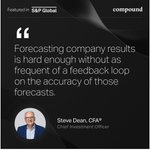
Our CIO Stephen Dean, CFA spoke with S&P Global Market Intelligence about what that tradeoff looks like in practice:
→ Six months of company news hitting at once means there could be bigger bigger earning surprises and more volatility in small- and mid-caps
→ Analysts without access to alternative data or management relationships will have a harder time filling the gaps
→ That information asymmetry could create more misvaluations — and more opportunity for active managers
Read Steve’s full take with S&P Global Market Intelligence about what this shift could mean for investors and markets: spglobal.com/market-intellig…

277
We've been having these conversations with clients for years. Now we're sharing them with you. Come join us on The Concentrated Position. 🎙️
Tim Hamilton, CFP®, CIMA® and Dimitry Farberov, CFA®, CFP® have spent nearly two decades sitting across from people with complicated financial lives, helping them through big decisions and real trade-offs.
Now you get a seat at the table.
Each episode covers what's moving markets and the personal situations that keep our clients up at night: concentrated stock, liquidity events, private investments, and everything in between.
And we're kicking things off with a good one.
Tim and Dimitry dig into the wealth immunity trap. Why do people who've responsibly saved and planned still feel like they don't have enough?
They also get into why markets are at all-time highs when nothing in the news feels like it should allow that.
Subscribe now so you don't miss future episodes.
🎧 Apple Podcasts: podcasts.apple.com/us/podcas…
🎧 Spotify: open.spotify.com/episode/0bb…

263
Our own Tara Shulman spoke with the Wall Street Journal about the real emotional toll an IPO takes on employees coming into life-changing money for the first time.
With SpaceX, Anthropic, and OpenAI all heading toward public debuts, more employees are about to face that moment than we’ve seen in years.
When working with clients through a liquidity event, Tara starts by figuring out what the money actually needs to do for their life before they feel pressure once the lockup expires.
That context is what makes it possible to build a real plan, one that accounts for taxes, timing, and concentration risk, but is ultimately grounded in something more personal than market performance.
And when the pressure does arrive, having someone who can hold you to that plan is what separates a good outcome from a costly one.
Read her full perspective on what to do before your equity becomes liquid here: wsj.com/personal-finance/spa…

402
compound retweeted
Want to learn about 529 plans?
They're a great, tax-advantaged way to save money for your children’s education (or another beneficiary’s).
Here's how 529 plans work:
manual.compoundplanning.com/…

We officially crossed $5B in AUM, marking 75% growth since January 2025.
This growth reflects what happens when you build wealth management around a client's entire financial life, not just a portfolio.
Since January 2025, we've:
→ Added 24 advisors and 700+ new clients
→ Grown AUM by over $2 billion
→ Most recently welcomed four senior leaders across advisory, tax, product, and advisor growth
We're deepening what we can deliver in the areas that matter most to our clients.
And we're building the future of wealth management, and that future feels closer every day.
Read more 👉 compoundplanning.com/newsroo…

2
1,591
New Manual just dropped.
If you're a Figma employee or have ISO, this a must read:
manual.compoundplanning.com/…

979
Stephen Dean, CFA is back with his State of the Market update for November 2025: Priced for Perfection
He dives deep into October’s market dynamics and the key risks he’s watching heading into year-end and 2026
Read it here: info.compoundplanning.com/in…
