

Product engineer working on something new ✨ prev. @trycampsite @Meter @useinterval
Los Angeles, CA
Joined November 2007
- Tweets10.4K
- Following840
- Followers850
- Likes6.9K






Pinned Tweet
I wrote about my approach to incorporating AI into my engineering work. TLDR: I've done enough weekend vibe coding to realize that understanding stuff still matters. Don't use AI to skip important cognitive work; do use AI to accelerate later.

played Factorio today thinking building stuff by hand again would feel energizing, only to find myself wishing for agents to delegate grunt work to so I can move up the stack and focus on higher level impact
2
160
This kind of stuff has to be culturally taboo on your eng team. It's not fun to be the guy who calls out comment slop in PRs but everyone knows that opus waxing poetic about a refactor won't fly here.


1
3
318
How I'm working, August 2026
I spend a lot of my day with Devin - chatting with Devin in Slack, reviewing PRs in GitHub, using the CLI for one-off tasks. Devin has MCP access to all of our major systems - BigQuery, Sentry, Inngest, Slack, Linear - so it can inspect traces, look up data questions, file tickets, and answer most queries. It's also an expert on my codebase and doesn't speak in cryptic prose. I could not love Devin more.
It's astonishing how much time I've gotten back by no longer needing to spend a day tracking logs between systems. This is where most of my AI gains are - not from running 6 parallel terminals but from offloading triage/investigation work and by saying "devin investigate this" or "devin fix this one-liner" or "devin scope this" in Slack and coming back to it later without having to write up a ticket.
My local CLI usage continues to decline and I'm mostly all-in on Devin's cloud sessions. I'll typically have 1-2 terminal tabs open to either Claude Code or Codex for investigative sessions where I'm asking questions and learning systems — more muscle memory than deliberate choice imo (although a model picker in Devin would help nudge me).
I'm finally at the point where I write very little code by hand anymore, although I'm still deliberate about when/why I do write code by hand. It's usually to either implement a feature in an existing system that I want to understand better, or to stand up a new system where I need a strong mental model of how it works. I've not found a way to build the mental model I need without being hands-on.
My biggest pet peeve right now — everyone's pet peeve — is the way these models talk to me. Codex used to be this way, now Opus is somehow even worse. All of my most-used skills now are some form of "say that to me more clearly" - /bro, /i-have-adhd, "read that back to me using plain language". It's so exhausting to have to constantly decode what these models are telling me. Last week a colleague sent me an incredible Slack message bringing me up to speed on something and I think about it literally every day. How much nicer would my days be if everything was explained to me like that TLDR? I'd love to get to the end of the day and have enough brain power left to read a nice book.
Other things I'm tired of: trying different models or tools and needing to re-approve commands like "can I run ls in this directory?". Reading Markdown, especially in monospace fonts. Reading LLM outputs in general, whether it's models talking to me or being handed straight LLM output. Good technical writing energizes me and you don't see much of that anymore.
6
2
603
I'm very pro-write-your-own-PRs but I sense I'm part of a shrinking minority here, especially when every other part of the process wants to move at machine speed and the art of good technical writing isn't celebrated like it once was. nitter.cf/tnm/status/20865693022…
205
I've been trying so hard to automate logging what I work on every day to a text file but unfortunately the most effective solution is also the most boring one: build the muscle of writing it down myself
122
I'm torn on this - I usually let AI take a first pass, but I aggressively edit down before sharing.
Writing clarifies my thinking, and if I can't plainly describe work that needs done or what a PR is doing, then I probably don't understand it well enough.

I just declared a moratorium against AI-written change descriptions (e.g. PR and commit messages, also issues/tickets) from my team.
AI was writing change descriptions that were worse than useless to me as I tried to review PRs: outlining details of the code that could easily be seen by looking at the code, but omitting the higher-level framing needed to understand broadly what the code is doing.
I think people like having AI write these things because the output looks structured and thorough, which makes it feel professional in a way. But this isn't actually valuable. Concise, high-level descriptions are better for everyone. If I need to use my own AI to interpret what your AI wrote then something is wrong. Let AI write code, sure, but for the description, I'd rather see your prompt than your output.
We could maybe have extended agents.md with guidelines on writing descriptions, but this seemed a bit pointless since a good, concise change description only takes a few minutes to write -- not a significant time savings to delegate to AI. At least, it doesn't take long if you understand the code -- and if you don't understand the code, then I'm definitely not merging it.
1
174
Dan Philibin retweeted

as an alternative to scrolling thru 36 tweets (lol), here is a blog post version of the talk i gave yesterday!
geoffreylitt.com/2026/07/02/…


finally had some time to try @flueai this morning and dang, the DX is 🤌
- just paste a URL into your agent to get started
- quick setup, no complexity, all agent-driven
- tight demo loop, easy to see the value
- CLI for local docs search 🥰
35
the ideal amount of code to write, review, and maintain is still 'as little as possible'
(doubly so for the code that isn't your core product)

I've watched a ton of people vibe code internal tooling only to realize:
"I am now the admin for something that basically does the same thing as the software we used to use "
And go back to using that software. It turns out 10% more customization isn't really worth it at all
1
35
Dan Philibin retweeted

Nobody really knows what works right now re: Coding Agent workflows. Nobody knows what a "software factory" looks like. Nobody knows if the opinionated workflows on here are useful, and where this is all going to land.
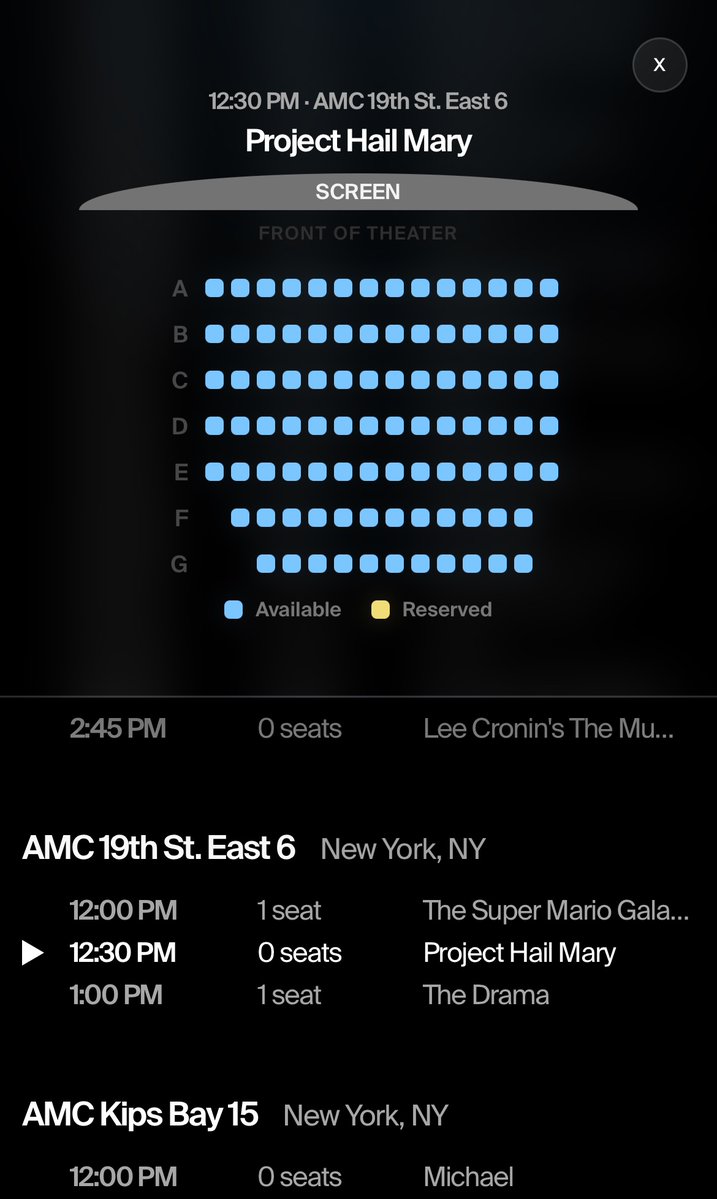
I once had the opposite of this - a script that polled AMC for the best seats at sold out IMAX/Dolby and texted me if seats became available last minute. I did not tweet it out for obvious reasons 😅

10% of AMC movie showings sell no tickets at all. I made a site that finds them. Go enjoy your private theater
2
147
Dan Philibin retweeted

Introducing Flue — The First Agent Harness Framework
Flue is a TypeScript framework for building the next generation of agents, designed around a built-in agent harness.
Flue is like Claude Code, but 100% headless and programmable. There's no baked in assumption like requiring a human operator to function. No TUI. No GUI. Just TypeScript.
But using Flue feels like using Claude Code. The agents you build act autonomously to solve problems and complete tasks. They require very little code to run. Most of the "logic" lives in Markdown: skills and context and AGENTS.md.
Flue is like Astro or Next.js for agents (not surprising, given my background 🙃). It's not another AI SDK. It's a proper runtime-agnostic framework. Write once, build, and deploy your agents anywhere (Node.js, Cloudflare, GitHub Actions, GitLab CI/CD, etc).
We originally built Flue to power AI workflows inside of the Astro GitHub repo. But then @_bgiori got his hands on it, and we realized that every agent needs a framework like Flue, not just us.
Check it out! It's early, but I'm curious to hear what people think. Are agents ready for their library -> framework moment?

ALT A code snippet of Flue. Check out https://flueframework.com/ to see it there.
doing ~50% of my pairing these days with @DevinAI in Slack and it feels... good?? never thought my favorite pairing experience would be in slack 😅
has a nice "work with the garage door up" aspect as well, especially when working through design decisions and weighing tradeoffs.
Dan Philibin retweeted

all the best programmers i know spent effort testing the practical limits of AI. they identified a sweet spot that delivers productivity improvements while retaining control of design, implementation, and cognitive ownership so they could remain responsible and accountable.

some thoughts:
- I feel the futility of reviewing AI-generated code and wondering whose ears the feedback is following on. that said...
- a good staff/senior engineer delivers constructive PR feedback.
- a good junior engineer is eager to learn from PR feedback and apply it to future work.
- a good engineering culture assigns code ownership to the PR author, not agents, and still expects small, reviewable PRs. if I'm constantly giving the same feedback on your PRs or you're constantly landing 20+ file PRs in my inbox to review, then you, the PR author, are failing to use these tools correctly.
- for every small one-shot PR I have another with several rounds of rigorous scrutiny over variable names, function signatures, and system design, but all the team sees is the final output. the process of coding with agents is a bit of a black box and senior folks should find ways to do some of that work in public.

staff/senior engineer thought:

ALT in the past when i saw a ambitious but naive proposal from a junior or new developer, i would feel anxious but calm down because it will be a good learning experience for the author as they discover the tradeoffs and when it does eventually reach me, we can review it together but now, i’m just anxious because i know there is a PR written by AI coming my way for review very soon and no there will be no lessons learnt from it
2
192


Dan Philibin retweeted

Tragically I am continuing to find that the most effective guardrail against slop is extremely talented engineers doing very thoughtful, human code review
Slack would feel so much more usable if the "recents" list was more like Linear with a list of discussions and threads instead of channels


1
78
