

I help early-stage founders find PMF and build a successful go-to-market motion.
Salt Lake City, UT
Joined November 2009
- Tweets2.2K
- Following720
- Followers626
- Likes4.6K






Technical founders sit on expertise they’re not using to drive leads, and most of them don’t know they have it.
While at @Unusual_VC I once heard a founder ask @jyotibansalsf how many customer interviews he did before he started building. The founder wanted a number. Jyoti didn’t give one: “We stopped when we stopped hearing anything new.”
Notice what that implies. If you’re focused on a narrow ICP, the point where you stop hearing anything new comes fast; qualitative researchers who’ve measured this put it at around a dozen interviews for a tight group. Keep going into the 20s and something shifts. You stop collecting problems and start seeing distribution. Which workaround most of them built. Where it broke. What the two teams who actually solved it did differently. You can finish a prospect’s sentence before they do, and you’re right most of the time.
No prospect has that view. They have their own company, a few war stories picked up from conferences, and whatever a vendor told them. You’ve seen twenty-five versions of their problem; they’ve lived one. That makes you the most informed person they’ll talk to this quarter on the one topic they’re losing sleep over, and you got there in a couple of months of calls.
Most founders keep that to themselves and don't think it's valuable content to share.
Meanwhile the prospects they want to reach are scrolling LinkedIn looking for exactly one thing: how are other teams like mine handling this? They don’t want your product yet. They want to be educated.
So write it down. “Here’s what I keep seeing across teams doing X.” Anonymize it, teach it, don’t pitch.
The right readers will stop because you’ve described their pain, and some of them will comment or message you. Those engagements are leads; they arrive warm and they already trust you.
You don’t need 100 calls to earn the right to teach. If you’ve stopped hearing anything new, you already have it.

It’s been a banner week for drones!

Today, Zipline raised $1.5b at a $21.5b valuation.
When we started Zipline, flying autonomously in the US was illegal. Which made it really hard to convince investors to give us money! But we were too naive to think that meant we shouldn’t try.
We started the company on a cow farm. We worked out of run-down construction trailers so that we could keep engineering, manufacturing, and flight test all unified and in one place. Hiring people from normal companies like Google was hard because we didn’t have a cafe or laundry service. But enough risk takers and rebels wanted to go on an insane adventure with us. They became the early team.
We decided to launch in smaller countries and focus on life-saving use cases. We hired incredible entrepreneurs and operators in Rwanda, Ghana, Cote D’Ivoire, and other countries. For eight years, Zipline expanded our service across Africa, serving thousands of hospitals and health facilities and reducing maternal mortality by 51%. Today, the network saves over 14k lives every year and is cash flow positive.
Last year, Zipline launched at scale in the US and the service exploded. We grew flight volumes about 100x over the last 18 months, and now make more than a million deliveries a year per metro. We’re now expanding with our partners to millions of deliveries per day. Normal families love having access to anything they need in 10-20 minutes, no matter where they live. Spend more time with loved ones and less time worrying about errands.
Zipline builds drone delivery that is silent and safe. No one wants to hear an extremely loud “swarm of bees” delivering to their backyard or their neighbor’s. Automated delivery needs to be insanely quiet, which guided the overall architecture of our technology delivering from 330 ft in the air. We are 6 times quieter than the closest competitor during delivery. Zipline also now has over 150m commercial autonomous miles (10x the rest of the industry combined) and no safety incidents. Neighborhoods should demand silent and safe delivery!
Today, Zipline is announcing two things. First, we just signed the largest autonomous vehicle contract in human history to expand automated delivery nationally with Walmart, our first and biggest partner in the US. We’re starting by scaling to 300 supercenters throughout the country. Second, we’ve raised $1.5b at a $21.5b valuation from existing and new investors, led by Paradigm, WCM, and Layer.
Zipline was a hard company to believe in for the first ten years of our history. Investors didn’t think the company was “investable”. Most people didn’t even think Zipline was an economic venture. Thanks to those who have rooted for us along the way. To all of the tens of millions of customers and families who rely on Zipline day in and day out: thank you for helping us build the future. Zipline has grown more than @ryanzip, @keenanwyrobek, I, and all others at the company could have imagined.
There is a big opportunity to build a new layer of infrastructure for humanity over the coming years. We want to approximate teleportation. We can build a logistics network that connects and serves all people on earth. We can free human flourishing from the choking constraint of traffic and roads. There are no roads where we’re going. 🚀🌎
Doug Regner retweeted

Today, Zipline raised $1.5b at a $21.5b valuation.
When we started Zipline, flying autonomously in the US was illegal. Which made it really hard to convince investors to give us money! But we were too naive to think that meant we shouldn’t try.
We started the company on a cow farm. We worked out of run-down construction trailers so that we could keep engineering, manufacturing, and flight test all unified and in one place. Hiring people from normal companies like Google was hard because we didn’t have a cafe or laundry service. But enough risk takers and rebels wanted to go on an insane adventure with us. They became the early team.
We decided to launch in smaller countries and focus on life-saving use cases. We hired incredible entrepreneurs and operators in Rwanda, Ghana, Cote D’Ivoire, and other countries. For eight years, Zipline expanded our service across Africa, serving thousands of hospitals and health facilities and reducing maternal mortality by 51%. Today, the network saves over 14k lives every year and is cash flow positive.
Last year, Zipline launched at scale in the US and the service exploded. We grew flight volumes about 100x over the last 18 months, and now make more than a million deliveries a year per metro. We’re now expanding with our partners to millions of deliveries per day. Normal families love having access to anything they need in 10-20 minutes, no matter where they live. Spend more time with loved ones and less time worrying about errands.
Zipline builds drone delivery that is silent and safe. No one wants to hear an extremely loud “swarm of bees” delivering to their backyard or their neighbor’s. Automated delivery needs to be insanely quiet, which guided the overall architecture of our technology delivering from 330 ft in the air. We are 6 times quieter than the closest competitor during delivery. Zipline also now has over 150m commercial autonomous miles (10x the rest of the industry combined) and no safety incidents. Neighborhoods should demand silent and safe delivery!
Today, Zipline is announcing two things. First, we just signed the largest autonomous vehicle contract in human history to expand automated delivery nationally with Walmart, our first and biggest partner in the US. We’re starting by scaling to 300 supercenters throughout the country. Second, we’ve raised $1.5b at a $21.5b valuation from existing and new investors, led by Paradigm, WCM, and Layer.
Zipline was a hard company to believe in for the first ten years of our history. Investors didn’t think the company was “investable”. Most people didn’t even think Zipline was an economic venture. Thanks to those who have rooted for us along the way. To all of the tens of millions of customers and families who rely on Zipline day in and day out: thank you for helping us build the future. Zipline has grown more than @ryanzip, @keenanwyrobek, I, and all others at the company could have imagined.
There is a big opportunity to build a new layer of infrastructure for humanity over the coming years. We want to approximate teleportation. We can build a logistics network that connects and serves all people on earth. We can free human flourishing from the choking constraint of traffic and roads. There are no roads where we’re going. 🚀🌎
What did the pirate CFO say when the first mate asked for more AI spend?
“I don’t see the Arrrrrrrr O I”
A tough sales lesson I see many technical founders learn the hard way...
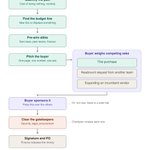
The User loved the demo. The Champion said “this is exactly what we need.” Best product in the evaluation, clear fit, warm handshake. Then the deal went quiet.
Winning the hearts and minds of Users and the Champion is half the battle. Most technical founders assume it’s the whole thing, because it’s the half they can see.
The other half happens in rooms you’re never in. Your champion walks into a budget meeting and your purchase is one of four asks on the Buyer’s desk, next to a headcount request and a renewal from a vendor already through security. The Buyer isn’t judging your product; they’re deciding where this half’s remaining dollars go, and “not now” is the answer nobody gets fired for.
Here’s the part that surprises founders most: your champion often can’t tell you how buying works at their own company. They’ve never pushed a purchase through before. Or they know exactly how it works and quietly decide the six weeks of memos, procurement forms and hallway lobbying aren’t worth it for a tool that makes their Tuesdays easier.
Harder to tease out: They’ve done the math on their own political capital and know they don’t have enough to spend on you. None of them will say any of this on a call.
You can’t attend that budget meeting. You can find out early whether your champion knows the path, wants to walk it, and has the standing to get there, and you can arm them for it: the cost-of-doing-nothing math, the budget line it displaces, the reference who’ll take a call, the security packet sent before anyone asks. These are all questions unrelated to your product and a muscle you'll to build
Of course, the best way is to engage the Buyer early and find out their mandate and translate your solution helps them.

Holy s***! Never thought I’d walk into an appliance showroom and have my breath taken away by a piece of art. This Kyle Bunting mural was done entirely from dyed cow hide.
Check it out at the new Roth Living store in Holladay, UT

A few of my neighbors on one of our favorite shows! Can’t wait to watch.

11 years ago, my dad, mom, and I received an email welcoming @korebaseball to Season 7 of Shark Tank. We had a date to go on the show and booked our flights.
I was a sophomore in college, running this little baseball company out of my dorm, and this was going to change everything.
But it never happened. Instead, my dad was diagnosed with a brain tumor and we put the company on hold. The Shark Tank dream was over. Our baseball company was still awesome, but growth slowed and no one was focused on it much. My dad passed away and I took a job elsewhere, but our love for that little squishy baseball never changed.
Fast forward to 2023. My two younger brothers decided to list it on TikTok Shop and posted some videos. It took off. We knew it was time to bring Kore back.
We developed bats, custom tape, bases and more. Millions of kids around the world have now played with the Kore Ball. A little squishy baseball that started with a family that played lots of baseball together. Will, Charlie, and my mom have done such an amazing job building the company.
Tonight, we air on Shark Tank, Season 18.
11 years after our first "Welcome to Shark Tank" email.
Tune in to watch my mom and brothers knock it out of the park. I know my dad will be watching.
Life is crazy.

Bingo

The big wrong turn, as I see it, was the vast cultural and spiritual shift that came of defining ourselves by our pasts, our injuries, instead of by our destinies, our potentials. The idea became to repair, repair, not to prepare and strive.
Therapy overtook destiny.
"Don't look back."
An ancient warning, ignored.
But we are not the sum of what's happened to us, as individuals or groups; we are the carriers of what is possible for us -- as we divine it and go out to meet it.
Instead of obsessing on its own roots a tree should grow toward the sun.
If you’re a technical founder who needs pipeline, you need a customer education plan.
The best part of it is already in your call notes.
You’ve talked to 30 people with the same problem. Each thinks their situation is unique. You know it isn’t; you’ve heard the same problem articulated over and over.
That’s a pattern, and only you can see it. That's gold and your customers want to hear that insight.
I created a free resource to help founders. DM me if you'd like it.


My bet is "the church" will never let the lake collapse. Grateful for this and all the other generous donations they've committed.

The @Ch_JesusChrist has committed $3 million to help more water reach the Great Salt Lake by removing invasive phragmites along its shores.
These aggressive reeds consume twice as much water as native plants, obstruct natural water flows, degrade critical habitat for millions of migratory birds, and increase wildfire risk.
The funding will accelerate removal efforts and support long-term wetland restoration led by the Office of the Great Salt Lake Commissioner and @DNR.
Together, we’re going to save the Lake.
If you’re an early-stage founder who needs pipeline, you need a customer education plan. Here’s how I’d build it in seven steps.
1. Define your "Desperate Who". Name the exact title at a specific type of company. “Robotics engineer at a non-warehouse robotics company deploying its first autonomous fleet,” not “robotics leaders.”
2. Define your "Desperate Why". What is the job they’re trying to do and what’s breaking.
3. Define the "Desperate Why Now". What happens to the business if nobody fixes it.
4. Founder credibility. Write out at least three stories of how you solved this before you started the company.
5. Mistakes. Three ways the Who gets it wrong today.
6. Patterns. Three themes you’ve noticed across every conversation with the Who.
7. Surprises. Three things that surprised you building and deploying the product for customers.
That’s 12 topics you already know. Cut out any topic idea you haven't lived or heard firsthand. No guesses. Also rewrite any overt product pitch.
Then post 2-3x per week from your personal account, not your company page.
Technical founders will rebuild an auth system over a weekend before they’ll post on @X
I’ve watched this for years now, across hundreds of seed-stage founders. Of everything that stalls a company between first customers and $1M, this is near the top of the list, and it’s the one founders least expect: the product works, a handful of customers are happy, growth is flat, and the thing that would fix it is the thing they refuse to do.
The stated objections come in a few flavors.
“Posting is cringe.”
“My audience is different.”
“My posts have to be perfect before I’ll publish one.”
Plenty of founders skip the objections and agree with me outright. They nod, they say they know they need to do this, and then three months pass and nothing goes out. Or four posts go out in week one, the engagement is modest, and the whole thing quietly dies.
My read on why: it’s the last thing on the list they actually want to do, so it sits at the bottom of the priority stack every single week, and the bottom of the stack never gets touched. Building is the default state for a technical founder because building is what they’re excellent at. Shipping a feature has a clear finish line and a dopamine hit. Writing about a customer’s problem has neither, at least not for the first month or two.
So the founder does what feels like the responsible thing instead and hires someone to run cold email. A few years ago that worked okay. Today it doesn’t. Reply rates have collapsed to 1% if you’re lucky, and paid ads aren’t the answer either; they reach the sliver of buyers already shopping, who usually have a vendor they trust by the time they search.
What’s working for pipeline today is educating your target customer before they ever search. And which companies are doing that well in your category? In most, nobody. That’s the opening, and it’s sitting there for the one person who knows the problem better than anyone on the buyer’s side.
What I tell founders: you don’t need a personal brand and you don’t need the post to be good. You need to describe one specific person’s problem so accurately that they stop scrolling because it sounds like you’ve been reading their Slack. Then do it again next week, whether or not the first one got any likes. Likes are noise; a post with eight likes and two booked calls beats one with forty likes and none.
The habit is the hard part, and it’s the whole thing. The founders this works for aren’t the best writers. They’re the ones who treated it like a standing meeting they weren’t allowed to cancel.
If you’re a technical founder stuck here, I’m happy to compare notes.

If an employee was at a startup for 10 years, promoted 6x, but the founder is out there giving them negative back channel references does that say more about the employee or the founder?

Doug Regner retweeted

Averaging all my different rankings for best overall state for families.
Ranked best to worst. Save this cheat sheet for your future.


