

40+ years helping financial professionals stay ahead of market trends. We do not reply to DMs/comments. For support, visit https://nitter.cf/t.co/nXEDyR00YV.
- Tweets26.2K
- Following291
- Followers122K
- Likes3.2K

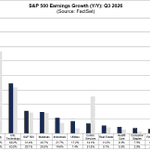




ALT Bar chart titled "S&P 500 Earnings Growth (Y/Y): Q3 2026" from FactSet. It displays percent growth across sectors: Energy (149.4%), Information Technology (69.2%), S&P 500 (63.3%), Materials (31.4%), Industrials (17.4%), Utilities (16.1%), Communication Services (14.1%), Real Estate (8.8%), Health Care (4.9%), Consumer Staples (4.5%), Financials (3.9%), and Consumer Discretionary (3.3%). Two time periods are compared: "Today" and "30-Sep".

ALT Banner for FactSet Insight displaying the title "Metals & Mining: Global Drill Results Monitor." Text mentions capturing copper and gold drill results from over 1,000 properties and highlights significant projects and regions. The author's name, Banu Nadarajah, is included.

ALT Screenshot of a webpage titled "U.S. ETF Monthly Summary: October 2026 Results" from FactSet Insight. The page highlights a total of $16.5 trillion in U.S.-listed ETFs, with October having a 45% increase from September, collecting $204.2 billion. The author, Lois Gregson, is noted at the bottom.

ALT Apple Inc. dashboard on FactSet displaying stock performance charts, company profile, headquarters location, and key statistics like market cap and revenue. Options to connect with the company and links to news articles.


ALT This image is a page from FactSet Insight. It includes the article title "Stress Testing Amid Rising Fears of an AI Bubble" and mentions that recent market reactions to an AI bubble are prompting a revisit to stress testing analysis. The text is by Kristina Bratanova-Cvetanova.

ALT This image displays an interface for intelligent prospecting. The screen lists "Recommended Prospects" with columns for name, title, company name, city, and wealth triggers. Companies listed include Walt Disney Co, Pixar, and Apple Inc. The left panel shows filter options like position, events, and company criteria.


