
President, John Reed Stark Consulting LLC | Senior Lecturing Fellow, Duke University School of Law | Former Chief, SEC Office of Internet Enforcement
Bethesda, Maryland
Joined September 2010
- Tweets4.7K
- Following300
- Followers30.6K
- Likes4.3K




Pinned Tweet
My late grandfather was a patriot's patriot but don't take my word for it. A treasure trove of his letters home, found in a dusty old shoebox, not only offer a unique/unfiltered glimpse into WWII army life, but they also bestow 6 essential career lessons.
linkedin.com/pulse/six-caree…

The spy novel is the sideshow. I read four years of Nvidia's SEC filings and wrote it all down: the numbers, the footnotes, the law, the CFO, the auditor, the SEC, DOJ and PCAOB. The fullest account I know of the question nobody is asking.

The SEC's recently released FY2026 Enforcement Report is propaganda above all else, an Orwellian Theater of the Absurd. And it proves, once again, that it’s 1984 all over again at the SEC Division of Enforcement. 10 Reasons why (with receipts).

Do You Currently Work at the SEC? Are You Sick and Tired of the Corruption of Paul Atkins and His Minions? Want to Speak Truth to Power? Here’s My Guide for SEC Employees Who Want to Speak Up Carefully and Make It Count.
I'm talking today about the SEC staffer told: to stop investigating a company because of who owns it, to leave a related party out, to steer clear of anything crypto, to look away when the evidence points toward a friend of the White House, to abandon the SEC's mission and the list goes on.
None of it is hypothetical. Atkins has dismissed/closed dozens of crypto-related cases/investigations; 8 of the 14 it dropped involved the President's family's business partners. Per Reuters, the Trump family has earned more than $2B from crypto while investors lost about as much. And then there's the President's memecoin, which paid him $636M and cost nearly a million buyers $3.8B. The Enforcement Director quit the same day after clashing with Atkins. The whistleblower office denied all 24 claims it decided in a quarter. One commissioner is now a quorum of the entire SEC. North Korea took $6.3B from Binance, the exchange the SEC had let go, and the SEC said nothing. I'm told the Atkins suite runs on Signal and takes its orders from the White House and the crypto industry. You were in the room when the stand-down came, when the related party came off the report, when crypto vanished from exam /investigation priorities. You know where the bodies are buried.
These are abuses of authority, evidence of corruption and even obstruction. And the SEC's own training never answers the real question: what can you lawfully do about it, and who can you tell? No one has ever written a comprehensive guide for the people inside the SEC. So I wrote one, (18,000 words) every fact linked to its source, built to be read on a Sunday night so you know your options by Monday. What's in it:
• Two bodies of law, and why only one was built for you
• The 1912 right to tell Congress, the Whistleblower Protection Act, and the 2019 amendment
• What you can disclose and what you can't: describe, don't carry
• Understanding the SEC's confidentiality rules and NDAs
• The Inspector General: Do's and don'ts for reporting abuses
• Anonymity: what it buys you, what it costs you
• Congress: which committees, how to reach their staff
• The Office of Special Counsel: the 3rd door and its deadlines
• The press: the route that feels natural but can cost you everything
• The mistakes hardest to undo, from the personal device to the file that leaves the building
• Recognizing retaliation before it becomes a firing
• Who protects you and how far to trust them
• What history teaches: Watergate, Aguirre, Flynn, Madoff
• The lessons of a 1991 anonymous memo
• A checklist for the SEC employee who has seen something
• The case for coming forward and an offer of help
You have options for Speaking Truth to Power. You're not alone.
Read my Guide at: johnreedstark.com/wp-content…
🤖 Made with AI

John Reed Stark retweeted

Crypto and AI super PACs spent $250 million on the midterms. In competitive races, their candidates got clobbered: nine losses out of 12 called so far, including Ohio, where crypto spent $64 million and still couldn’t beat Sherrod Brown.

ALT Election results bar charts showing $74 million of $92.4 million spent on competitive races went to losing campaigns, only $8.3M went to likely winners and $10.6M to safe winners
One of the Blue Wave's first casualties will be SEC Chair Paul Atkins. Here's the autopsy, written in advance: who holds each gavel, what they can compel, the 10 questions he'll be asked under oath, and a roadmap for the Blue Wave's impact on the SEC.
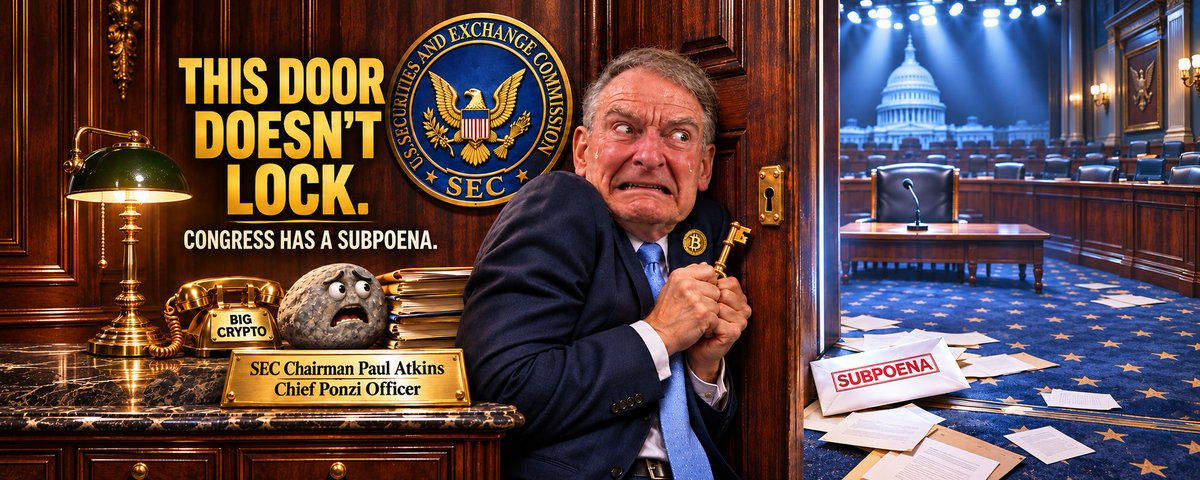
Hello Darkness, My Old Friend: Paul Atkins and the $6.3 Billion Sound of Silence
Four days ago, North Korea stole $6.3 billion from Binance in about twenty minutes. I would call it the largest theft in the history of money, except that bitcoin and crypto are not money, and they are not digital assets either. They are the outputs of unsolvable math problems, strings of numbers that represent nothing, back nothing and produce nothing, which is exactly why they are so easy to steal and so impossible to recover. Call it instead the largest ripoff of investors ever recorded, and it happened on the watch of the man who runs the most powerful investor protection agency the world has ever known.
Paul Atkins, the Chairman of the U.S. Securities and Exchange Commission, has said nothing.
Not a statement, a tweet, a staff alert, an investor bulletin, or so much as a line acknowledging that the SEC is even aware of the event. His Director of Enforcement, David Woodcock, has also said nothing. For four days the SEC has looked at the biggest heist in human history and decided to pretend it did not happen.
I ran the SEC's Office of Internet Enforcement for 11 years. When a brokerage lost a few hundred thousand dollars to a hacker, we had a statement out that day and a team on the phone with the firm by nightfall. That was the job. Atkins understands it too. He is not confused about what happened at Binance; he dropped the SEC's own case against Binance 17 months ago, with prejudice, and Binance thanked him by name.
Atkins knows that anything he says now, even a sentence of sympathy for the victims, would concede that crypto exchanges are exactly as dangerous as his predecessors said they were. So he says nothing, because the one constituency he will not risk offending is the industry he was appointed to police.
A regulator who cannot bring himself to acknowledge a multibillion dollar theft from investors has stopped being a regulator. This is not merely sad. For the chairman of the SEC to go mute while North Korea pockets billions of dollars of stolen investor funds, because speaking would be inconvenient for Big Crypto, is a dereliction so complete that it should be investigated as one.
The Stark Reality is that silence is a statement, and Paul Atkins has now made his. Billions in customer funds are sitting in Pyongyang, the thieves are already studying the replay, and the SEC Chairman has looked at the greatest robbery ever committed and decided that his loyalty runs to the industry that got investors robbed, not to the investors.
Atkins has one job, written over the door of the building, but when the moment came to do it, he hid. Investors will remember who spoke up for them this week, and they will remember who didn't.
Somewhere in Pyongyang tonight, a hacker is celebrating $6.3 billion, and somewhere in Washington, the man paid to stop him is cowering under his desk, hoping no one asks him about it.

The Binance heist was the single most predictable event in finance, and SEC Chair Paul Atkins personally arranged it. 17 months ago he dismissed, w/ prejudice, the SEC's own case against Binance, a case the agency was winning. Binance thanked him by name.

Big Crypto Owns Paul Atkins, and He Just Proved It Again: the SEC Chairman Has Once Again Erased Crypto From SEC Examination Priorities, Ordering SEC Examiners Who Walk Into Registered Firms to Stop Looking at It. Regulatory Capture Ad Nauseam.

Who Made Paul Atkins King? The SEC Won 200 Crypto Cases in Ten Years. Paul Atkins Just Forfeited All of Them. The Senate Wouldn’t Touch the Crypto Bill, So He’s Gleefully Passing It Himself, as a Rule. Lee Reiners and I Filed 33,000 Words Explaining Why Vacating This Atkins Travesty Will Be the Easiest Decision Any Court Will Ever Write.
Introduction. On August 18, 2026, U.S. Securities and Exchange Commission Chairman Paul Atkins proposed Regulation Crypto Assets, a rule that would let crypto issuers sell unregistered tokens to anyone: up to $5 million with no financial statements and no SEC or state review, up to $75 million a year under a loosened version of Regulation A, with no holding period for insiders under either, plus a "safe harbor" that lets the issuer certify its own token out of the securities laws on a form no one reviews.
Call this monstrosity what it is: an aberration in law and an abhorrence in policy. So @leereiners and I filed a comment letter asking the Commission to withdraw it. Every word. Here's why:
For more than ninety years, the law governing the sale of securities has rested on one premise: The seller tells the truth first, and the buyer decides second. Paul Atkins proposes to reverse the order. Investor protection is not a courtesy Paul Atkins extends to markets he likes. It is the price Congress attached to the privilege of selling to the public, and Paul Atkins now proposes to waive the price and keep the privilege, for one industry, on that industry’s terms.
The SEC’s 200 crypto victories were not a policy choice that Paul Atkins inherited and may discard. They were legal conclusions, reached by Article III judges appointed by six Presidents. Those judgments cannot be disappeared by Paul Atkins. The judges who entered them are still sitting, and what they decided must be respected and enforced.
So when this rule reaches a courtroom, the hardest question will not come from the challengers. It will come from the bench:
Counsel, for ten years your agency stood at that lectern and asked this court for judgments on the ground that these offerings were securities. Now you ask us to accept the opposite. The tokens haven’t changed. The statute hasn’t changed. Howey hasn’t changed. The only thing that changed is that Paul Atkins became Chairman. So tell us: when Article III judges appointed by six Presidents apply Howey to these offerings more than two hundred times and reach the same answer every time, and Paul Atkins then announces they were all mistaken, which of those is the law of the United States? Does Paul Atkins’s vote nullify a decade of judgments? Because if the answer is yes, the next Chairman can nullify Paul Atkins the same way, and nothing your agency says to any court will ever be worth believing again.
Paul Atkins’s Release never answers that question. Across 146 pages of the Federal Register, it never explains why a decade of its own litigated positions was wrong, never cites, let alone distinguishes, a single one of the rulings it would displace, and never acknowledges those who relied on them. It simply proceeds as if none of it happened. That deafening silence is not an oversight. It's the only option available, because the honest answer is that nothing changed except the Chairman.
The Gist of Our Comment Letter. For a decade the SEC told federal judges that unregistered crypto offerings harm investors, and won more than 200 times before judges appointed by six Presidents. ICOs, SAFTs, utility tokens, lending, staking: securities offerings, every time. Now it proposes to exempt the very transactions those courts found easiest to classify.
The startup exemption combines what no exemption does: any number of retail investors, general solicitation, immediately tradable tokens, no intermediary, no investment limit, no financial statements, no SEC or state review. Insiders can sell on day one; the Release concedes a holding period could strengthen investor protection and rejects one anyway.
An issuer may raise $75M every 12 months, then exit through a safe harbor you could drive a truck through: a checkbox on a form, effective when filed, reviewed by no one, certifying that the issuer has completed, or permanently ceased, the efforts it promised. An exit visa from oversight, stamped by the traveler.
At the same time, the SEC has not applied its own interpretation to the token of the venture affiliated with the President's family. Investors, a footnote suggests, can protect themselves by contract: caveat emptor, restated by the agency created to replace it.
Sections 28 and 36 are 1996 backstop provisions, not a license to build a parallel offering regime, and with Chevron gone a court will read them de novo. The Senate declined even to take up the CLARITY Act; the SEC cannot enact by rule what Congress has declined to enact by law. The Release lists monetized benefits as n/a, never estimates investor losses, and never mentions FTX, Terra, Celsius, or any hack, theft, scam, or collapse. It does not contain the words money laundering, illicit, terrorist, or Bank Secrecy Act. It never explains its reversal of a decade of its own litigated positions, as Fox, Encino, and Regents require. It issued with no public meeting.
Who pays? Retail investors who buy unrestricted tokens. Who profits? Venture funds that buy at a discount, insiders who sell immediately, and platforms freed from state review, in an industry that spent $189M on the midterms by midyear. Nearly 18 years in, blockchain has no killer use case beyond speculation and trading; Big Tech will spend more than $700B this year, overwhelmingly on AI, and effectively nothing on blockchain. So the SEC proposes to give blockchain the one thing it never found on its own: a steady supply of retail buyers.
The Stark Reality. Paul Atkins is not deregulating crypto. He is pardoning it. Federal judges appointed by six Presidents applied the law to crypto more than two hundred times and reached the same answer every time. They did not read it wrong. Nothing in those cases has changed except the nameplate on the Chairman’s door, and a nameplate is not a legal authority.
Yet with one signature, Paul Atkins proposes to erase every one of those judgments and replace them with a vending machine: insert a form, pull the lever, and out comes a certificate declaring that the securities laws no longer apply to you. No one checks the machine, no one refills it, and Paul Atkins built it on the honor system, in an industry whose honor has already cost investors billions.
Presidents pardon people. Paul Atkins proposes to pardon an asset class. The Constitution gives him no such power, and no court will pretend otherwise.
(Fair warning to the TL;DR crowd: Reading the letter is not for the faint of heart. It runs more than 33,000 words and 235 footnotes. Pack a lunch sports fans.)
Read our comment letter here: sec.gov/comments/S7-2026-27/…

John Reed Stark retweeted

The @SECGov 's proposed Regulation Crypto Assets is a hot mess. In our comment letter, @JohnReedStark and I ask the SEC to withdraw the proposal in its entirety.
For a decade, the SEC persuaded federal judges appointed by six Presidents that unregistered token sales are securities offerings, compiling more than 200 enforcement victories. The proposal would exempt the very transactions those courts found easiest to classify.
On September 15, the Senate declined even to begin debate on the CLARITY Act. The Senate's text would have directed the SEC to adopt a "Regulation Crypto," with a $200 million lifetime cap, a bar on companies organized abroad, and mandatory holding periods for insiders. The SEC's proposal allows $75 million every 12 months with no overall cap, opens its startup exemption to companies organized anywhere, and imposes no holding period on insiders. The agency is writing by rule a looser version of a bill the Senate would not take up.
The treatment of insiders is more generous still. @Coinbase urged the SEC to limit token sales by development teams until a network is "sufficiently decentralized." The SEC's proposing release concedes that a one-year holding period for insiders "could benefit potential investors by strengthening investor protection," then rejects one, observing that "an exit of a large insider could potentially result in a broader base of investors." That broader base is the retail public, buying what the insider is selling.
The proposal also treats work to "secure" a functioning network as categorically outside the managerial efforts that make a token an investment contract. Yet migration to post-quantum cryptography may decide whether many tokens retain any value, and neither the proposing release nor the SEC's March 2026 interpretation mentions quantum computing. The Senate Banking Committee's CLARITY text includes a finding that quantum advances threaten "the security of digital assets."
The exemptive authorities the SEC invokes, Section 28 of the Securities Act and Section 36 of the Exchange Act, are backstop provisions enacted in 1996. With Chevron deference gone after Loper Bright, a court will decide for itself whether they authorize a parallel offering regime for an entire asset class, and we believe any final rule resembling this proposal will be vacated. The SEC cannot enact by rule what Congress has declined to enact by law.
The full letter, all 235 footnotes of it is here: sec.gov/comments/S7-2026-27/…
#crypto #SEC
Hot off the presses: Two items hit my feed yesterday. Together they tell you where U.S. investor protection still lives, and where it went to die.

One person's now a quorum at the SEC. SEC Commish Mark Uyeda, Chief Doublethink Officer of the SEC's new Ministry of Truth, calls it a "clarification." His own 2022 speech says otherwise. Here's the record w/ receipts, which Uyeda's hoping you won't read.

In the Ultimate SEC Irony, Hester Peirce Thanks Her Critics on the Very Day Paul Atkins's Quorum of One Kicks In
At 5:15 p.m. on Friday, October 2, her last day as an SEC Commissioner, Hester Peirce posted her final tweet. She thanked her "many critics" and wrote: "Vigorous critiques of government officials are part of what makes this country great."
That same day, an SEC rule took effect that lets one Commissioner, acting alone, be a quorum of the entire Commission whenever the others are disqualified from a matter. The SEC never proposed it and never took a single public comment. It was adopted on September 30, while Commissioner Peirce was still in office, and the release records no dissent.
In its 92 years, the SEC has never before let one Commissioner become the Commission because a colleague stepped aside. In 1995, the Commission looked at that exact question and refused. Thirty-one years later, Paul Atkins's Commission did it anyway in secret, and never asked the public a single question.
Congress created a bipartisan Commission of five. Today it has two members, Chairman Paul Atkins and Mark Uyeda, both from the same party. Under the new rule, if either one is disqualified from a matter, the other one is the SEC. Nobody has to be persuaded, and nobody is left to write a dissent.
I worked at the SEC for almost 20 years. The debates among Commissioners were one of the most interesting and rewarding part of the job, because people who disagreed about nearly everything were all trying to get it right. That argument is a big reason U.S. financial markets became the envy of the world.
Paul Atkins sat on a five-member, bipartisan Commission from 2002 to 2008. He knows exactly what he is dismantling.
The Stark Reality is that the SEC has gone without a minority-party Commissioner before, for about seven months in 1995–96 and about five months in 2008, and both times the empty seats were filled. This time the gap has run more than nine months, and the SEC's answer was to rewrite its quorum rule.
With all due respect, Hester, I’ve known you for over 20 years, and you cannot thank your critics on Friday afternoon and lock them out of the room the same day. Praise for "vigorous critiques" from a Commissioner whose agency rewrote that rule on her watch, with no public notice and not one public comment, is pure theater, so spare us the eulogy for the debate this SEC just buried. It is a con, and every securities lawyer in America knows a con when they see one.

One man can now be the entire SEC. A rule slipped through with zero public comment lets a single commissioner write rules for every investor in America. Every securities lawyer knows it's indefensible. Almost none will say so. So I will. Read the receipts.
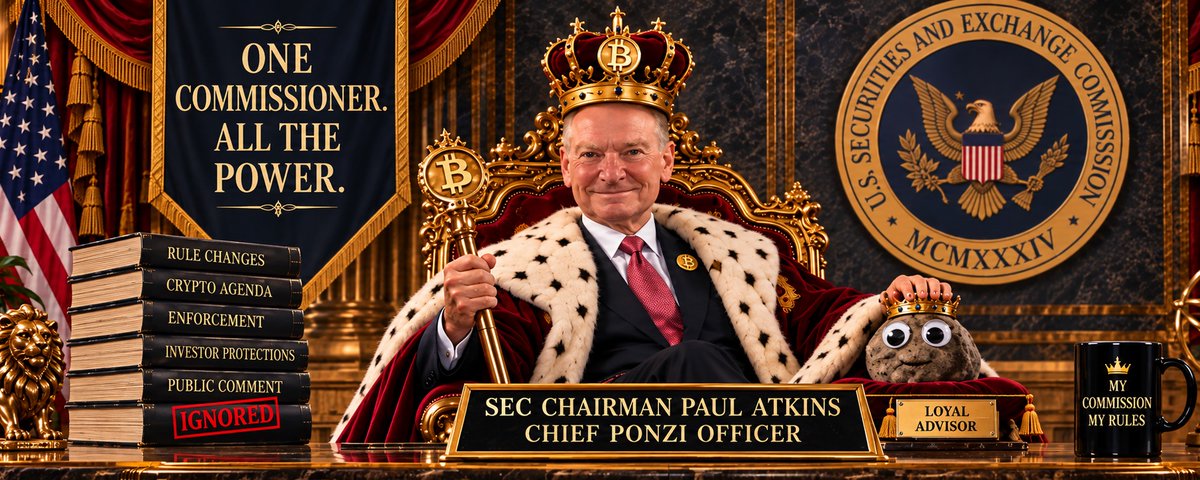
Breaking: SEC’s Top Cop to Fraudsters: “I Am Not Preoccupied With Numbers”
For years at the SEC, I helped write enforcement speeches. We wrote them to tell the market what we were doing. David Woodcock writes his to explain what he isn’t doing.
For SEC Enforcement Directors, the formula is simple. Find the fraud. Aim the resources. Bring the cases. Then take the podium, announce the results and remind markets that the SEC is on the beat.
And the podium is always there. Every financial conference wants the Enforcement Director as its keynote. Woodcock has held the job for 143 days and given exactly two speeches. Two. What you remember from both is what the SEC is not doing. Pathetic is too kind a word. Mr. Director, you cannot hide, we still see you.
Speech #1 (May): “back to basics,” plus a “quick aside” on “the decline in the number of cases brought.” His answer: “this SEC has deliberately shifted toward an emphasis on quality over quantity, and I fully support that direction.” sec.gov/newsroom/speeches-st…
Speech #2 (September): “Now, let me briefly touch upon enforcement statistics.” Then a fifth of the speech on why no one should judge the program by them, including a section titled “A Healthy, Visible Enforcement Program Matters More Than Statistics.” sec.gov/newsroom/speeches-st…
With twelve days still left in the FY2026, he declared that, “FY2026 was a transitionary period.”
How did he know? The Enforcement Director’s front office counts the numbers internally, with a tracker that shows the trends as they happen — and it also tracks “likely cases” for the months ahead. These preemptive apology speeches are a huge tell. “Sentence first—verdict afterwards.” It's Alice in Wonderland at the SEC. linkedin.com/feed/update/urn…
This is what panic looks like. While Woodcock lowers expectations from the podium, his Division has spent September cranking out dozens of fill-in-the-blank orders against companies that simply stopped filing their reports, padding the very numbers he says “tell us little.”
Woodcock's greatest hits:
“To be clear, we are not looking for opportunities to pile on.”
“I am not preoccupied with numbers.”
“This review is not a sign of weakness.”
What the cop on the beat left out:
• Meme coins and meme stocks: zero mentions.
• Crypto treasury companies: zero.
• Prediction markets: zero.
• Cybersecurity: zero.
• Whistleblowers: zero.
• Private credit, whose “stresses” he flagged in May: zero in September.
• FCPA: zero.
Woodcock even quoted former SEC Chairman Harvey Pitt: visibility is “an essential predicate for any effective enforcement program.” Agreed. Physician, heal thyself.
Picture a CISO taking the stage at Black Hat to announce that their team is watching fewer doors. Every ransomware gang on the planet would be inside their network by Monday. Pump-and-dump crews, Ponzi promoters and boiler rooms listen to SEC speeches just as closely.
The SEC's top cop is managing expectations instead of fraud. Disgraceful to say the least.
It's time to stop the hustle.
🤖 Made with AI

I had a front row seat watching the CLARITY Act fail in real-time and @leereiners is spot-on in this compelling article. Now the true test will be the midterms. Big Crypto wants to take out every Democrat who opposed the CLARITY Act, and they've been very successful in the past. So the ultimate question is whether the CLARITY Act's failure was a harbinger — or an aberration. We'll know in 40 days. theconversation.com/how-trum…
