




ALT The image features a graphic for the "East Palestine Illustrated Digest" by NTSB. It highlights the digest titled "East Palestine, Ohio Norfolk Southern Railway Derailment and Hazardous Materials Release Illustrated Digest." A call-to-action button reads “Explore the Illustrated Digest.” In the background, there's a photo of a train. The NTSB logo and website link are included at the bottom.


ALT The image features a warning about natural gas leaks. On the left, large text reads, "You can't always smell a natural gas leak" in white and yellow against a dark blue background. Below, smaller text states, "A hidden danger can become a life‑threatening emergency." On the right, there is an image of a natural gas alarm emitting smoke. The letters "NTSB" are prominently displayed in white at the bottom left corner.

ALT A graphic explaining natural gas safety. On the left, text reads: "WHAT IS THE ISSUE? Natural gas is naturally colorless and odorless. Utilities add a 'rotten egg' odor to help detect leaks. But this warning isn’t always reliable." On the right, there's an illustration of a yellow gas pipe with a valve emitting a blue flame, indicating a gas leak.

ALT A diagram illustrates a two-story house with a bedroom and living room. Text on the left reads: "Why It Matters." There are icons and lists: one with a crescent moon and star labeled "Be asleep," a nose labeled "Be unable to smell the odor," and a door labeled "Be in another room." A warning triangle is above the text. At the bottom, it states: "In some cases, the odor can even fade before the gas enters a building.

ALT Here is an image featuring a safety message from the NTSB. It advises installing a natural gas alarm to alert individuals to dangerous methane levels before an explosion occurs. The image includes an illustration of a gas alarm and icons instructing actions if the alarm sounds: evacuate immediately, call 911, and contact the gas company. The text directs to ntsb.gov/SafetyIssues for more information.

ALT Accident scene. (Source: Union Pacific Railroad; annotated by NTSB.)

ALT CVR from the Learjet 60.

ALT CVR from the Learjet 60 at the NTSB Vehicle Recorders Laboratory in Washington, D.C.

ALT CVR from the Learjet 60 at the NTSB Vehicle Recorders Laboratory in Washington, D.C.

ALT CVR from the Learjet 60 at the NTSB Vehicle Recorders Laboratory in Washington, D.C.

ALT The image is a promotional flyer for the NTSB's Family Assistance Operations TDA Course. It includes the NTSB and Transportation Disaster Assistance logos. The flyer describes a three-day course focusing on family assistance operations after major transportation accidents. The course is free, in-person, and will take place from March 9-11, 2027, in Washington, DC. Applications are due by November 23, 2026. Additional details and contact information are provided.


ALT The image features a blurred background of railway workers on tracks. The prominent text reads, "Routine rail work shouldn't be fatal." Additional text states, "Recurring NTSB investigations show preventable hazards continue to put workers at risk." The logos for NTSB and "Strengthening Rail Safety" are at the bottom.

ALT A rail worker stands on train tracks, holding documents, surrounded by industrial structures. The background features track infrastructure and another person in a reflective vest and hard hat. Text on the left reads: "What is the Issue? Rail workers continue to be killed or seriously injured while: Inspecting and maintaining tracks, Operating maintenance equipment, Conducting switching operations, Working near trains, vehicles, and heavy equipment." Below, it says, "Many incidents occur during routine work.

ALT The image is an NTSB safety recommendation poster titled "What Needs to Change?" It highlights four actions: Protect Workers Around Maintenance Machines, Reduce Risks During Shoving Movements, Move Beyond Train Approach Warning, and Strengthen Oversight. Each action is accompanied by icons and further details about the recommendations. The background shows individuals in safety gear on a rail track. The URL ntsb.gov/Rail is at the bottom.


ALT Left to right: Ginny Stone on April 30, 2025, and Isla de Bioko on April 29, 2025

ALT Recreational vessel and USV hauled out of the water, with the USV split into two large pieces and entangled in the recreational vessel’s starboard pod. (Source: Monroe County Sheriff)

ALT A blue background with white text reads: "Ensuring Passenger Seat Belt Use on School Buses." Below, "NTSB Investigation Spotlight" is displayed in white text. Yellow arrows point left and right on either side of the main text.

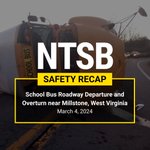
ALT The image shows a school bus that has overturned on a roadway. Text overlays the image, reading: "NTSB Safety Recap: School Bus Roadway Departure and Overturn near Millstone, West Virginia, March 4, 2024."