

Father, husband, enthusiast of law, politics, sports, art +life. Père, mari, passionné de justice, politique, aime les sports, les arts et la vie.
Canada 🇨🇦
Joined November 2012
- Tweets10.2K
- Following3.1K
- Followers52.1K
- Likes3.9K




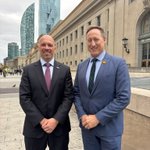



Perfect day, excellent game and wonderful friends.@CFL & @greycup was a huge success in Calgary AB this yr. It even had @calstampeders fans pulling for the @GoElks.


Peter MacKay retweeted

The Canadian Forces has released that a fifth soldier has died due to the October 17th fire in Wainwright.
Private William Dougal Dal Bianco served with 3PPCLI.
They shall grow not old, as we that are left grow old:
Age shall not weary them, nor the years condemn.
At the going down of the sun and in the morning
We will remember them.


Sunny Brae & Stellarton NS cenotaphs were surrounded by grateful citizens today. Stoic, respectful,
beautiful.


A stirring Remembrance service @NewGlasgow today. Well attended and run by RC Legion Normandy Branch 34. Vets, Serving CAF and emergency responders on parade. Prayers, poppys, pipes and caring Canadians there to give thanks and remember what was done by others for all.


Peter MacKay retweeted

In 1943, a Canadian soldier walked into a restaurant in his own hometown, in uniform, and asked for a meal.
The owner refused to serve him.
When he wrote to Ottawa to complain, the government told him there was no law against it.
The town was Dresden, Ontario.
It had been one of the end points of the Underground Railroad. People escaping slavery in the United States had settled there in the 1800s, and by the 1940s Black residents made up about 17 per cent of the town.
They went to school with white children. They lived on the same streets.
But they could not get a haircut in a single barber shop. They could not get a meal in a single restaurant. They could not shoot pool in a single pool hall.
One historian later described the discrimination in Dresden with one word.
Absolute.
The soldier was Hugh Burnett.
He was born on a farm just outside Dresden on July 14, 1918, a descendant of people who had escaped enslavement. He became a carpenter.
He had first felt it at 16. He stopped his truck to help a white motorist who had run out of gas. The grateful stranger insisted on buying him lunch in town.
Burnett thought that, in the company of a white man, maybe this time they would serve him.
They did not.
He decided then that he was going to do something about it.
When the war came, he enlisted. He was later discharged for medical reasons. In 1943, at 25, he was living in Windsor with his wife, Beatrice, and working at Ford. He came home to visit family, still in uniform, and was turned away.
So he wrote to the federal Minister of Justice, Louis St-Laurent.
Even in uniform, he wrote, a Black man could not be served in any restaurant in Dresden.
The reply from the Deputy Minister was simple. There was no law against racial discrimination in Canada.
Go and check. In 1943, that was true.
In 1948, Burnett moved his family back to Dresden. He joined his uncles in a small group of Black farmers and tradespeople called the National Unity Association.
He became its secretary, its organizer, and its voice.
They asked the town council for a bylaw banning discrimination in local businesses.
Council refused. Then it agreed to put the question to the voters.
In 1949, the people of Dresden voted on whether restaurants should be allowed to refuse service because of race, colour or religion.
The bylaw lost.
Five to one.
That was roughly the ratio of white residents to Black residents in town.
Burnett did not stop. He took the fight to Toronto, joining labour and human rights groups pushing for a provincial law.
In 1951, Ontario passed the Fair Employment Practices Act, banning discrimination in hiring. Burnett wrote to Premier Leslie Frost to point out that it still said nothing about restaurants.
In March 1954, he stood in front of the Premier and his cabinet and told them what Dresden was like.
Reports said Frost was moved.
That same year, Ontario passed the Fair Accommodation Practices Act. Refusing service because of race became illegal.
And in Dresden, nothing changed.
Two restaurants, Kay's Café and Emerson's Restaurant, kept refusing Black customers. So Burnett and his neighbours walked in, sat down, and asked to be served. When they were refused, they filed formal complaints.
These were sit-ins.
In 1954.
Years before lunch-counter sit-ins swept the American South.
The province was slow to lay charges. Some owners simply locked their doors when they saw the group coming. So the activists sent in out-of-towners the owners did not recognize, with a Toronto reporter along to watch. One test case went to court. The owner of Kay's Café was found not guilty.
They tried again.
In November 1955, two university students from Trinidad were refused at Kay's Café. The owner was charged again in early 1956. This time he was convicted and fined.
On November 16, 1956, members of the National Unity Association walked into Kay's Café.
For the first time, they were served.
Here is what it cost the man who led them.
His family received anonymous threats. The life of his school-age daughter, Patricia, was threatened. White residents boycotted his carpentry business until there was no work left.
That same year, Hugh Burnett was forced to leave Dresden.
He moved to London, Ontario, and kept a low profile for the rest of his life. His daughter later remembered her mother stretching meals with fewer potatoes and fewer onions as the money dried up.
"I think that he was on this earth to do what he did," Patricia said. "He had to do it."
Back in 1954, Burnett had explained what he expected the new law to do.
"It has been stated that you can't make a law to make one man love another," he said. "But it would eliminate the act of discrimination. And of course our personal feelings will come into it later. We will learn to like each other."
He died on September 29, 1991. He was 73.
Almost nobody outside Dresden knew his name.
On July 31, 2010, the Ontario Heritage Trust unveiled a plaque on the main street of Dresden, near the restaurant that had once turned him away. It credits Hugh Burnett and the National Unity Association with laying the groundwork for human rights law across Canada.
Think about the last time you walked into a restaurant and simply sat down.
Nobody asked who you were.
A carpenter lost his business, his town, and his home so that question would never be asked again.

Peter MacKay retweeted

Today we take pause to reflect on the generations of Canadians who answered the call. We join together as part of a national commitment to ensure we honour the fallen and help the living. Lest we forget. 🇨🇦

Peter MacKay retweeted
Tomorrow most of the country will be standing at a cenotaph. A lot of us spent at least one Remembrance Day in Afghanistan instead, on parade at KAF or out at a FOB, wherever we happened to be that year.
If you've got photos from one of those, we'd like to get them on the map. Make an account at projectathena.ca, hit Add, and pin it where it was taken

Peter MacKay retweeted

Today, Canada’s Fallen will be honoured and Remembered. Please join us in observing a moment of silence at 11:00 am to mark the sacrifice of those who have fallen in the service of their country.
#RemembranceDay #CanadaRemembers

Peter MacKay retweeted
Calling all Canadians!
Funds raised during the Poppy Campaign directly support Veterans and their families. From emergency financial assistance to housing and mental health services, your donations make a direct impact in the lives of Canadian Veterans.
Your Poppy makes a difference. legion.ca/remembrance/the-po…
#LestWeForget #GetYourPoppy

So proud of Nazanin, recently recognized by @simonwiesenthal for her long standing efforts as a human rights & democracy advocate. Her promotion of tolerance & antisemitism and alliance between Jewish & Iranian people merits this recognition.
989xfm.ca/nazanin-afshin-jam…


Peter MacKay retweeted
The Royal Canadian Legion is honoured to present Mrs. Virginia Hicks, from the community of Frankford, Ontario, as this year’s National Silver Cross Mother. On November 11, she will place a wreath at the National War Memorial in Ottawa.
“Her presence on behalf of all mothers is so incredibly meaningful,” says Sharon McKeown, Dominion President. “In sharing her daughter’s story, we are all reminded with deep gratitude, of the incredible sacrifice of those who give their lives in service to our country. We will remember her.”
Mrs. Hicks’ daughter, Sapper Mariebeth Short served with 2 Combat Engineering Regiment, based in Petawawa, Ontario. Born on January 23, 1980, in Comox, British Columbia, she grew up in a family with a history of military service – including that of her mother.
Mariebeth was killed on September 23, 2002, during a training exercise on the Matawa Plains in Petawawa. The exercise was a recap, a part of the overall intensive training the Sappers completed to learn everything possible about LAVs (light armoured vehicles). The vehicle she was traveling in that day rolled, and she did not survive.
legion.ca/news/articles/2026…


Peter MacKay retweeted
Educating young Canadians about the service and sacrifices of our Veterans is an important part of the Legion’s mission.
We love seeing initiatives like the @ttctransit Remembrance campaign that bring Veterans and youth together, sharing stories, building understanding and ensuring their experiences are never forgotten.
When young people hear these stories firsthand, the importance of Remembrance takes on a whole new meaning.
Thank you to the TTC for helping inspire the next generation to Remember.
Video Credit: @CityNewsTO
Peter MacKay retweeted

🪖As a wounded combat vet, wear the poppy. Honour the ones who never came home and the ones still carrying it. 🇨🇦 🌺

Peter MacKay retweeted

Tomorrow, vote for a Toronto that lives up to its full potential.
A city where you can get home on time, afford to build a life with your family, and feel safe in your neighbourhood.
We know what Toronto can be. Let's vote to get it there.


Peter MacKay retweeted
At 22 years old, Allan “Scotty” Davidson was captain of the Toronto Blueshirts, the team that would later become the Toronto Maple Leafs, and led his team to the city’s first Stanley Cup victory. He left his team, his career, and his home behind to become one of the first professional hockey players to volunteer for the Canadian Expeditionary Force.
On June 16, 1915, he was killed in action after a shell exploded near him in the trenches. He was one of the many thousands of Canadians who never came home and whose names and stories should never be forgotten.
legion.ca/dontforget

Peter MacKay retweeted

On this day in 2014, Corporal Nathan Cirillo was killed at the National War Memorial. The shooter ran to the Parliament Buildings where he was killed.
Sgt-at-Arms Kevin Vickers, his security team and the RCMP earned the Star of Courage and Medal of Bravery.
📸 Guillaume Haché

ALT Corporal Nathan Cirillo standing at attention outdoors, viewed from a three-quarter angle. He has short dark hair, a trimmed beard, and a serious expression, wearing a dark military uniform jacket with epaulets, a white collared shirt and dark tie, sleeve stripes, a triangular shoulder patch, name tag, small pins, and a crown-shaped insignia on his chest. A dark Glengarry-style cap with a small pom-pom top and checkered band sits atop his head. His belt is light-colored with a polished buckle, and the blurred background includes architectural structures and faint figures.
Peter MacKay retweeted
We will remember Pte. Aidan Goulding, Pte. Shaun Farrell, Pte. Hayden Lykkemark and Sgt. Morgan Wong. Our deepest sympathies and support extend to the families of the fallen and everyone impacted by this national tragedy.


