

MD, PhD, Medical Oncologist | Clinical Fellow @DanaFarber | @Harvard. Associate Editor @ESMO_Open. Interested in breast oncology, HER2, ADCs and good music.
Boston, MA
Joined January 2018
- Tweets18.5K
- Following829
- Followers32.8K
- Likes48.2K




Pinned Tweet
ADCs enable an improved delivery of chemo, expanding its activity, but not necessarily decreasing its side effects. Why is that? How can we reduce the toxicities of ADCs?
Glad to share our @NatRevClinOncol article on how to optimize the safety of ADC! 🧵
nature.com/articles/s41571-0… – at Boston, MA

Paolo Tarantino retweeted

Honored to be a candidate for ASCO nominating committee among other great candidates! Please visit
asco.org/about-asco/asco-ove…
to learn more about us & cast your vote to help shape asco future! We are all excited to serve & support asco mission! Deadline is Dec 2nd at 3pm EST! Best regards :-)


Voting in the ASCO Election is open now until December 2! Meet the candidates for the Nominating Committee – Undesignated Member seat.
Learn more about each candidate and make your voice heard: bit.ly/4zi4KWm

65yo woman with stage II, pT2 (2.5 cm) N1 (1/3), ER+/HER2- breast cancer, grade 2, OncotypeDX RS 12. Completed local treatment.
Assuming all available, which adjuvant treatment would you favor?
18%AI monotherapy
38%AI + CDK4/6 inhibitor
27%Giredestrant monotherapy
18%AI+CDK4/6i ➡️giredestrant
176 votes • 20 hours Paolo Tarantino retweeted

lidERA: discussion around adjuvant Giredestrant (oral SERD) approval by @FDA ✅ for Stg I-III HR+ breast cancer w/ @dradityabardia
Full 🗣️:
⭐️ oncbrothers.com/lidera
⭐️ “Oncology Brothers” podcast
@OncUpdates #OncTwitter #bcsm
Paolo Tarantino retweeted

📣 Today #FDA approved giredestrant for adults with Stg 1-3 #breastcancer at intermediate to high recurrence risk based on the lidERA trial. NNT 35.7 to prevent 1 IDFS event (36 month IDFS rate).
⚠️ Bradycardia & embryofetal toxicity. OS not mature.
#OncTwitter #bcsm
1/3
Paolo Tarantino retweeted

In case you bookmarked Dario's claim to cure all disease in 10 years to come back to it in 2036, here, for reference, is Microsoft making the same claim in . . . 2016. $ANT
telegraph.co.uk/science/2016…

BREAKING: giredestrant becomes the first oral SERD approved for the adjuvant treatment of ER+/HER2− breast cancer. 30% reduction in iDFS risk at 3 years vs SOC ET. Longer follow-up and a full publication remain needed, but, for now, a major step forward! fda.gov/drugs/cancer-approva…

Paolo Tarantino retweeted

In 1996, No One Knew What a Study Coordinator Was
▶️ Watch the full Episode 11 on YouTube - youtu.be/LkwnIW4--Ls?si=LJes…
🎙️ Hosted by Drs. @JAMouabbi & @PTarantinoMD - @CHMediaHub
🎧 Listen on Spotify, Apple Podcasts, Amazon Music, CastBox & iHeartRadio
#BreastFriendsPodcast
Paolo Tarantino retweeted

A milestone 10 years in the making!
Today we shared results from BROADEN2, our first global, placebo-controlled trial of KT-621, an investigational oral drug for atopic dermatitis, asthma and potentially other type 2 diseases.
Impressive results:
- Statistically significant efficacy across all doses at Week 16
- Significant improvement in skin (EASI) and itch as early as Week 1
- Efficacy at least in line with marketed biologics. The likely Phase 3 dose (mid dose) was numerically superior to dupilumab on almost all endpoints, with 45% placebo-adjusted EASI reduction, 40% placebo-adjusted EASI-75, and 38% placebo-adjusted ≥4-point PP-NRS improvement
- Safety in line with pathway biologics
KT-621 is the first oral drug to deliver a biologics-like profile. Thanks to targeted protein degradation, Kymera's target selection strategy, and our world-class team.
What does this mean for AD and other type 2 diseases? Millions of patients (~95% of total moderate to severe) are untreated or undertreated, most of them are waiting for a safe, effective oral therapy that gives them control of their disease.
Today, we're one step closer to delivering for them.
None of this would have been possible without the patients and families who took part in the study, the investigators and site staff, our partners and collaborators, and my incredible colleagues at Kymera.
We're just getting started!

Today, we announced positive results from the BROADEN2 Phase 2b trial of KT-621, our investigational, first-in-class, once-daily oral STAT6 degrader, in patients with moderate-to-severe atopic dermatitis.
The data demonstrating rapid and substantial improvements in AD severity and itch, with a favorable safety profile, reinforce KT-621's potential to expand the number of patients receiving advanced therapy. These findings bring us closer to our founding vision of turning groundbreaking science into oral medicines with the opportunity to transform care for millions of patients living with chronic inflammatory diseases.
Our deepest thanks to the patients, investigators, and the incredible Kymera team whose dedication made this significant milestone possible.
Learn more in our press release and join our live video webcast at 8:00AM ET today: bit.ly/4fQ98Uz
Paolo Tarantino retweeted

Here’s the #BreastCancer Research Digest-a summary of last week’s publications from select high-impact journals (November 13th - November 20th, 2026). #ClinicalResearch #CancerTreatment #BCSM #BreastCancerResearch #BreastCancer


Paolo Tarantino retweeted
We are leading a phase 2 study, called #TRUDI, to test the safety and effectiveness of an investigational drug combination (trastuzumab deruxtecan and durvalumab) to learn if the intervention works in stage III, HER2-expressing #InflammatoryBreastCancer.
dana-farber.org/clinical-tri…
PI: @FilipaLynce #TDXd #BreastCancer #IBC @IBC_DanaFarber

Paolo Tarantino retweeted

My third book “AI and Cancer Care: When Machines Meet Modern Medicine” is available everywhere.
Thankful to @CliffordHudis @dapattmd & @VivekSubbiah for endorsing the book that explores AI applications across the cancer Journey.
U can order here: a.co/d/02n8O0uS


Paolo Tarantino retweeted

As a cancer biologist, imo the idea "solving cancer" is itself a problem. It's not a singular. It's dozens of complex diseases manifesting in 1000s of ways in different patients. There is no one event of "solving" cancers. "Solve" is more a math verb, not the right verb for bio.

Paolo Tarantino retweeted

While these comments have definitely caused a shit storm online, there's still a lot of truth to what they're saying.
First, remember that when Italian Americans talk about being Italian, they mean Southern Italian, the place that over 80% of IAs' families emigrated from.
It's undeniable that Italian-Americans often preserve older, more traditional Southern Italian family culture better than many people living in that part of Italy today.
This is a classic diaspora argument:
- Immigrants and their kids often freeze and protect the culture they left with (late 1800s–early 1900s Southern Italian dialects, intense family loyalty, food traditions, religious practices, etc.).
- Meanwhile, Italy itself modernized, standardized Italian over regional dialects, and shifted social norms. In that process, a lot of the culture, dialects, and traditions of Southern Italy have sadly been lost, and are only now still kept alive by the descendants of those whose families left the country before this began.
So the hosts are leaning into the provocative take that, in certain everyday cultural ways (family intensity, language at home, “old country” habits), some Italian-Americans feel more connected to a traditional version of Italianness than contemporary Italians do.
It’s the same kind of claim you hear from other diaspora groups (Irish-Americans, Greek-Americans, Lebanese diaspora, etc.). It's just the way that we diasporids think.

Paolo Tarantino retweeted

TroFuse-015 (Ph3, n=473): investigational TROP2 ADC sac-TMT met primary OS vs chemo in 3L+ gastroesophageal cancer. PFS not met; no HR yet.
"Interesting to see yet another ADC improving OS, but not PFS, in gastric cancer." — @PTarantinoMD
hubs.ly/Q04F-FPZ0
#GastricCancer

Paolo Tarantino retweeted

I get sometimes asked what I'd do if I as an oncologist or one of my family members were diagnosed with cancer. Next to evidence based treatment there are 5 things I would focus on:
1) I'd have the pathology report reviewed. A diagnosis is one person's interpretation of cells under a microscope. Usually right, occasionally not, and everything from then on depends on it. A second pathologist will agree in 9.5/10 times, but the one time where they don’t, it might be life changing.
2) I'd get the tumor genetically sequenced early. Not after three lines of treatment have failed, right at the start, while the information can still change what I'm given. This is the biggest gap between what's possible and what most patients get.
3) I'd ask about open and relevant clinical trials on day 1. Eligibility narrows every time you start something new. The patients who end up in good trials asked early or had a forward looking oncologist, the ones who ask at the end have usually ruled themselves out with getting all the treatment without even knowing that.
4) I'd keep my own records. Every scan report, every pathology result, every letter. Not out of distrust, because the system loses things, and the person who notices is the one holding the file.
5) I'd bring someone to every appointment. You cannot listen properly to news about yourself, especially not if it’s life changing. You need a second memory in the room, if it is just for someone making notes.
As you notice: None of that is alternative medicine or special treatment. It's the same treatment everyone gets, but just run properly right from the start.
Paolo Tarantino retweeted

35 is a weird age bc if you work out and don’t get fat you still look and feel young, but when you push yourself you learn you’re not 21 anymore.

.@NYCMayor Zohran Mamdani (D) reveals he tore his Achilles tendon while playing soccer against the NYC press corps: "I scored a goal soon after getting on the pitch, and I forgot that I was 35."
Paolo Tarantino retweeted

So proud to see the work of @The_Right_Dose featured in the @ASCOPost!
dailynews.ascopubs.org/do/sh…

Paolo Tarantino retweeted

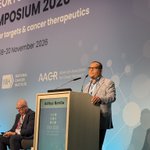
What an excellent line-up of speakers discussing innovative ADCs. It’s so important to have a holistic understanding of the different elements of antibody drug conjugates and their relevance for clinical outcomes. Drug discovery is complex but science is advancing now rapidly.

40 years of ADCs: an extraordinary journey, and we’re only getting started!
A privilege to review the past, present & future of ADCs at the EORTC-AACR-NCI (ENA) ADC Plenary Session alongside @dradityabardia, @raffcolo, Alex Spira & Nicole Biber. #ENASymp26


