

Identity Security Architect @ TrustedSec. Microsoft Certified Master #ActiveDirectory & former Microsoft MVP. Co-Host @ Enterprise Security Weekly. He/Him. #BLM
4°08'15.0N 162°03'42.0E
Joined August 2014
- Tweets23.7K
- Following738
- Followers37.3K
- Likes42.9K




Pinned Tweet
To my black family, friends, and people seeing this:
I love you
You matter
I'm here for you
#BlackLivesMatter


Sean Metcalf retweeted

🚨 Hackers are actively exploiting critical flaws in VMware, Cisco, Apache, and SAP.
CISA confirms 4 vulnerabilities under attack, including 9.8-rated bugs. A suspected China-linked espionage group is using VMware flaws to deploy backdoors and steal data.
Patch deadline: Nov 23.
Details: thehackernews.com/2026/11/ha…

Sean Metcalf retweeted

Microsoft reporting a data breach due to vulnerability on Microsoft Entra Connect Health. Friend sent me this.
FYI.

Sean Metcalf retweeted

New #SecurityNoise drops next week 🐲 On this episode, we sit down with @PyroTek3 to chat about his recent conference talk "Entra the Dragon" where he covers the latest attacks against the Microsoft cloud. Listen and subscribe wherever you get your podcasts!

Sean Metcalf retweeted

The recording of my Ignite Session: Navigating the AI Revolution is available at:
ignite.microsoft.com/en-US/s…

Sean Metcalf retweeted

Awesome post by @HackingLZ on how agents change the economics of attacker attention. I'm preparing another blog post on the topic, focusing on the effects of this fundamental change and how it's going to shape the future.


Some commentary on autonomous offensive frameworks
trustedsec.com/blog/accuracy…

Sean Metcalf retweeted
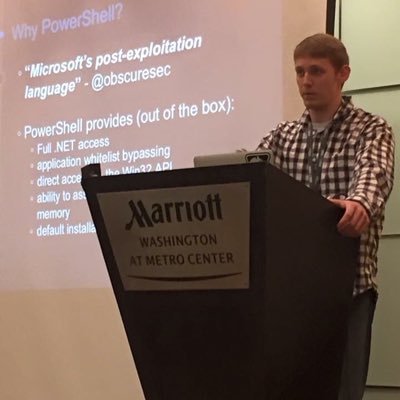
Bypassing App Control for Business's Constrained Language Mode though command injection in the -InstanceIdStr parameter of Test-DesiredProperty function. MSRC (after confirming they didn't want to fix it) marked as non-fix.
gist.github.com/enigma0x3/d4…

Sean Metcalf retweeted
🚨 GitLab has released urgent security updates for the critical #Ruby2Shell flaw (CVE-2026-132825), which could lead to remote code execution.
Self-managed GitLab users should upgrade to 19.6.1, 19.5.8, or 19.4.10.
Read - docs.gitlab.com/releases/pat…

Sean Metcalf retweeted

How to protect your endpoints from SSO session theft.
1, Prevent users from installing browser extensions. Maintain an approved list, review permissions and security history before deployment.
2, Disable developer tools for regular users. Make exceptions for people whose jobs require them. Also disable remote debugging; it has a separate browser policy.
3, Remove local admin rights from regular users. Make software installation and security setting changes go through a managed IT process.
4, Bind sessions to devices where supported. Entra's token protection makes supported stolen sign-in tokens harder to replay from another device. Lots of nuance here so be sure to review this well.
5, Have a session theft response plan. Revoke sessions, isolate and investigate the endpoint, and review what the attacker accessed. Enable risk-based policies in Entra and continuous access evaluation where supported.
There's no 100% secure and there's no panacea, but this is my advice for folks who are worried than an attacker could gain access to their SSO apps by compromising end user devices.
Sean Metcalf retweeted

Not that he needs any third party validation, but I know Dave Kennedy personally and will tell you that if says something, I can guarantee you it’s legit. 100% of the time, all the time.

CNN has now published its second extraordinary NSA story in a single week. This time, a former NSA hacker claims that AI agents bypassed 2FA. Let me explain why this is disinformation put out by the US government, using simple logic.
David Kennedy claims AI agents found a vulnerability that allowed them to bypass 2FA.
App based 2FA can only be bypassed through reverse proxy phishing, which I first wrote about on behalf of the PKI Consortium in 2019. People who believe apps such as Google Authenticator and 1Password protect them from phishing are mistaken. FIDO hardware security keys are phishing-resistant.
But Kennedy isn’t claiming phishing was involved. He’s claiming that AI agents discovered a vulnerability that allowed them to “bypass 2FA”.
Unless Kennedy identifies the specific 2FA service that was breached, or the security company itself publicly discloses the vulnerability, we should assume this story is disinformation.
Even AI with another 20 years of research and quantum capabilities wouldn’t be able to bypass 2FA. That would take a vulnerability in the authentication service. But that’s not what we’re being told.
Here’s how app based 2FA works. When you activate it, the authentication service and your authenticator app share a secret key. The app uses that key and the current time to generate a 6 digit code, usually every 30 seconds.
The server independently calculates the expected code and checks it against the one you enter. There are 1 million possible combinations, but the server limits failed attempts and rejects codes outside the accepted time window. AI can’t calculate the correct code without the secret key. It can’t bypass the server’s verification by guessing faster either.
Even AI with another 10 years of research and quantum computing capabilities couldn’t bypass 2FA. That would take a serious vulnerability in the service’s authentication implementation, not the underlying TOTP algorithm.
What vulnerability is he talking about? Which authentication product did they bypass?
If Kennedy discovered a serious vulnerability, he has a professional responsibility to notify the affected company so it can fix the problem. That company also has a duty to publicly disclose the vulnerability.
Kennedy also claims the AI agents stole company data and encrypted an entire file system in 14 minutes. This is noise. Focus on his claims about bypassing 2FA.
He hasn’t provided the technical evidence for anything.
3 days earlier, CNN reported that 6 sources had disclosed problems with the NSA’s highly classified internal communications network.
I find it astonishing that people believe 6 sources independently disclosed problems with one of the US’s most sensitive intelligence networks to CNN. If classified information about those networks was disclosed as reported, the people responsible would face serious prison sentences. And the NSA doesn’t seem bothered by such a disclosure. Does this mean Snowden can come home?
Now CNN is promoting another extraordinary cybersecurity story through someone who previously worked for the NSA, this time bombastic claims about AI agents that supposedly defeated a security system that’s impossible to bypass.
2 NSA related stories on CNN in one week, both with serious national security implications and neither supported by any public technical evidence for independent verification.
If the claims about AI agents turn out to be false, that makes the timing of CNN’s earlier NSA story even more suspicious.
Who benefits from frightening the public into believing that conventional cybersecurity protections are no longer effective against AI?

Readers added context they thought people might want to know
David Kennedy clarified his CNN comments referred to a specific customer application flaw allowing MFA bypass after valid credentials—not a general 2FA/crypto break. Focus was 14-min AI attack speed; details limited by active IR/NDA.
x.com/HackingDave/st…
ibtimes.co.uk/ai-attack-bypa…
Sean Metcalf retweeted

The first 100,000 CVEs took 18 and a half years to publish (Sep 1999 to Apr 2018). 2026 published 100,000 in 322 days.


Sean Metcalf retweeted
‼️WARNING - A #Linux VM just accessed 127 GB of its host's RAM.
A newly disclosed KVM flaw (CVE-2026-99312) breaks VM isolation on AMD hosts with nested virtualization enabled.
Researchers demonstrated host memory access from inside a guest VM.
Read → thehackernews.com/2026/11/ne…

Sean Metcalf retweeted

🔴 CRITICAL 9.8 · OpenSSL: heap buffer overflow in EVP_EncodeBlock() output sizing (CVE-2026-121481)
An attacker can trigger writes past a caller's output buffer, corrupting memory or crashing the application.
👉 Fix: 4.1.1, 4.0.4
cve.now/CVE-2026-121481?utm_…

Sean Metcalf retweeted
As I said .. lost all trust in human written code


Sean Metcalf retweeted

So excited to see Defender finally tackling ClickFix and similar type attacks
By default, this feature monitors clipboard contents from browsers, but you can extend the processes that are monitored ;)
HKLM:\SOFTWARE\Microsoft\Windows Defender\ClipboardMonitor\Processes

Microsoft Defender gets clipboard protection against ClickFix attacks, aiming to stop malicious commands before users execute them.
techcommunity.microsoft.com/…

Sean Metcalf retweeted
🚨 NO PATCH yet for critical VMware RCE flaw.
Broadcom warns that VMware Aria Operations and HCX are affected by CVE-2026-119618 (CVSS 9.8), which could allow unauthenticated remote code execution.
Apache has fixed the bug, but VMware patches are still pending.
The workaround: Disable HTTP/2.
Read: support.broadcom.com/web/ecx…

Sean Metcalf retweeted

The Christmas Song featuring my all-black female orchestra, The Black Swan Collective, now available on all streaming platforms! youtu.be/-jPgDqQvhuk?is=Dr0F…
Sean Metcalf retweeted

If you are still using #PowerShell 5 exclusively it's time to reconsider and install PowerShell 7.
PowerShell 5 is officially deprecated.
support.microsoft.com/en-us/…
Sean Metcalf retweeted
These comments from @Paul__Walsh are things I have never stated or are conflated. I never stated AI found a vulnerability in MFA thus rendering MFA vulnerable for everyone. This segments theme was based on the time and speed it took. Defenders are not capable today of responding in 14 minutes and it's deeply my largest concern as these attacks move so fast from what we're seeing.
He seems to be highly confused that by me referencing attackers were able to circumvent MFA - that it immediately is a flaw in cryptography. Never stated that, never stated that MFA was insecure - just that this customer had an issue that allowed them to gain access without MFA.
I'm not a regular talking head, I've been in the cybersecurity industry for 25 years - I've written widely popular exploitation frameworks, wrote the book Metasploit: The Penetration Testers Guide, I'm extremely technical and have worked all spectrums of cybersecurity including heavy red teaming and incident response.
I can't provide the evidence (yet) because it is an active investigation. The customer would have to allow me to share this or I breach NDA and my companies reputation. The customer did give me approval to talk about the high level of this when I approached them as long as their names weren't used, as they are concerned also.
This wasn't meant to be a scare tactic on TV, and I probably could have been clearer that the issue was a configuration flaw - but the MFA that your honing in on wasn't even the main point of the discussion.
This segment was 4 minutes, 33 seconds - and we covered three completely different topics in those four minutes. I don't have in-depth time to explain each component and trying to bring an overall theme that people can take with them from listening each time I'm on.
CNN has now published its second extraordinary NSA story in a single week. This time, a former NSA hacker claims that AI agents bypassed 2FA. Let me explain why this is disinformation put out by the US government, using simple logic.
David Kennedy claims AI agents found a vulnerability that allowed them to bypass 2FA.
App based 2FA can only be bypassed through reverse proxy phishing, which I first wrote about on behalf of the PKI Consortium in 2019. People who believe apps such as Google Authenticator and 1Password protect them from phishing are mistaken. FIDO hardware security keys are phishing-resistant.
But Kennedy isn’t claiming phishing was involved. He’s claiming that AI agents discovered a vulnerability that allowed them to “bypass 2FA”.
Unless Kennedy identifies the specific 2FA service that was breached, or the security company itself publicly discloses the vulnerability, we should assume this story is disinformation.
Even AI with another 20 years of research and quantum capabilities wouldn’t be able to bypass 2FA. That would take a vulnerability in the authentication service. But that’s not what we’re being told.
Here’s how app based 2FA works. When you activate it, the authentication service and your authenticator app share a secret key. The app uses that key and the current time to generate a 6 digit code, usually every 30 seconds.
The server independently calculates the expected code and checks it against the one you enter. There are 1 million possible combinations, but the server limits failed attempts and rejects codes outside the accepted time window. AI can’t calculate the correct code without the secret key. It can’t bypass the server’s verification by guessing faster either.
Even AI with another 10 years of research and quantum computing capabilities couldn’t bypass 2FA. That would take a serious vulnerability in the service’s authentication implementation, not the underlying TOTP algorithm.
What vulnerability is he talking about? Which authentication product did they bypass?
If Kennedy discovered a serious vulnerability, he has a professional responsibility to notify the affected company so it can fix the problem. That company also has a duty to publicly disclose the vulnerability.
Kennedy also claims the AI agents stole company data and encrypted an entire file system in 14 minutes. This is noise. Focus on his claims about bypassing 2FA.
He hasn’t provided the technical evidence for anything.
3 days earlier, CNN reported that 6 sources had disclosed problems with the NSA’s highly classified internal communications network.
I find it astonishing that people believe 6 sources independently disclosed problems with one of the US’s most sensitive intelligence networks to CNN. If classified information about those networks was disclosed as reported, the people responsible would face serious prison sentences. And the NSA doesn’t seem bothered by such a disclosure. Does this mean Snowden can come home?
Now CNN is promoting another extraordinary cybersecurity story through someone who previously worked for the NSA, this time bombastic claims about AI agents that supposedly defeated a security system that’s impossible to bypass.
2 NSA related stories on CNN in one week, both with serious national security implications and neither supported by any public technical evidence for independent verification.
If the claims about AI agents turn out to be false, that makes the timing of CNN’s earlier NSA story even more suspicious.
Who benefits from frightening the public into believing that conventional cybersecurity protections are no longer effective against AI?
Readers added context they thought people might want to know
David Kennedy clarified his CNN comments referred to a specific customer application flaw allowing MFA bypass after valid credentials—not a general 2FA/crypto break. Focus was 14-min AI attack speed; details limited by active IR/NDA.
x.com/HackingDave/st…
ibtimes.co.uk/ai-attack-bypa…