

AI Engineer | Software Engineering | Forward Deployed Engineer @ Redis | https://nitter.cf/t.co/6gvuKCLF3N
Utrecht, Nederland
Joined May 2022
- Tweets2.8K
- Following428
- Followers925
- Likes5.2K




Raphael De Lio retweeted

Had @RaphaelDeLio try Jollof rice for the first time ever 😂😂. He loved it!
Shoutout to @flavorsbyoyinda for the phenomenal food! Highly recommend if you’re looking for a Nigerian restaurant in Porto 🙌🏾


Honestly, GPT-6 Astra still sucks. It still cannot read my mind. If I don't share every detail of what I need it just won't get it right.
New forward deployed engineer video: In this one, I explain how Spark prepares Snowflake data in Redis and how Redis Context Retriever exposes it to agents through generated MCP tools with access control.
youtube.com/watch?v=TtIIlri4…
2
167
OpenClaw is defining an enterprise architecture through RFC 27. In this video, I explain the proposed model and where Redis Agent File System fits as persistent workspace storage for disposable Kubernetes compute.
youtu.be/LfdsN1qcekY
1
2
250
OpenClaw Enterprise RFC: github.com/openclaw/rfcs/blo…
Redis Agent File System: github.com/redis/agent-files…
1
70
Raphael De Lio retweeted

🍃 Reduce LLM calls with Vector Search Design Patterns by @RaphaelDeLio @ Spring I/O 2026
▶️ Video: youtu.be/2EPsjM0mrf8 #springio26

For my first engagement as a Forward Deployed Engineer, I built disposable OpenClaw environments on Kubernetes. In this video, I explain how Redis Agent File System separates persistent user workspaces from temporary compute.
youtube.com/watch?v=adolZPF1…
A couple of friends asked me recently why I moved away from Developer Advocacy. I decided to make a video to explain!
Why I Moved from Developer Advocacy to Forward Deployed Engineering: youtu.be/u00VnvQkIWg
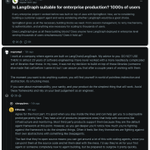
This is the number one discussion in the LangChain subreddit today. And it shows a large gap between personal/small projects and enterprise systems.
LangChain has been around for about four years. LangGraph has been around for about two. That is still early for enterprise software.
I understand why developers want to use them. Early in my career, I wanted to try every new technology too. I cared more about learning the tool than thinking about who would maintain the system years later.
One of my first teams had a lot of freedom to choose technology. We ended up with multiple services solving similar problems because different developers wanted to try different stacks.
That does not work well in enterprise environments.
A CTO, tech lead, senior developer, or business owner has to think about hiring, maintenance, production support, migration costs, and long term risk.
Now, what caught my attention was the response from the LangChain subreddit itself. You would expect the community to defend the technology, but most people did the opposite. They told OP not to use it in production.
The general consensus was that it can be useful for POCs, but painful in production.
That's why battle tested frameworks and stacks keep resurfacing. Enterprise teams tend to choose technology that has already survived years of production use across many companies.
Check the whole thread: reddit.com/r/LangChain/comme…

1
105
Back in March, I needed to move faster on a few implementations. Codex could plan a long running task, but the work still took too long. It also tended to lose track of what it had committed to at the start.
At the time friend introduced me to the idea of atomic tasks. The idea was to split work into tasks that would not clash with each other, so multiple subagents could work on the same feature without needing separate worktrees or resolving merge conflicts.
I ended up building a skill for this back in March. It plans the full implementation, creates md files for each phase, defines which phases can run in parallel, starts the subagents automatically, and tracks implementation status inside the md files.
Before completing an implementation, an extra subagent is dispatched to confirm that the task has been correctly implemented.
At the end of April, I also ran some experiments where an agent worked for around 4 hours triggering subagents and completing all phases of an implementation without losing context.
Today I realized I've been using it practically everyday since March, so I decided to share it in case anyone wants to also give it a try:
github.com/raphaeldelio/agen…
3
69
The live agent activity stream is possible thanks to NDJSON (Newline Delimited JSON), where each event is sent as an individual JSON object separated by a newline. This allows the UI to display agent thoughts, tool calls, and intermediate results as they happen, without waiting for the entire workflow to finish.
127
I was on a call with @DamienCacheux yesterday where we were discussing about our experimentations with Spring AI when the agent I've been building threw this exception out of the sudden.
Damien promptly said it was a good thing to see this error wasn't something only he was facing while using Spring AI. 😅
Turns out my chat endpoint was using Spring MVC async streaming. If the response generation takes longer than the configured MVC async timeout, Spring closes the request before the agent finishes.
With embedded Tomcat, that default is 30 secs. For an agentic application, that's not enough,
The OpenAI call then gets interrupted, which is why the stack trace points at Spring AI and OpenAI even though the root cause is the MVC request timeout.
The fix is to increase the Spring MVC async request timeout:
`spring.mvc.async=request-timeout: 5m`

67
Sempre quis ter um longboard. Comprei um essa semana.
Dia 1: caí igual um saco de batata
Dia 2: andando de boa
Dia 3: aprendendo a surfar nele
Tá me fazendo bem!
1
2
83
AI engineering is a role that emerged in 2023 as teams started building systems around large language models. It combines machine learning engineering and traditional system engineering.
Objectively, AI engineering is the discipline of designing the context, runtime, and harness around AI agents so they can operate as reliable, observable, and scalable systems.
It took us three years to understand what composes this role as we do today.
𝗔𝗴𝗲𝗻𝘁 𝗿𝘂𝗻𝘁𝗶𝗺𝗲 executes the agent loop: model calls, tool calls, control flow, state transitions, and intermediate outputs.
𝗖𝗼𝗻𝘁𝗲𝘅𝘁 𝗲𝗻𝗴𝗶𝗻𝗲𝗲𝗿𝗶𝗻𝗴 selects, structures, and updates the information the model receives, including instructions, memory, retrieved data, and tool results.
𝗛𝗮𝗿𝗻𝗲𝘀𝘀 𝗲𝗻𝗴𝗶𝗻𝗲𝗲𝗿𝗶𝗻𝗴 builds the infrastructure around agent execution: orchestration, isolation, observability, scaling, retries, persistence, and recovery.
Anyone building agentic systems needs to understand all three components.
In my upcoming Redis webinar, we'll dive deeper into 𝗵𝗮𝗿𝗻𝗲𝘀𝘀 𝗲𝗻𝗴𝗶𝗻𝗲𝗲𝗿𝗶𝗻𝗴 and focus on three components that matter for reliable and scalable systems:
- Caching
- Session management
- Rate limiting
As an extra, we will also discuss how context engineering fits into agentic system design.
The session takes place next Thursday, May 28.
Don't forget to RSVP: redis.io/resources/videos/se…

83
Harness engineering is the discipline of designing the infrastructure, rules, and execution environments around AI agents so they can operate as reliable, observable, and scalable work systems.
It covers the runtime pieces that manage sessions, permissions, tool execution, state, caching, rate limits, retries, logging, monitoring, and failure handling.
System engineering by another name.
This is one of the slides from the session where I'll cover three specific components of reliable and scalable systems:
- Caching
- Session Management
- Rate Limiting
Whether you're a machine learning engineer trying to harness your agents or a traditional software engineer trying to scale your systems reliably you will definitely learn something new in this webinar.
And as an extra, we will also talk about context engineering! All of that around @Redisinc
The session will take place next Thursday, the 26th of May. Don't forget to RSVP!
Webinar:
redis.io/resources/videos/se…

69
Harness engineering is the buzzword of 2026. But the ideas behind it are decades old.
It turns out that building scalable agents still requires the same systems engineering skills software engineers have relied on for years to build scalable and sustainable systems.
Whether you are building traditional applications or AI agents, mastering concepts like rate limiting, session management, and caching is essential.
Next week, I’ll be leading a webinar covering these topics and discussing why they matter even more in the age of AI systems.
Looking forward to seeing you all there. Don’t forget to RSVP!
redis.io/resources/videos/se…

44
Agents need low latency access to context. If every request to an agent turns into requests across multiple systems, latency becomes a UX bug. (Tail latency amplification)
This is a problem most agents face because context is usually scattered across the business: CRM data, order systems, support history, docs, user preferences, calendar data, email, tickets, transactions, and product data.
If the agent takes 15 seconds to call different services before responding, the answer might be correct, but the experience already failed.
This is the problem Redis Iris, the newest suite of products released by Redis yesterday, is targeting.
Redis Iris puts Redis in the middle as the fast context layer agents can query while they are reasoning.
As part of Redis Iris, you get:
𝐑𝐞𝐝𝐢𝐬 𝐃𝐚𝐭𝐚 𝐈𝐧𝐭𝐞𝐠𝐫𝐚𝐭𝐢𝐨𝐧: A streaming data integration layer for moving data from source systems into Redis. It can keep Redis updated as the underlying data changes, then reshape that data into structures that are easier for applications and agents to query.
𝐑𝐞𝐝𝐢𝐬 𝐂𝐨𝐧𝐭𝐞𝐱𝐭 𝐑𝐞𝐭𝐫𝐢𝐞𝐯𝐞𝐫: A semantic layer over Redis data. Instead of giving the agent raw keys, hashes, JSON documents, and indexes, you define business entities like `customer`, `order`, or `delivery`. Context Retriever exposes those entities through agent usable interfaces like MCP tools.
𝐑𝐞𝐝𝐢𝐬 𝐀𝐠𝐞𝐧𝐭 𝐌𝐞𝐦𝐨𝐫𝐲: A memory service backed by Redis. It stores short term conversation state and extracts longer term memories from interactions, such as facts, preferences, decisions, or things the agent learned while completing a task.
𝐑𝐞𝐝𝐢𝐬 𝐋𝐚𝐧𝐠𝐂𝐚𝐜𝐡𝐞: A semantic cache for LLM workflows. Instead of matching on exact prompt strings, it caches based on meaning or intent, so similar requests can reuse previous results and reduce latency and cost.
The useful architecture pattern here is that Redis is not the source of truth. Your source systems stay where they are.
Redis becomes the low latency operational layer that agents query while they are reasoning. That matters because agents are not good at dealing with scattered context directly.
If an agent has to inspect raw database structures, infer relationships, call multiple slow APIs, and remember what happened in previous sessions, every request becomes a mini integration project.
If a user asks why an order is late. The agent needs to identify the customer, retrieve the relevant order, inspect delivery state, possibly check policy or restaurant data, pull memory, and generate a response.
The answer is only the visible part. The real work is context retrieval, indexing, memory, and caching underneath.
That is what Redis Iris is trying to package into a more standard agent architecture: model + tools + Redis backed context layer.
Watch the livestream announcement with @rowantrollope and @simba_khadder: youtube.com/watch?v=7JOnwT1v…
Blog post: redis.io/blog/context-is-all…
63