

This is the official Twitter presence for Vito Technology, Inc. that developed the night sky app Star Walk! #GoStargazing with #StarWalk #AstronomyApp
Alexandria, VA
Joined January 2009
- Tweets20.2K
- Following444
- Followers40.9K
- Likes6.1K






🌖 Seven times in 200 years. This Monday makes seven.
On November 30, Jupiter, Mars, and Regulus will crowd in beside the Moon. At their closest, all four will fit in a patch of sky just half a fist wide at arm’s length (a circle just 5.2° across). We searched from 1900 to 2099 for gatherings of the Moon, two planets, and a star this bright and this close. Monday’s is the last one we found.
You can tell them apart with just your eyes. The brightest point beside the Moon is Jupiter. The rusty-orange one is Mars. The faintest of the three is Regulus, the blue-white star at the heart of Leo.
⏰ In North America and Europe, look before dawn on November 30. In East Asia and Australia, your best view comes on the night of November 30 into December 1.
As dawn approaches, turn toward the eastern horizon. Spot brilliant Venus first, then look lower for Mercury in the morning glow. Catch both and that’s four planets before breakfast. ☕
Learn more: starwalk.space/news/moon-jup…
📍Want a carousel showing how the Moon, Jupiter, Mars, and Regulus will look from different cities at the best time to see them? Tell us which city we should include! 👇
🤖 Made with AI


All the premium features. Zero monthly payments. 🪐
From Nov 27 to Dec 4, save big on lifetime access to Star Walk 2 and Sky Tonight in our Black Friday sale. Get one or treat yourself to both! A single payment per app unlocks every premium feature for life. ✨
🔗 Star Walk 2: get.starwalk.space/bf2026
🔗 Sky Tonight: get.skytonight.app/bf2026

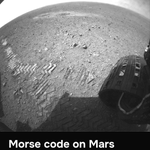
Look just to the left of Curiosity’s wheel. See those three straight rows among the zigzags? There’s a message in them. 👀
Fifteen years ago today, Curiosity launched for Mars with that message cut into all six wheels. As each wheel rolled over soft ground, the holes stamped dots and dashes into the Martian soil. Can you read the three letters on the slide?
They spell JPL, short for Jet Propulsion Laboratory, where Curiosity was built. The engineers had a practical reason for putting their initials there, too. On smooth sand, there might be few rocks for the rover’s cameras to track. The pattern gave Curiosity a landmark of its own, so it could compare photos and tell how far it had actually moved, even if the wheels slipped.

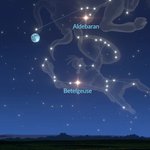
A bull’s eye, a hunter’s shoulder, and the Moon. Can you spot the triangle? 🌖
Before dawn on November 26, start with the nearly full Moon and look for two bright, warm-colored stars. Orange Aldebaran marks the eye of Taurus the Bull. Orange-red Betelgeuse marks the shoulder of Orion the Hunter. Both should be visible to the naked eye, even from a city under clear skies.
✊ Try measuring one side yourself. Hold your fist at arm’s length. About two fist-widths fit between Aldebaran and Betelgeuse — roughly 21°.
From St. John’s, Canada, and Natal, Brazil, the Moon will be about that far from each star, too, making the triangle nearly equilateral. How does it look from where you are?

🌍 Climate Change Is Making Earth's Days Longer
Melting ice is slowing Earth's rotation at a rate unseen in 3.6 million years.
⏳ Earth's days are getting a tiny bit longer — and climate change is part of the reason!
🧊 As glaciers and polar ice sheets melt, water spreads across the oceans, redistributing Earth's mass and slightly slowing its rotation. Think of a figure skater spinning more slowly when they stretch out their arms!
⏱️ The effect? Climate change is currently adding about 1.33 milliseconds to the length of a day per century. That's far too small for us to notice, but it's a remarkable change on a planetary scale.
🌙 The Moon has been slowing Earth's rotation for billions of years. Now, melting ice is adding its own measurable effect.
🌎 Even something as fundamental as Earth's rotation isn't completely untouched by climate change.

Uranus reaches opposition on Nov 25! 🪐✨
At mag 5.6, it'll be at its brightest for the year and visible all night in Taurus. But bright moonlight will make it tricky to spot! 🔭
starwalk.space/news/facts-ab…

The Beaver Supermoon is coming! 🌕✨
On Nov 24, the Full Moon peaks at 14:53 UTC. It’ll look full on Nov 23–25, so watch it rise around sunset for the best view. No telescope needed! 👀
starwalk.space/news/full-moo…
#StarWalk #FullMoon #Supermoon

Watch Jupiter's Moon Disappear 🔭🌑
On November 23, 2026, at approximately 07:24 UTC, Jupiter’s moon Io will disappear from view as it enters the gas giant's shadow.
Unlike an occultation, where a moon passes behind a planet, this is an eclipse. Io will fade from view while still appearing beside Jupiter.
👀 Where and when to watch
The event is best observed from North America with a telescope. It occurs at 2:24 a.m. in New York and 11:24 p.m. on November 22 in Los Angeles. 🇺🇸
💡 A little history: In 1676, astronomer Ole Rømer used observations of Io’s eclipses to demonstrate that light travels at a finite speed. His discovery turns 350 this year! 🎉
💬 Did you know Jupiter can eclipse its own moons?

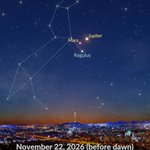
Look for a sky triangle on Nov 22! 🔺✨
Before dawn, Mars, Jupiter, and Regulus form a nearly isosceles triangle in Leo. Find brilliant Jupiter, reddish Mars, and blue-white Regulus — all visible without a telescope. 👀
starwalk.space/news/mars-the…

If your kid sees a dinosaur where the star chart shows a bear, ask them to point out the tail. 🦖✨ Then let them draw it so you can both try to find it again on the next clear night.
November 20 is World Children’s Day, a good excuse to let your child be the sky guide. If the Moon is up, try asking, “See where it is above that roof? Where do you think it’ll be in half an hour?” Take a photo, head inside for a snack, then come back and see whose guess was closer.
Swipe for three things to try without a telescope, including how to spot the International Space Station. That little moving dot has people on board. Give them a wave!
You’ll find all nine activities in our family stargazing guide at starwalk.space/news/stargazi…


Is Mercury a dead planet? 😵
For a long time, Mercury looked geologically quiet. Its surface is covered in ancient impact craters and vast plains left by eruptions billions of years ago. Scientists knew Mercury once had active volcanoes, but its surface today looked almost unchanged. Then, they used AI to take a fresh look at old spacecraft images and found 402 clues that Mercury might still be geologically active.
The team trained an AI model to recognize bright streaks called lineae in photos from NASA’s MESSENGER spacecraft, which ended its mission in 2015. By combing through roughly 100,000 images, the team could map hundreds of them and see a pattern that was hard to trace with the human eye.
🔎 Take a look at the cover of this post. Those thin white lines running down the crater wall are the streaks the researchers were looking for. Near their upper ends are bright, shallow pits called hollows, where the streaks appear to begin.
Most of the streaks turned up on steep, sun-facing slopes of young impact craters. The researchers think impacts may crack the rock, allowing buried materials to escape as gas when heated by the Sun. That process could help explain both the hollows and the streaks.
BepiColombo could photograph the same slopes again. If new streaks have appeared since MESSENGER last looked, that would be a clue that Mercury’s surface is still changing.
What other discoveries might be hiding in images we have for years? 👀
📷 Cover image credit: NASA / JHUAPL / Carnegie Institution of Washington

Happy 28th birthday, ISS! 🛰️🌅
On Nov 20, 1998, Zarya (“Sunrise”) launched as the station’s first module. It orbited Earth alone for 16 days before Unity joined it.
Spot the ISS with Star Walk 2, then test your space station knowledge:
starwalk.space/quiz/iss

Never seen Mercury? Set an early alarm! ⏰
Mercury reaches greatest western elongation (19.6°) on Nov 20. Look low in the east before sunrise. Find bright Venus first, then look below it for Mercury. 🌅
More about Mercury and how to spot it:
starwalk.space/news/facts-ab…

🌔 What are those two dots near the Moon?
Look up after dusk on November 19–22. The brighter, pale golden dot is Saturn. The fainter one is Algenib, a star that marks one corner of the Great Square of Pegasus. If you can only see Saturn at first, try again once the sky is fully dark.
November 20 and 21 are the nights to compare. On the 20th, the Moon forms a wide triangle with Saturn and Algenib. Look again around the same time on the 21st, and you’ll find the Moon roughly between them. That’s how far it travels across our sky in just one day! 🌙
#MoonTonight #Saturn #Algenib #Stargazing #StarWalk

On November 18, 2026, NASA’s Voyager 1 became the first human-made object to reach one light-day from Earth. That’s about 25.9 billion kilometers (16.1 billion miles). 📡
A light-day is how far light travels in 24 hours. Radio signals travel at the same speed, so a command from Earth takes about a day to reach Voyager 1. Even if the spacecraft replies immediately, its answer takes another day to get back.
Voyager 1 took more than 49 years to cover that distance. Since launching in 1977, it has flown past Jupiter and Saturn, entered interstellar space, and kept sending scientific data home.
🗓️ The next milestone will be on September 5, 2037, which will mark 60 years since Voyager 1 lifted off from Cape Canaveral. The spacecraft will still be traveling through interstellar space, carrying its Golden Record with sounds and images from Earth.
If you could add one sound from Earth to the Golden Record today, what would it be? 🌍
PATTERNED ROCKS ARE FALLING FROM THE SKY! ☄️
Some iron meteorites hide something extraordinary inside: stripes, triangles, and intricate geometric patterns.
Gifts from aliens? Fragments of ancient extraterrestrial machinery?
Nope. The explanation is much more boring. (Or fascinating, depending on how you look at it.)
Meet the Widmanstätten pattern (VID-man-shtay-tin), also known as the Thomson structure.
Billions of years ago, deep inside ancient asteroids, hot iron and nickel began to cool. Very, VERY slowly.
As the temperature dropped, the metal's structure changed. Two different iron-nickel phases formed, and one grew into thin crystal plates along specific directions.
Over millions of years, these plates created an intricate geometric pattern.
Eventually, pieces of those asteroids fell to Earth. Humans cut them open and... saw pretty much nothing.
Turns out, the hidden artwork needs a little help. The cut surface has to be polished and etched with acid, which reveals the pattern by reacting differently with the two metallic phases.
We were really hoping for messages from aliens, but apparently not this time.


The Planet Parade isn’t over! 👀🪐
Nov 20–22 is your chance to spot Mercury, Venus, Mars, and Jupiter before sunrise! Mercury reaches its greatest western elongation on Nov 20, making it easier to see.
Learn more:
starwalk.space/news/planetar…


🌍💧 Earth isn't the Solar System's biggest water world!
We may call Earth the Blue Planet, but some icy moons could be hiding far more liquid water beneath their frozen surfaces! 🧊🌊
🪐 Ganymede, Titan, Callisto, and Europa may all contain more liquid water than Earth — even though they're much smaller!
💦 And here's the surprising part: liquid water makes up only about 0.13% of Earth's total volume!
🔭 Scientists are still exploring these mysterious ocean worlds, and estimates of their hidden oceans remain highly uncertain.
✨ Which of these ocean worlds would you most like to explore?
